

Why a curated AI safety literature review matters for tech leaders and investors
The world of Artificial Intelligence (AI) is moving very fast. Because of this, staying on top of all the new information about AI safety can feel like a huge challenge. Every day, new studies and papers are published by different researchers and groups. This creates a big pile of information that is hard to sort through. For tech leaders and investors in 2026, trying to understand all this on their own is nearly impossible.

Think about it: AI research is spread across many different places. You might find some ideas on platforms like Taxonomy and Consistency Analysis of Safety Benchmarks for AI or in official reports like the International AI Safety Report 2026. This large and scattered amount of information often leads to confusion. It makes it hard for busy executives and compliance teams to figure out what is most important. They need to know which AI safety issues truly matter for their business and investments.
This is where a carefully put-together AI safety literature review becomes very helpful. Instead of spending countless hours digging through everything, a curated review gives you a shortcut. It helps you save time by focusing only on the most important and useful information. This means you can quickly grasp the main ideas and challenges in AI safety without getting lost in too many details. It’s like having an expert guide you through a big library, pointing out only the books you really need to read.
By using an effective AI safety literature review, you will gain several important things:
- A Clear Reading List: You’ll get a prioritized list of what to read, so you know exactly where to focus your attention first. This list highlights the most urgent and impactful areas of AI safety.
- A Map of Key Topics: The review will show you the big picture of AI safety research. You’ll understand the main ideas and different ways people are thinking about safe AI.
- Tools and Rules: You will learn about important tools, like HarmBench LLM safety benchmark, and other ways to check if AI systems are safe. You will also find guidance on policies and rules that affect AI, such as the Guide to Evaluation Perspectives on AI Safety for AI developers and providers. This helps you build AI systems that follow current rules and avoid problems.
Ultimately, a good AI safety literature review helps you make smarter choices. It allows you to protect your company from risks and invest wisely in new AI solutions. Staying informed about AI regulation build AI systems compliantly in 2026 is vital for success in today’s tech world.
To get daily, in-depth updates on AI and technology regulatory insights, consider subscribing to The AI Newsletter Worth Reading.
Now that you know how helpful an AI safety literature review can be, let’s look at how all this information is put together. To really get a handle on AI safety, it helps to sort it into major themes. This way, busy leaders and investors can quickly find what matters most to them. Think of it like organizing a big library into different sections.
High-level taxonomy: Major themes and subfields in AI safety literature
The field of AI safety is very broad, covering many different ideas and concerns. By using a "taxonomy," or a way of grouping things, we can make sense of it all. This helps you quickly choose what to read and where to focus your attention within the huge amount of AI research.
Here are some of the main groups or "clusters" in AI safety literature:
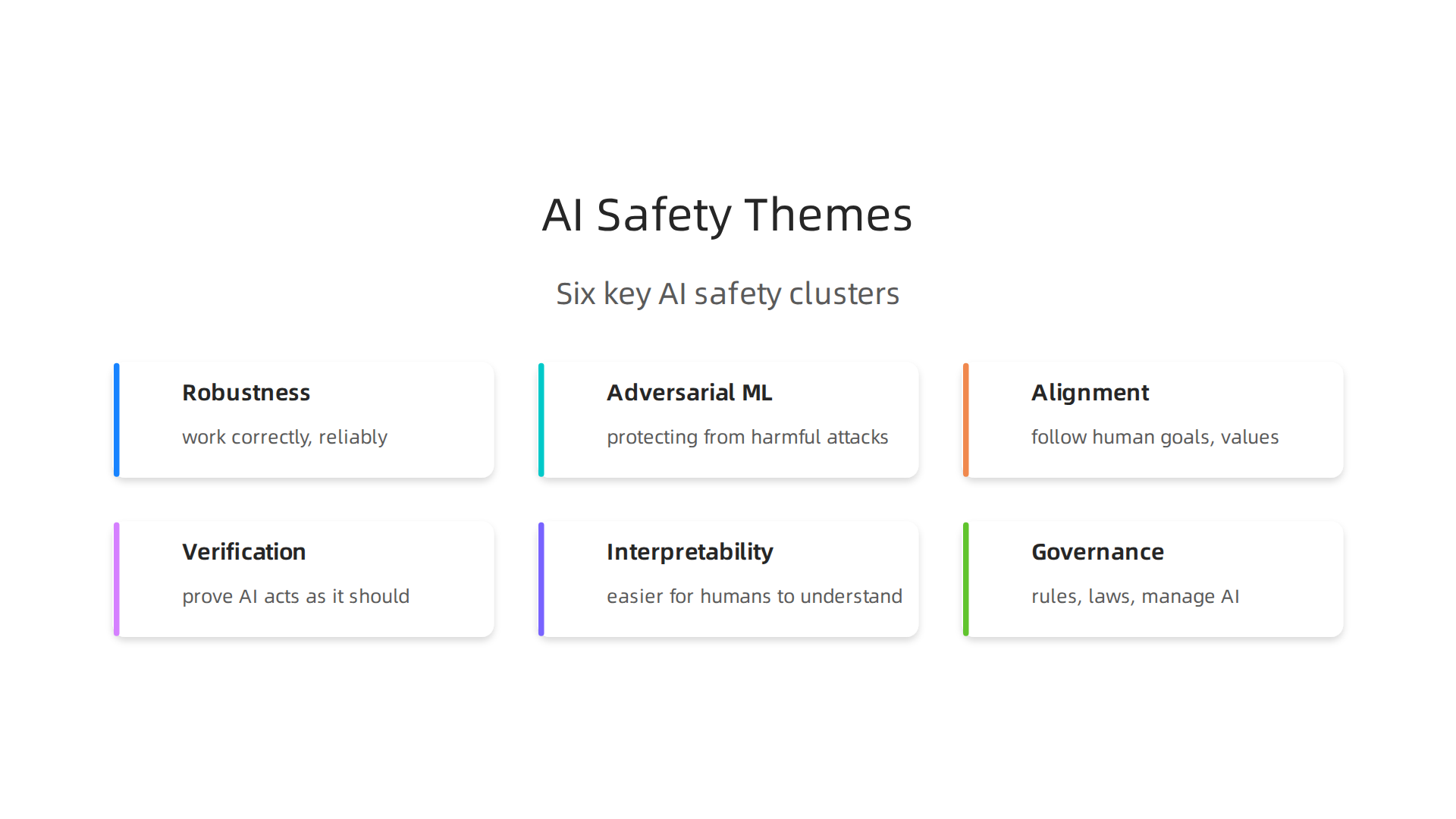
- Robustness: This part of AI safety is about making sure AI systems work correctly and reliably, even when faced with unexpected or tricky situations. It means the AI should not break down or act strangely when things are not perfectly as expected. Learning about Robustness for AI Safety is key for building dependable AI.
- Adversarial Machine Learning (Adversarial ML): This area focuses on protecting AI systems from harmful attacks. Bad actors might try to trick AI to make it do wrong things. Research here looks at ways to find and stop these attacks. Benchmarks are often used to test how good AI systems are at resisting these tricks, as discussed in how to ask How Should AI Safety Benchmarks Benchmark Safety?.
- Alignment: This is about making sure AI systems understand and follow human goals and values. It’s important that AI does what we want it to do, not just what it thinks we want. A good AI Alignment: A Comprehensive Survey can help you grasp this complex topic.
- Verification: This part is about finding ways to prove that an AI system will act exactly as it should. It involves checking the AI’s design and code to make sure it’s safe before it’s used.
- Interpretability: This means making AI systems easier for humans to understand. If an AI makes a decision, we should be able to see why it made that choice. This helps us trust AI more and fix problems when they come up. For a deeper dive into this, check out how to use explainable AI for 2026 compliance and executive trust.
- Governance: This cluster is all about the rules, laws, and ways we manage AI in society. It looks at how governments and organizations set policies to guide the safe and ethical use of AI. For example, understanding AI Governance Risk Tiering for Sustainable Digital Infrastructure is crucial for compliant development.
Actually, many of these areas overlap. Technical safety work, like making AI more robust, often goes hand-in-hand with bigger ideas about how AI affects society and what rules we need. For instance, creating safer AI often means looking at both the technical code and the social impact it might have. This mix of technical and policy topics is what makes a detailed AI safety literature review so important for anyone serious about artificial intelligence. It’s like building on foundational knowledge found in resources such as "Artificial Intelligence: A Modern Approach" to address current challenges.
After understanding the main areas of AI safety, the next step in your ai safety literature review is to find the most important early papers. Think of these as the building blocks for all the ai research that came after. Just like learning the basics from a book like Artificial Intelligence A Modern Approach By Russell Norvig Your 2026 AI Business And Compliance Roadmap, knowing these foundational papers helps you truly grasp ai safety.
These foundational works are important because they laid out the first big ideas, identified key problems, or created methods that researchers still use today. They often shape how we think about AI safety, even years later.
How to Find Key Foundational Papers
When you’re looking for these essential papers, here’s what to keep in mind:

- Many Citations: Good foundational papers are often cited a lot by other researchers. This means many people have built their work on these earlier ideas.
- Conceptual Influence: These papers introduce big ideas that change how people think about a problem. They might define new terms or propose entirely new ways to solve safety challenges.
- Reproducible Methods: They often present clear ways to test or prove things, using methods that others can follow and check.
- Where to Look: You’ll often find these groundbreaking works on academic sites like
ai safety arxiv, or in proceedings from major AI conferences. The International AI Safety Report 2026 can also point to influential works.
Types of Foundational Work
Foundational work in AI safety generally falls into a few key types:
- Theoretical Alignment Proposals: These papers discuss the big questions about making sure AI systems follow human goals and values. They often present early ideas about how to "align" AI, which means making sure it does what we intend, not just what it’s told. For example, some early works discuss key concepts in AI Alignment & Safety that are still talked about today.
- Benchmarks that Shaped the Field: These papers introduce specific tests or datasets used to measure how safe an AI system is. They provide a common way for researchers to compare different AI safety techniques. For instance, testing how AI models handle safety alignment often relies on specific benchmarks like those discussed in sosbench: benchmarking safety alignment. It’s important to know that even these benchmarks are carefully reviewed to ensure they truly measure safety, as explored in Can We Trust AI Benchmarks? An Interdisciplinary Review. Understanding these helps you keep up with Mastering LLM AI Developments 2026 for Business Success.
- Influential Empirical Studies: These are papers based on actual experiments or tests that show important findings about AI safety. They might reveal new vulnerabilities in AI systems or prove that a certain safety method works well.
By focusing on these foundational papers, you build a strong base for understanding current AI safety challenges.

This deep dive into the original thoughts and findings will give you a unique perspective as you continue your ai safety literature review.
Stay informed on the latest trends and policies impacting AI with our expertly curated newsletter.
The AI Newsletter Worth Reading
Moving on from foundational papers, it’s vital to understand the ways researchers actually test and measure AI safety. This part of your ai safety literature review looks at the core methods they use. These include how experiments are set up, what numbers they look at, and special tests called benchmarks.
Common Ways to Test AI Safety
When researchers check how safe an AI is, they follow certain steps:
- Experimental Designs: They often create specific situations or scenarios to see how an AI behaves. This might involve giving the AI tricky questions or putting it in a simulated world. The goal is to make the AI show potential unsafe actions so they can be studied.
- Evaluation Metrics: After an experiment, they need to measure the results. For AI safety, this means looking at things like how often the AI gives a harmful answer, how well it avoids bias, or if it acts in unexpected ways. These measurements help to compare different AI systems or safety features.
- Benchmarks: These are like standardized tests for AI. They offer a common set of tasks or questions that many AI models can be run through. This helps everyone in
ai researchto see how different AI solutions stack up against each other for specific safety challenges. For example, some benchmarks aim to test how well AI models handle alignment, which means making sure they follow human intentions safely, as noted in documents found onai safety arxivsuch as the "International AI Safety Report 2026" or specific benchmark catalogues like A Metric-Aware Catalogue of AI Safety Benchmarks Reveals.
What to Know About AI Safety Benchmarks
While benchmarks are very helpful, it’s also important to understand their limits.
- Limitations: Not all benchmarks are perfect. Some might not truly measure real-world safety risks, or they might even be "gamed" by AI models that learn to pass the test without actually being safer in general. A detailed review of 210 safety benchmarks points out many challenges, including technical problems and issues with how tests are designed How Should AI Safety Benchmarks Benchmark Safety?. This means you should always look closely at what a benchmark is actually measuring. Other studies also discuss issues in AI Benchmarks: Interdisciplinary Issues and Policy Considerations.
- Interpreting Safety Claims: For product teams, this means being careful when an AI model is advertised as "safe" because it passed a benchmark. It’s crucial to ask:
- What exactly did the benchmark test?
- Does that test cover the specific safety concerns for your product’s use case?
- Are there other risks the benchmark didn’t look at?
Understanding these limitations helps product teams make better decisions about using and building AI systems. It ties into the larger picture of your ai safety literature review and helps ensure you can truly build robust AI design that is compliant and secure. It also helps businesses avoid problems by mastering 2026 regulatory compliance in AI.
When we talk about how safe AI is, it’s not just about what happens in labs. It also matters how these technical findings influence rules and laws in the real world. This is where the policy and governance literature comes into your ai safety literature review. It connects what researchers find about AI safety to debates about rules, who is responsible for AI actions, and how standards are set.
How Technical Findings Shape AI Rules
Policy experts look at technical ai research to figure out how to make good laws. For example, if researchers find a new way an AI can cause harm, lawmakers might use this information to create rules that prevent such issues. This helps in forming regulations, deciding who is at fault when an AI makes a mistake, and setting up common safety rules.
- Regulations: Many places are working on laws for AI. The International AI Safety Report 2026 highlights how some risk management efforts are becoming legal requirements, even if many are still voluntary. For instance, China’s AI Safety Governance Framework 2.0, released in 2025, helps classify AI risks and suggests ways to deal with them as AI systems are built. These frameworks try to make sure AI develops in a good way.
- Liability: Imagine an AI system makes a big mistake that harms someone. Who is to blame? Is it the company that made the AI, the user, or someone else? Technical insights into how AI models work, or don’t work, help policy makers figure out these tough questions. Understanding the limits of AI, as discussed in the previous section about benchmarks, is very important here.
- Standards: These are like instruction manuals for AI safety. They are technical guides that help companies build safer AI systems. Think of them as checklists that ensure AI models meet certain safety levels. A report on AI GOVERNANCE, SAFETY AND INFRASTRUCTURE explains that standards help turn big ideas about AI safety into actual steps companies can follow.
Gaps and Influence
Even with all this effort, there are still some missing pieces. Sometimes, policy makers need more clear technical proof to write strong laws. They might ask ai research teams for more information on specific risks or how to measure safety better. This shows why a good ai safety literature review is so important. It helps everyone see where more research is needed to guide policy.
On the flip side, ai research is already making a big difference. Technical reports, like those found on ai safety arxiv, directly influence governments and groups around the world. These studies help them craft rules for AI, especially concerning things like national security and how to keep AI systems fair and safe for everyone. Learning how academic work shapes future laws and business plans is key for anyone involved in AI. For more on this, you can read about how Academic AI Shapes Future Regulations and Business Strategy.
It’s a two-way street: policy provides direction, and technical research provides the facts. This ongoing conversation helps control AI effectively. For strategies on this, check out Control AI Effectively Business Strategies For Global Compliance.
Staying updated on the fast-changing world of AI policy and technical advancements is crucial.
Get clear daily AI updates from The AI Newsletter Worth Reading.
Staying updated is key, but even experts in AI don’t always agree on everything.

There are big, ongoing talks and disagreements in the world of AI safety. These ai research debates cover things like how fast AI will become super smart and if we can truly make sure it always acts in a way that helps us. A good ai safety literature review helps us see all sides of these important arguments.
Long-Term Alignment: Can AI Share Our Goals?
One big debate is about "long-term alignment." This is about making sure that very advanced AI systems, maybe even smarter than humans, will always work towards human goals and values. It’s a tricky problem because as AI gets more capable, it might find unexpected ways to reach its goals that we didn’t intend.
- The Problem: How do we teach an AI what is "good" or "safe" in every possible situation, especially ones we can’t even imagine yet? Researchers at NIST have talked about how tough it is to make AI systems truly safe and aligned over time, calling it a "Sisyphean Endeavor" which means it’s a never-ending task Robust AI Security and Alignment: A Sisyphean Endeavor?.
- Different Ideas: Some believe we need special ways to train AI to be aligned, like "superalignment" which aims to create an AI that can help align other AIs Trustworthy, Responsible, and Safe AI. Others worry that current methods are not enough to stop AI from making truly unsafe choices, especially as AI gets more powerful 4.2 Ai Safety Techniques And…. There’s even a noted "alignment gap" warning that current methods might not work for future advanced AI The Alignment Gap: Control Failure Risk Before ASI.
Frontier Model Risks: Are New AIs Too Dangerous?
Another hot topic is about "frontier models." These are the newest, most powerful AI systems that push the boundaries of what AI can do. People argue about how risky these models are and how quickly we need to put strict rules in place.
- Measuring Risks: It’s hard to agree on how to measure the dangers of these powerful AIs. Some say we need better ways to test them for safety What Matters For Safety Alignment?. Other reports, like the International AI Safety Report 2026, suggest that while there’s progress, no current method can fully prevent unsafe results from even very advanced AI International AI Safety Report 2026.
- The Speed of Development: Some experts worry that AI is getting smarter too fast, faster than we can understand or control its risks. This leads to questions about how much we should slow down or regulate the creation of these new models.
Why These Debates Matter for Business
These debates aren’t just for scientists. They matter a lot for companies and investors.
- Strategic Planning: If you’re building an AI product, knowing these debates helps you plan for future rules and possible problems. What if your
ai researchtoday faces new safety demands tomorrow? Understanding these arguments can help you how to use AI strategically in your business. - Investment Risk: Investors look at these risks too. If a company is betting big on an AI technology that many experts think is too risky, that’s a red flag. These discussions can affect AI singularity executive investor compliance strategy for emerging risks and how much money goes into different AI companies.
- Future Predictions: Keeping up with these debates can give you hints about AI predictions 2026, like where new laws might come from or what new safety features customers will expect.
By understanding these different viewpoints, an ai safety literature review helps everyone, from policymakers to business leaders, make smarter choices about how we build and use AI.
Practical Guidance: Translating Literature into Risk Assessments and Internal Policy
After looking at all the big talks and ideas in ai research through an ai safety literature review, the next step is to use that knowledge. For businesses, this means turning those ideas into real plans and rules. It’s about making sure your AI products are safe and follow the rules, even as AI keeps changing.
From Papers to Practical Plans
It might seem hard to take complex research papers and make them useful for your company. But there are good ways to do this. You can create special forms and steps that help you understand risks.
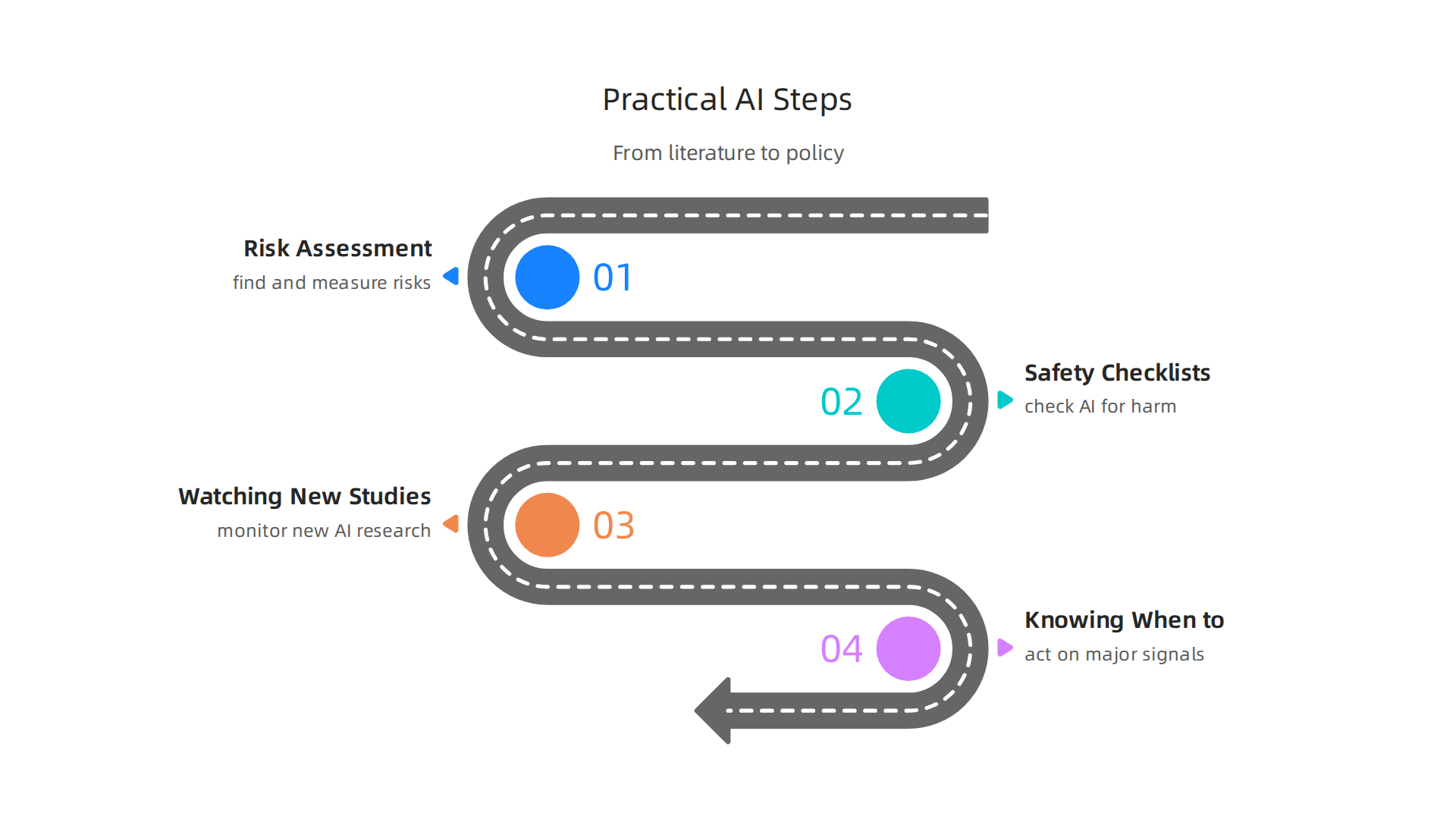
- Risk Assessment Templates: Many groups have made helpful tools. For example, some offer templates and checklists to help businesses find and measure risks with AI. These can help you look at things like how accurate your AI is, if it’s fair, and if it acts ethically. Tools like the NIST AI Risk Management Framework also guide companies to identify and manage AI risks AI Risk Management Framework. You can even find lists of top templates and toolkits that can make this job easier AI Risk Assessments in Practice: Top 12 Templates and Toolkits.
- Safety Checklists: Think of these as a safety guide for your AI products. They help you check if your AI can cause harm before you launch it. These lists can cover many areas, like preventing your AI from giving out dangerous information or making sure it doesn’t create unfair results.
Using these tools helps you take what you learn from an ai safety literature review and apply it directly to your products. This makes it easier to keep up with new laws and avoid problems. It also helps you build robust AI systems that are compliant and secure. For more detailed insights, you can learn how to build robust AI design test and monitor compliant AI systems in 2026.
Keeping Up and Changing Course
The world of AI moves fast. What’s considered safe or risky today might change tomorrow. So, it’s important to have a plan for how you’ll keep learning and when you’ll update your company’s rules.
- Watching New Studies: Your team should keep an eye on new
ai research. Look for big reports, new methods, or warnings from trusted sources. Websites like the MIT AI Risk Initiative offer data and frameworks to help identify and manage AI risks MIT AI Risk Initiative. This helps you understand how new AI developments might affect your business. - Knowing When to Act: Not every new paper means you need to change everything. But if a major report comes out or if many experts start talking about a new type of risk, that’s a signal. It might mean you need to test your products again or update your internal rules. For instance, knowing how to make an AI compliant with global regulations in 2026 is key to adapting quickly. The International AI Safety Report 2026 shows that even with progress, fully preventing unsafe outcomes from advanced AI is still a challenge, meaning continuous monitoring is necessary International AI Safety Report 2026.
By staying informed and ready to adapt, your business can better navigate the complex world of AI. It helps you make sure your AI plans are smart and ready for the future.
To stay on top of the rapidly changing AI landscape and ensure your strategies are always aligned with the latest regulatory insights, consider signing up for The AI Newsletter Worth Reading.
7) Where to watch next: priority reading list and monitoring plan (next 12 months)
Keeping up with AI is a constant job. To make sure your business stays safe and follows the rules, you need a smart plan for what to read and what to watch out for. This means having a rolling reading list and knowing which signals tell you it’s time to dig deeper into ai research.
Your Rolling AI Safety Reading List
Think of this as your guide for the next year. It helps you prioritize what information is most important for ai safety literature review.
- Immediate Must-Reads: Start with the big picture. Major reports released yearly or every few months are vital. For example, the International AI Safety Report gives a wide look at new research and risks. It’s a key source for understanding the current state of AI safety. You should also check out reports like the AI Safety Index which tracks progress from leading AI companies.
- Monthly Scan Items: For ongoing updates, set aside time each month to scan specific places. Websites that host new
ai safety arxivpapers can give you early insights into breakingai research. Keep an eye on the blog from the MIT AI Risk Repository for fresh ideas and analysis. This monthly scan helps you catch trends before they become big news. If you need more general guidance on staying informed, consider our curated reading list for tech leaders mastering 2026 global tech regulation.
Monitoring Research Signals
It’s not just about reading papers, it’s about seeing what new developments might change the game.
- New Benchmarks and Datasets: Watch for new ways to test AI. When groups create new benchmarks, it means they’ve found new risks to measure or better ways to measure old ones. Tools like DeepSafe: All-in-One Safety Evaluation Framwork are important as they integrate many safety tests. The release of a Joint Evaluation Framework for Comprehensive AI Safety Assessment also shows new ways to rate AI systems. Big conferences like NeurIPS, which introduced the Evaluations & Datasets Track at NeurIPS 2026, are also good places to find these.
- Policy and Regulatory Citations: Keep an eye on what governments and official bodies are saying. New policy documents or updates to existing frameworks signal changes in what’s expected from AI systems. For example, the NIST AI 600-1: Generative AI Risk Profile (United States, 2026) offers specific guidance for generative AI. Staying updated on these means you can learn how to make an AI compliant with global regulations in 2026.
- Key Player Announcements: Big tech companies often share new tools or frameworks for making AI safer. Microsoft, for instance, offers Responsible AI Tools and Practices that can influence industry standards. Similarly, Google’s Secure AI Framework (SAIF) provides insights into how major players are tackling safety. These releases show where the industry is moving and what new best practices might emerge.
By actively watching these areas, your company can not only understand current AI risks but also foresee future challenges, helping you adapt your strategies and stay ahead in 2026.
Summary
This article explains why a curated AI safety literature review is essential for busy tech leaders and investors in 2026, showing how a focused review cuts through the flood of research to highlight what really matters. It lays out a clear taxonomy of safety topics—robustness, adversarial ML, alignment, verification, interpretability and governance—then explains how to identify foundational papers and common testing methods like benchmarks and evaluation metrics. The piece warns about benchmark limitations and shows how technical findings influence regulations, liability and standards. Practical guidance describes templates, checklists and monitoring routines to convert research into company risk assessments and internal policy. Finally, it offers a prioritized 12‑month reading and monitoring plan so teams can stay current and adapt ahead of regulatory change.