

In 2026, artificial intelligence (AI) is a big part of how businesses work, helping with everything from making products to talking with customers. But as AI gets more powerful, new problems pop up if these systems are not built and managed carefully. When AI systems fail or act in ways we don’t expect, there are real dangers.

These dangers include new rules from governments that companies must follow, which we call regulatory risks. If an AI system makes bad choices or shows bias, a company can lose trust from its customers and the public. This is a reputational risk. Also, if the AI systems used every day don’t work right, they can cause big problems for how a business operates, leading to operational risks. Because of these challenges, it is very important that AI systems are made to be strong and fair from the start.
Building a robust AI system means it can keep working well and safely, even when things change or unexpected issues happen. It also means the AI should not pose unreasonable dangers. For example, AI needs to function properly in normal situations, or even if someone uses it in a wrong way on purpose, or in other difficult conditions, according to principles set by organizations like the OECD AI principles – OECD. Being ethical means the AI acts in a lawful, fair way that prevents harm and respects people Artificial Intelligence in Classrooms: Ethical Dimensions. This focus on ethical guardrails and strong design is key to building trust in AI.
This article will give you a clear, practical guide for building, testing, and watching over AI systems. We will show you how to design robust AI that includes strong ethical rules and good data governance for AI to keep everything in check. To get a foundational understanding of how AI works, you can read our guide on Artificial Intelligence Basics: A Non-Technical Introduction for Leaders.
Want to stay informed about the rapidly changing world of AI and its rules?
Get clear daily AI updates from The AI Newsletter Worth Reading.
When we talk about robust AI, we are talking about two main things: how well the AI works technically, and how well the company manages it. It is not just about the code itself, but also about the rules and people behind it.
What Robust AI Means Technically
Think of a strong shield. A robust AI system is like that shield for your business. It means the AI can keep doing its job correctly, even when things change or go wrong. For example, if the data it uses changes a bit, or if someone tries to trick it with bad information, the AI should still work well. This is called "adversarial resilience."
According to the Hong Kong government’s Ethical AI Framework, robustness means an AI model can perform well even when its basic rules or assumptions are changed Ethical AI Framework. It must be tested and checked often throughout its entire life to make sure it stays reliable and safe GAO-21-519SP, ARTIFICIAL INTELLIGENCE: An Accountability Framework for Federal Agencies and Other Entities. This includes making sure the AI is secure and does not cause unexpected problems, even if someone uses it incorrectly on purpose. A truly robust AI system performs reliably under normal conditions, during expected or unexpected changes, and can handle tricky situations without failing.
What Robust AI Means for an Organization
Robust AI is also about how a company handles and cares for its AI systems. It means having clear processes, good paperwork, and people who are responsible for the AI’s actions. This is often called AI governance, which is a system of roles, rules, and ways to control how an organization creates, uses, and runs AI systems AI Governance Framework: Build AI Oversight in 2026.
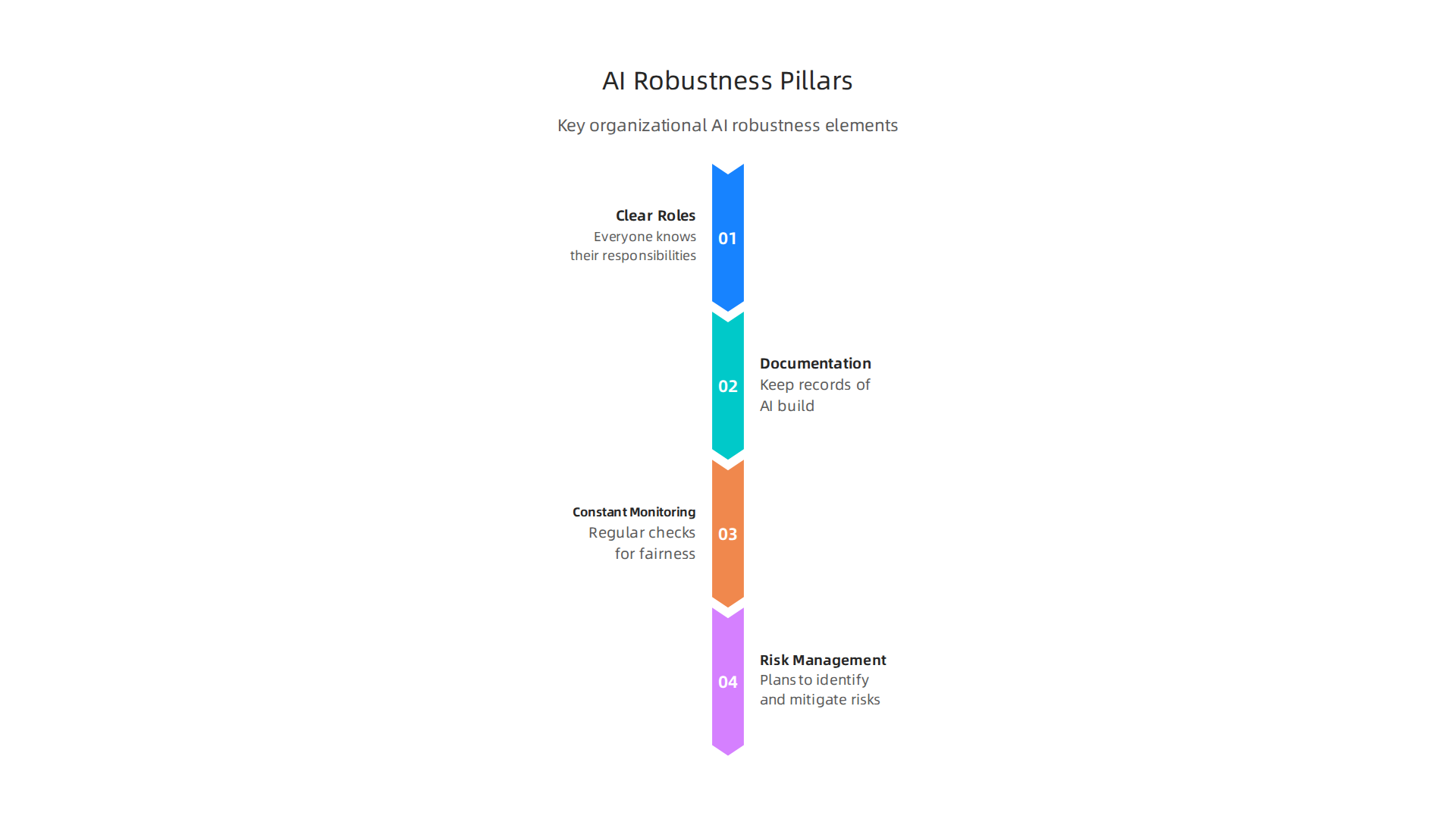
Good organizational robustness means:
- Clear Roles and Responsibilities: Everyone involved with the AI knows what they need to do. Who designs it, who tests it, who watches it, and who is in charge if something goes wrong.
- Documentation: Keeping good records of how the AI was built, what data it uses, and how it makes decisions.
- Constant Monitoring: Checking the AI regularly to make sure it is still fair, accurate, and working as expected. This helps catch problems early.
- Risk Management: Having plans to identify and deal with any risks the AI might create.
Teams and Structures for Robust AI
To make sure an AI system stays robust throughout its life, different teams must work together. It is not just a job for the tech team. You need a mix of experts:
- Top Leadership: People at the very top, like the board of directors and senior managers, set the main goals and decide how much risk the company is willing to take with AI AI Governance Operating Model Guide – VerifyWise. They oversee the big picture.
- Management Committees: These groups make sure the AI plans fit with company rules and ethical standards.
- Technical Teams: The engineers and data scientists who build, test, and improve the AI models. They ensure the AI is technically sound.
- Legal and Compliance Teams: These experts make sure the AI follows all laws and rules, helping to avoid legal trouble.
- Ethics and Risk Teams: These teams look at the fairness and safety of the AI, making sure it does not cause harm or unfair outcomes.
These teams create a three-level approach for AI governance, from setting big-picture goals to handling daily tasks. This kind of setup ensures that all parts of an AI system, from its technical build to how it is used in the real world, are strong and trustworthy. Building such a robust system requires careful thought and teamwork, making sure every angle is covered for compliance and safety. For more insights on integrating these processes, consider how to integrate regulatory compliance into your corporate AI strategy.
To truly make sure an AI system is strong and trustworthy, we need to look at what could go wrong. This means finding out how the AI might fail and any ethical problems it could cause.

It is like looking for weak spots in a shield so you can make it even stronger.
Spotting AI Failure Modes and Ethical Problems
Even the best AI can have problems. Knowing these problems helps us build more robust AI systems. Here are some common ways AI can go wrong:
- Bias: Sometimes, AI learns from data that is not fair. This can happen if the data mostly shows one group of people or one type of situation. When this happens, the AI might make unfair decisions for other groups. For example, a hiring AI could favor certain names or backgrounds, not because of skill, but because of biased training data.
- Drift: An AI system might work great when it is first launched. But over time, the world changes, and the data it sees might change too. If the AI does not keep up, its performance can "drift" or get worse. Imagine an AI that predicts fashion trends; if it does not learn about new styles, its predictions will quickly become outdated. This makes the AI less reliable.
- Adversarial Attacks: These are clever ways people try to trick an AI system on purpose. Small, hidden changes to data can make an AI give the wrong answer without anyone noticing. This is a big concern for the security of AI, especially for things like facial recognition or self-driving cars.
- Explainability Gaps: Sometimes, an AI makes a decision, but it is hard to understand why. This is like a black box. If you cannot explain why an AI decided something important, like whether a loan should be approved, it is hard to trust it. For a truly robust AI, we need to know how it thinks. To learn more about this, check out how Explainable AI for 2026 Compliance and Executive Trust is vital.
- Misuse: Even a well-built AI can be used in ways that cause harm. For example, if an AI designed for helpful purposes is used to spread wrong information or to unfairly monitor people, it becomes a problem. This is why thinking about ethics from the start is so important.
Doing an AI Impact Assessment
To find these problems, companies use something called an AI impact assessment. It is a detailed check-up to understand all the good and bad things an AI system could do. This assessment looks at both the technical risks (like bugs or bad data) and the social harms (like privacy issues or unfair treatment).
An AI impact assessment often involves these steps, as suggested by various templates in 2026:
- Describe the AI System: Clearly explain what the AI does, how it works, and what it is supposed to achieve. This includes defining its purpose and who will use it AI Impact Assessment Template 2026 | Free – Aona AI.
- Identify Potential Risks: Think about all the ways the AI could fail or cause harm. This includes the failure modes we just talked about, along with privacy concerns, security weaknesses, and effects on people. Many templates help list these risks, like the AI Risk Assessment Template available for download.
- Rate Likelihood and Impact: For each risk, figure out how likely it is to happen and how bad it would be if it did. Some tools use scores to help combine these two things, giving a clear picture of the overall risk AI Risk Assessment Template | Free PDF & Word ….
- Plan for Solutions: Once risks are found, you need to make plans to prevent them or lessen their harm. This might mean redesigning part of the AI, changing how it is used, or setting up strict monitoring.
- Review and Update: AI systems and the world around them change. So, these assessments are not a one-time thing. They should be done regularly throughout the AI’s life.
By doing these checks, companies can spot problems early and make sure their AI is not only smart but also safe and fair. This helps build truly robust AI that works well for everyone. If you’re wondering about the larger implications of AI gone wrong, consider reading about Why is AI Bad The Real Risks of Unrestricted Artificial Intelligence in 2026.
After understanding the risks an AI system can have, the next step is to put rules in place to make sure it works fairly and safely. This is where governance, compliance, and the regulatory landscape come into play in 2026. Governments and industry groups are working hard to create guidelines for how AI should be built and used. These rules are key to making sure we have truly robust AI systems.
Governance, compliance, and regulatory landscape (2026 implications)
The world of AI is growing fast, and so are the rules around it. In 2026, we see clear trends in how governments and groups are trying to keep AI safe and fair.
- Big Rules Like the EU AI Act: One of the most important new rules is the EU AI Act. It says that AI systems, especially those that might be risky, must be accurate, robust, and secure. This applies throughout their whole life, from when they are first made to when they are used every day ETSI TR 104 119 V1.1.1 (2025-09). It’s a big deal and affects how companies design and run their AI solutions. To stay on top of these kinds of changes, it’s wise to understand AI regulation 2026: navigate compliance and avoid risks.
- Data Governance for AI: A lot of AI problems come from bad data. That is why rules about how we handle data are so important for AI. These rules, often called data governance for ai, make sure data is collected and used in a way that is fair and keeps people’s privacy safe. Proper data governance helps prevent bias and ensures that the AI systems learn from good, ethical information.
- Standards and Frameworks: Groups like the National Institute of Standards and Technology (NIST) have created helpful guides. For example, the Artificial Intelligence Risk Management Framework gives companies a way to manage AI risks. It tells organizations to have practices for testing AI, finding problems, and sharing what they learn. There are also efforts to standardize how AI incidents are reported, so everyone can learn from mistakes Towards a common reporting framework for AI incidents. These frameworks help make sure AI systems, whether they are personal ai tools or large synthetic ai models, are built with care.
Turning Rules into Action
It is one thing to have rules, and another to actually follow them. Companies need to turn these high-level rules into everyday tasks for their engineers and product teams.
- Engineering Controls: This means building safety features right into the AI. For example, engineers might set up automated checks to look for bias or make sure the AI does not make decisions it cannot explain. They also need ways to test how robust ai is against attacks or changes in data. This can involve continuous testing and validation throughout the AI’s life cycle.
- Product Controls: This focuses on how the AI product is used. It might mean setting limits on what the AI can do, having humans review important decisions, or making sure users know how the AI works. For example, a company might need to keep detailed records of an AI’s performance and any problems it has had. Some regulations, like those for high-risk AI, also demand a "Robustness Report" to show an AI system’s strength ETSI TR 104 119 V1.1.1 (2025-09).
- Incident Reporting: When an AI system fails or causes harm, it is crucial to report it. New laws, like the AI Incident Reporting Act being discussed in the US, aim to make sure developers report issues quickly. This helps everyone learn and improve future AI systems untitled [moran.house.gov]. ISO is also working on a framework for reporting AI incidents, which will help make these reports more consistent ISO/IEC AWI 25870.
By putting these practices in place, companies can make sure their AI not only follows the rules but also works well for people and builds trust. Staying informed about these changes is crucial for anyone working with technology. Get clear daily AI updates from The AI Newsletter Worth Reading.
Design and engineering best practices for robust, ethical models
After learning about how to follow AI rules, the next big step is to make sure we build AI systems in the right way from the start. This means choosing smart ways to design AI models and using good methods when building them. The main goal is to create AI that is truly robust ai, fair, and trustworthy for everyone to use.
Smart Choices in AI Model Design
When we design AI models, like those used for personal ai or even complex synthetic ai, the choices we make are very important:
- Picking and Preparing Data: AI learns from data. If the data is bad or unfair, the AI will also be bad or unfair. So, picking the right data and making sure it’s clean and balanced is super important. We also use ways to make the data bigger or slightly different (called data augmentation) to help the AI learn better and avoid mistakes. This makes the AI more reliable.
- Building for Understanding and Certainty: Sometimes, AI can be like a black box; we do not know how it makes decisions. It is better to design AI in a way that we can understand why it did something. This is called interpretability. We also want the AI to know when it’s not sure about something. This "uncertainty estimation" helps us trust the AI more because it can tell us when it might be wrong. Learning about this helps achieve Explainable AI for 2026 Compliance and Executive Trust.
Good Engineering Practices
Having good rules is one thing, but putting them into practice is another. This is where special ways of working, often called MLOps (Machine Learning Operations), come in handy. These practices help make sure AI systems are built correctly and safely. Many companies are now looking for better ways to make sure their AI products are reliable Integrating Quality Assurance into MLOps for Reliable ML.
- Continuous Building and Testing: Imagine building a car. You would not just build it once and never test it again. AI is similar. Teams use methods like CI/CD (Continuous Integration/Continuous Delivery) for AI models. This means they are always checking the AI as it is being built and making sure new parts work well with old parts. This helps to quickly find and fix problems.
- Automated Testing for Safety: To make AI truly robust ai, we need to test it often. This includes automated tests that look for:
- Bias: Making sure the AI treats everyone fairly.
- Weak spots: Checking if bad actors can trick the AI (called adversarial attacks). Tools exist to help create these attacks to test the AI’s strength Automating Adversarial Robustness Testing of DNN Models.
- Security: Making sure the AI is safe from digital threats. Frameworks like SecMLOps help combine security checks throughout the whole AI building process SecMLOps: A comprehensive framework for integrating security.
- Tracking and Reproducing Work: Just like a good chef writes down every step of a recipe, AI teams need to keep track of every change they make. This includes saving different versions of the AI model and the data it learned from. This "versioning" helps them go back and fix things if something goes wrong, making the whole process clear and repeatable.
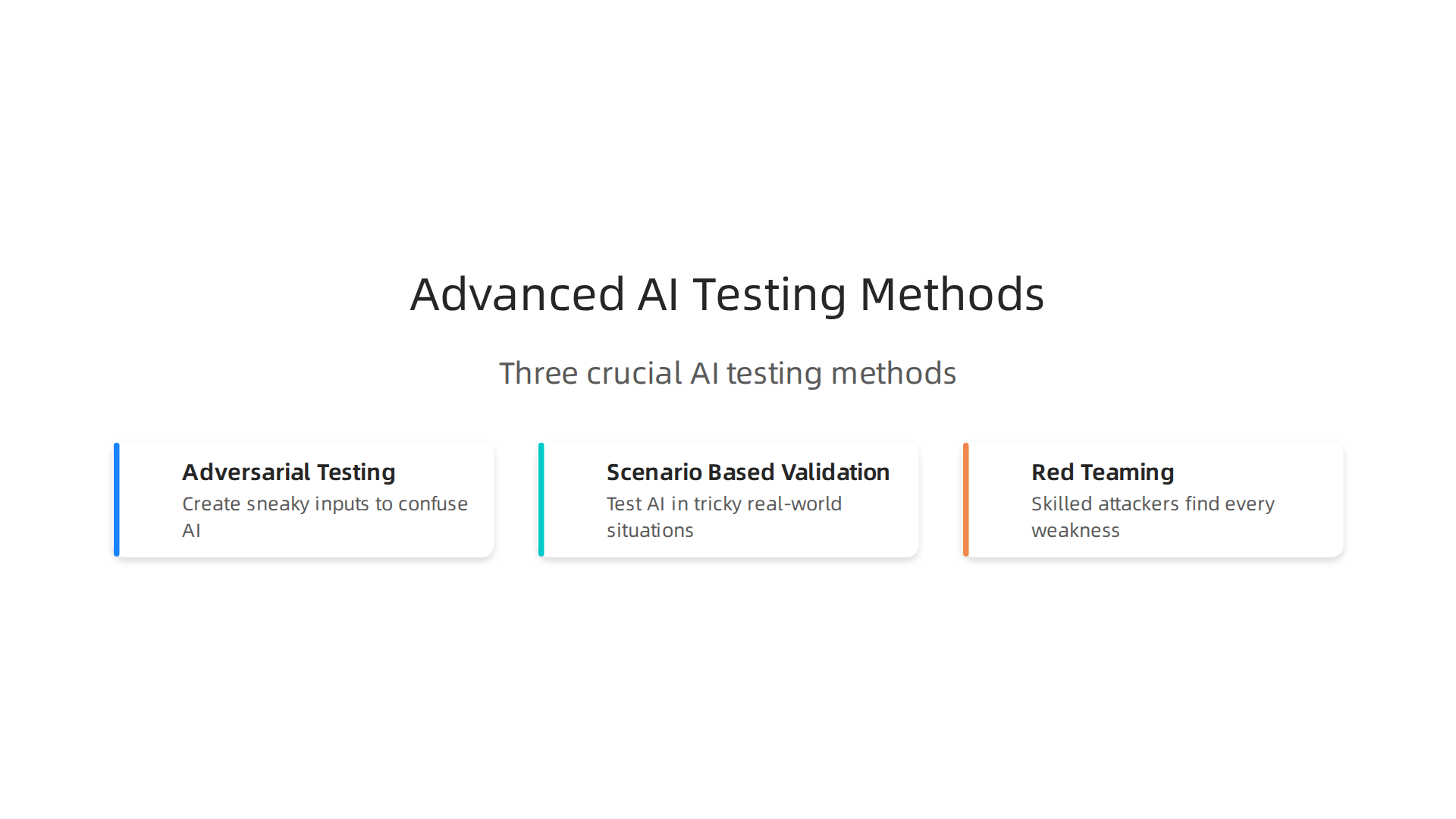
Even with great building practices like MLOps, AI systems need more than just standard checks. To make sure AI is truly robust ai in the real world, we must go further. This means using special ways to test AI, like adversarial testing, scenario-based validation, and red-teaming. These methods find weaknesses that normal tests might miss.
Why Advanced Testing Matters for Robust AI
Think of it like this: you can build a strong castle, but you also need to try to break into it to find hidden weak spots. AI is similar. Standard tests are good for checking if the AI does what it is supposed to do most of the time. But what about when things get tricky? What if someone tries to trick the AI, or if the real world changes in unexpected ways? This is where advanced testing comes in.
- Adversarial Testing: This is like playing offense against your own AI. Experts try to create sneaky inputs or situations that could confuse the AI or make it act wrongly. For example, they might add tiny, almost invisible changes to an image to make an AI think a cat is a dog. Toolkits are available that help automate these kinds of attacks, making it easier to test how strong an AI truly is against such tricks, helping build secure MLOps practices. These attacks help us see if a personal ai might give bad advice or if a synthetic ai might generate harmful content.
- Scenario-Based Validation: This means testing the AI in many different, often tricky, real-world situations. Instead of just using simple data, teams create complex stories or examples that mimic how the AI will really be used. This helps find out if the AI works well when data changes over time (called "drift") or if people try to use it in ways it was not meant for ("misuse"). Continuous validation helps ensure the AI remains reliable, as highlighted in studies on robustness in MLOps.
- Red-Teaming: This is the most thorough kind of testing. A special team, called a "red team," acts like a group of skilled attackers or mischievous users. Their job is to find every possible way to break, trick, or misuse the AI system. They look for problems related to safety, fairness, security, and even how people might try to make the AI say or do bad things. This helps make the AI super strong and ready for anything. Some organizations offer independent testing for things like deepfakes and model drift, which is part of ensuring accountable AI.
Making Testing Continuous and Smart
For AI to stay robust, testing cannot be a one-time thing. It needs to happen all the time. This is called continuous testing.

Just like building the AI, testing should be part of the ongoing MLOps process.
Teams create detailed test plans that think about all the possible ways AI might face challenges in the real world. These plans include:
- Simulating Real-World Drift: The world changes, and so does data. A test plan should include ways to mimic how data will change over time. For example, if an AI helps with shopping, the types of products people like or how they search for them can change. The tests should reflect these shifts.
- Testing for Misuse and Attacks: Because people will try to exploit systems, test plans must include ways to simulate bad uses and cyber attacks. This includes looking for new kinds of weaknesses that could make the AI less robust ai. Special frameworks help integrate security checks throughout the AI building process, forming what is known as SecMLOps, which enhances overall system security. This includes regular checks for potential policy deviations and unusual activity, as discussed in model-driven continuous validation.
- Incident Response Playbooks: Even with the best testing, problems can still happen. So, having a clear plan for what to do when an AI system acts up is key. These plans, called AI incident response playbooks, lay out steps for detecting issues, figuring out what went wrong, and fixing it quickly. This ensures that when an AI system fails, there’s a quick way to handle it, minimizing harm and getting things back to normal. Learning how to build an AI incident response playbook for 2026 is crucial for any business using AI. Such playbooks detail everything from immediate containment to root cause analysis, ensuring quick action when issues arise.
By making these advanced testing methods a regular part of how AI systems are built and managed, companies can create truly trustworthy and robust ai that works well, even when facing unexpected challenges. This continuous effort is part of a strong approach to AI regulation build AI systems compliantly in 2026.
For AI to truly be trustworthy and robust in the real world, we must keep a close eye on it even after it is running. This ongoing watch, called monitoring, is just as important as the testing done before the AI goes live. It is how businesses make sure their AI systems continue to work well and fairly over time.
Monitoring, incident response, and continuous improvement
Think of monitoring as the AI system’s health check. We constantly look at different signals to see how the AI is doing. Key signals include:
- Performance Drift: This is when the AI starts to get worse at its job. Maybe it used to be 90% accurate, but now it is only 70%. Monitoring helps catch this drop quickly.
- Distribution Shifts: The real world changes all the time, and so does the data AI uses. For example, if a personal AI helps people pick clothes, fashion trends change, and the AI needs to keep up. When the data changes in unexpected ways, it is a distribution shift.
- Fairness Metrics: It is very important that AI treats everyone fairly. Monitoring checks if the AI is accidentally being unfair to certain groups of people. For instance, a synthetic AI creating job descriptions should not use biased language.
- User Feedback: What people say about the AI is super important. Their comments and reports can show problems that the technical checks might miss.
When these signals go past a certain point, called an "alerting threshold," it means something might be wrong. Teams get alerts so they can investigate right away. This way, issues with a robust AI system can be fixed before they become big problems. For instance, monitoring tools can spot unusual activity or changes in output quality that signal a problem, helping teams respond quickly to issues, as described in detailed guides for handling AI incidents AI Incident Response Playbook – 14 Production Incident Classes.
Handling AI Incidents with Playbooks
Even with the best monitoring, problems can still pop up. That is where AI incident response playbooks come in. These are like detailed instruction manuals for what to do when an AI system acts wrongly or fails. They make sure everyone knows their role.
These playbooks bring together different teams:
- Engineering Teams figure out what went wrong technically and how to fix it.
- Legal Teams make sure the company follows all rules and laws, especially with how data is handled or if any harm was caused.
- Communications Teams tell the public or affected users what happened and what steps are being taken.
Having a clear plan like this is vital, especially for ethical incidents where the AI might show bias or cause unexpected harm. An effective playbook outlines steps for detection, containment, and recovery to minimize impact and learn from the event AI Incident Response Framework, V1. Many businesses in 2026 are using such tools to manage risks, and resources like an AI Incident Response Playbook (2026) Free Template help them set up their own plans.
This whole process of monitoring and quickly responding helps businesses continuously make their AI systems better. It is all about learning from what happens and improving the AI to be even more reliable and fair in the future. Strong data governance for AI is also a big part of this, as it makes sure the data used by AI is handled correctly and safely.
Want to keep up with the latest in AI regulations and developments? Stay informed with our expert insights.
The AI Newsletter Worth Reading
Summary
This article explains what