

Introduction: The Strategic Imperative of AI Regulation
Think about what your business looks like right now. Maybe you have a small team testing an AI tool for customer service. Or maybe your company already uses machine learning to sort job applications. Either way, something big changed in 2026.
The rules are no longer coming. They are here.
On 2 August 2026, major parts of the EU AI Act became fully enforceable. That means your AI systems must follow strict rules around risk, transparency, and documentation. And if you think this only applies to companies in Europe, think again. Any organization that uses AI in ways that affect EU citizens must comply. The fines can reach up to €35 million or 7% of global annual turnover. That is the kind of number that keeps board members awake at night.
Check the EU AI Act implementation timeline to see exactly which obligations now apply.
Prohibited practices have been banned since February 2025. Rules for general-purpose AI models started in August 2025. And as of August 2026, the remaining high-risk AI obligations kick in for many systems.
Here is the problem most leaders face: the rules are not just one set. They are a patchwork. The EU has one framework. The US has sector-specific rules. China has its own approach. And every country seems to update its laws every few months. Keeping up feels impossible.
That is exactly why you need a technology strategy board.

A technology strategy board is not another committee that meets once a quarter to nod at slides. It is a small, focused group of leaders who own the big decisions about AI, data, and digital risk. They connect the dots between compliance, innovation, and competitive advantage. Without one, your company makes reactive choices and hopes nothing breaks. With one, you stay ahead of the curve.
The future of AI depends on how well organizations govern it today. And the best way to govern AI well is to build the right oversight structure now.
If you want to cut through the noise and get clear daily updates on how these rules evolve, try The AI Newsletter Worth Reading. It helps busy leaders stay informed without drowning in headlines.
The Global AI Regulatory Landscape in 2026
The EU AI Act is the world’s most complete AI rulebook, but it is just one piece of a much bigger puzzle. Since August 2026, most of its rules are fully in force for high-risk systems. And here is the catch that surprises many leaders: the law applies to any organization whose AI affects people in the European Union, no matter where the company is based. That means a startup in Austin or a bank in Singapore must comply if their AI tools process EU citizen data.
The enforcement system itself is complex. Each EU country must designate market surveillance authorities to check compliance, and the European Commission oversees general-purpose AI models. You can dig into the AI Act enforcement and governance system to see how these layers work.

Now look across the Atlantic. The United States still has no single federal AI law. Instead, regulation comes through sector-specific rules. The Federal Trade Commission cracks down on deceptive AI practices. The Equal Employment Opportunity Commission watches AI in hiring. And states are stepping in. Colorado passed its own AI law in 2024, and California is moving forward with similar rules. It is a patchwork that changes every few months.
Then there is China. Beijing has issued new AI regulations focused on content control and algorithmic transparency. Companies must register their algorithms, label AI-generated content, and ensure recommendations do not spread harmful information. The goal is social stability. The result is a completely different compliance playbook.
Three regions. Three different approaches. Already your head might spin from the complexity.

That is exactly why a technology strategy board matters so much. One group inside your company needs to own the full picture of global rules. Without it, you are making blind decisions.
If you want to understand how these overlapping rules affect your specific industry, start by reading about navigating the global privacy and AI regulation landscape. It breaks down what compliance looks like when every country has its own playbook.
EU AI Act: Key Compliance Timelines
The EU AI Act did not arrive all at once. It rolls out in phases, and missing a deadline can cost your company millions.
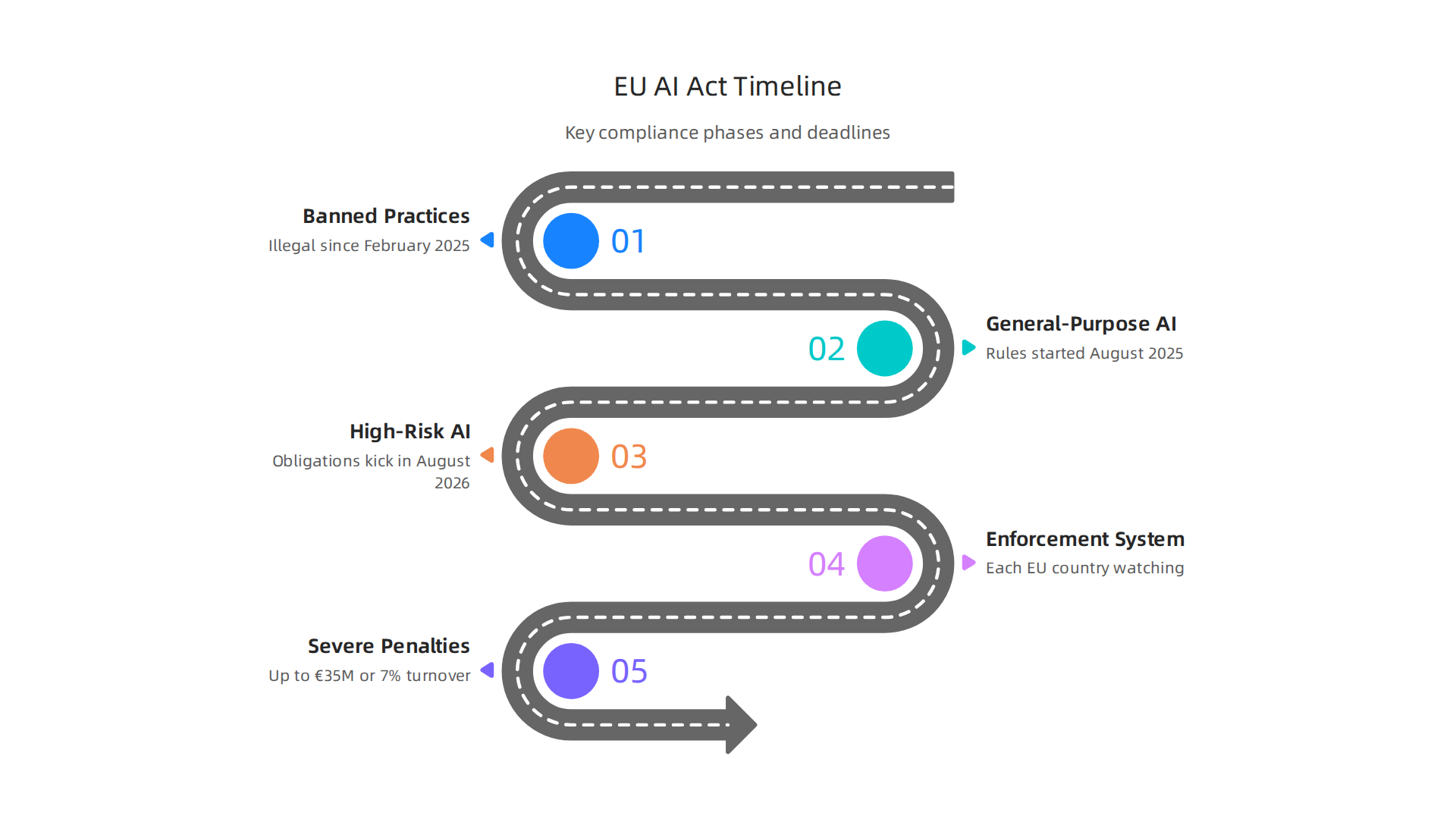
Here is the timeline you need to track.
The risk-based classification system has been in effect since February 2025. That means banned practices, like social scoring or manipulative AI, are already illegal. If your AI tool does something the Act prohibits, you are breaking the law today.
The big deadline you need to know is August 2, 2026. That is when most of the remaining rules start to apply. High-risk AI systems must now meet strict requirements around risk management, documentation, human oversight, and logging. If you are using AI for hiring, credit scoring, or biometric identification, this deadline likely applies to you.
And enforcement is real. Each EU country has its own market surveillance authority watching for violations. The penalties are severe. Companies face fines of up to 35 million euros or 7 percent of global annual turnover, whichever is higher. That is not a theoretical risk.
Want to see every single deadline broken down month by month? Check the EU AI Act implementation timeline for the full schedule through 2028.
You can also explore AI regulations for 2026 compliance strategies to understand how these rules apply to your specific systems.
Here is the thing. Your technology strategy board needs to own this timeline. Without someone tracking these deadlines, you risk waking up to a fine that could wipe out your quarterly profit. Most companies do not fail because the rules are unclear. They fail because no one watches the calendar.
US and China: Contrasting Regulatory Philosophies
Unlike the EU Artificial Intelligence Act, which creates a single rulebook, the United States and China take opposite approaches. Your technology strategy board must understand both to operate globally.
The US follows a sectoral model. Agencies like the FTC, HHS, and DOJ enforce AI rules through existing consumer and civil rights laws. States such as California are passing their own AI bills too. This patchwork means your compliance team must track multiple regulators at once.
China uses centralized control. The government sets strict content review rules, mandatory security assessments, and tight export controls. Companies follow the state’s direction with little room to negotiate.
The future of AI regulation will be shaped by these competing philosophies. For your technology strategy board, this means a system approved in Beijing may fail in California. You need a strategy for navigating global AI regulation across every market you enter.
To stay ahead of shifting global policies, get clear daily AI updates from The Deep View Newsletter.
The Role of a Technology Strategy Board in AI Governance
So what exactly does a technology strategy board do in 2026? Think of it as a dedicated team inside your boardroom that focuses on technology oversight. This group makes sure AI projects align with the company’s goals, follow the rules, and don’t create unexpected risks. Instead of creating a whole new committee, many boards are weaving AI oversight into their existing audit, risk, and strategy committees. According to a 2026 report from Harvard Law School on corporate governance priorities, leading boards are formalizing AI oversight by embedding it into familiar structures rather than building from scratch. The emphasis is on clarity of ownership and regular review.
A technology strategy board has three main jobs.
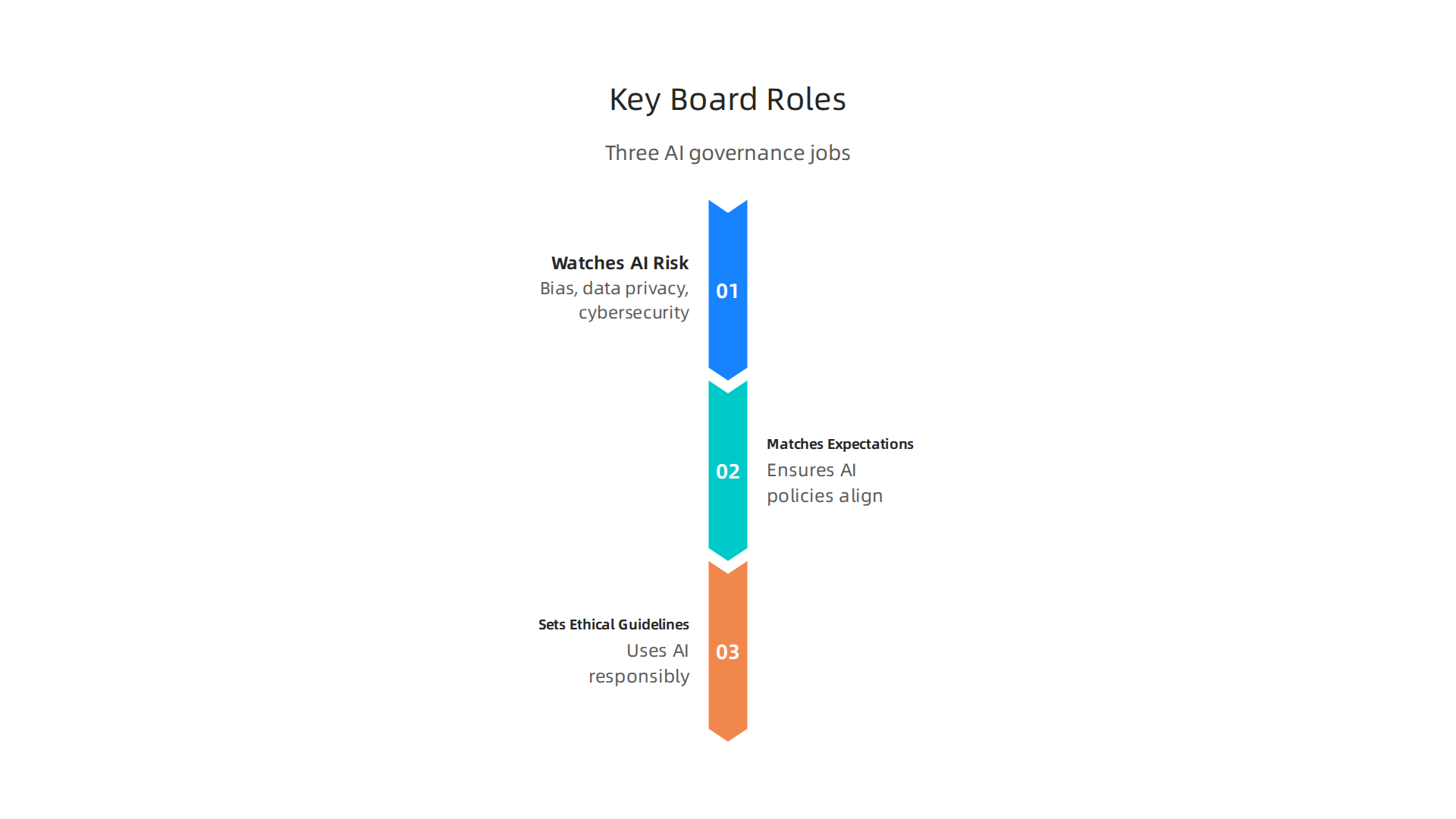
First, it watches over AI risk. This includes bias in algorithms, data privacy problems, and cybersecurity threats. Second, it makes sure AI policies match what regulators expect. Third, it sets ethical guidelines so the company uses AI responsibly. The board also helps close the gap between talking about AI and actually taking action. Many organizations discuss AI but haven’t decided who owns it. A technology strategy board gives that ownership.
If you want a clear example of how compliance teams are structuring oversight, check out our guide on AI regulations and compliance strategies for 2026. It walks through the exact steps your board can take to avoid costly mistakes.
By giving one group clear ownership, your company can move faster and stay safer. That’s the real value of a technology strategy board in today’s regulatory world.
Board Composition: Who Should Sit on the Technology Strategy Board?
Choosing the right members for your technology strategy board is critical. The ideal mix brings together four kinds of expertise: legal, technical, business, and policy.
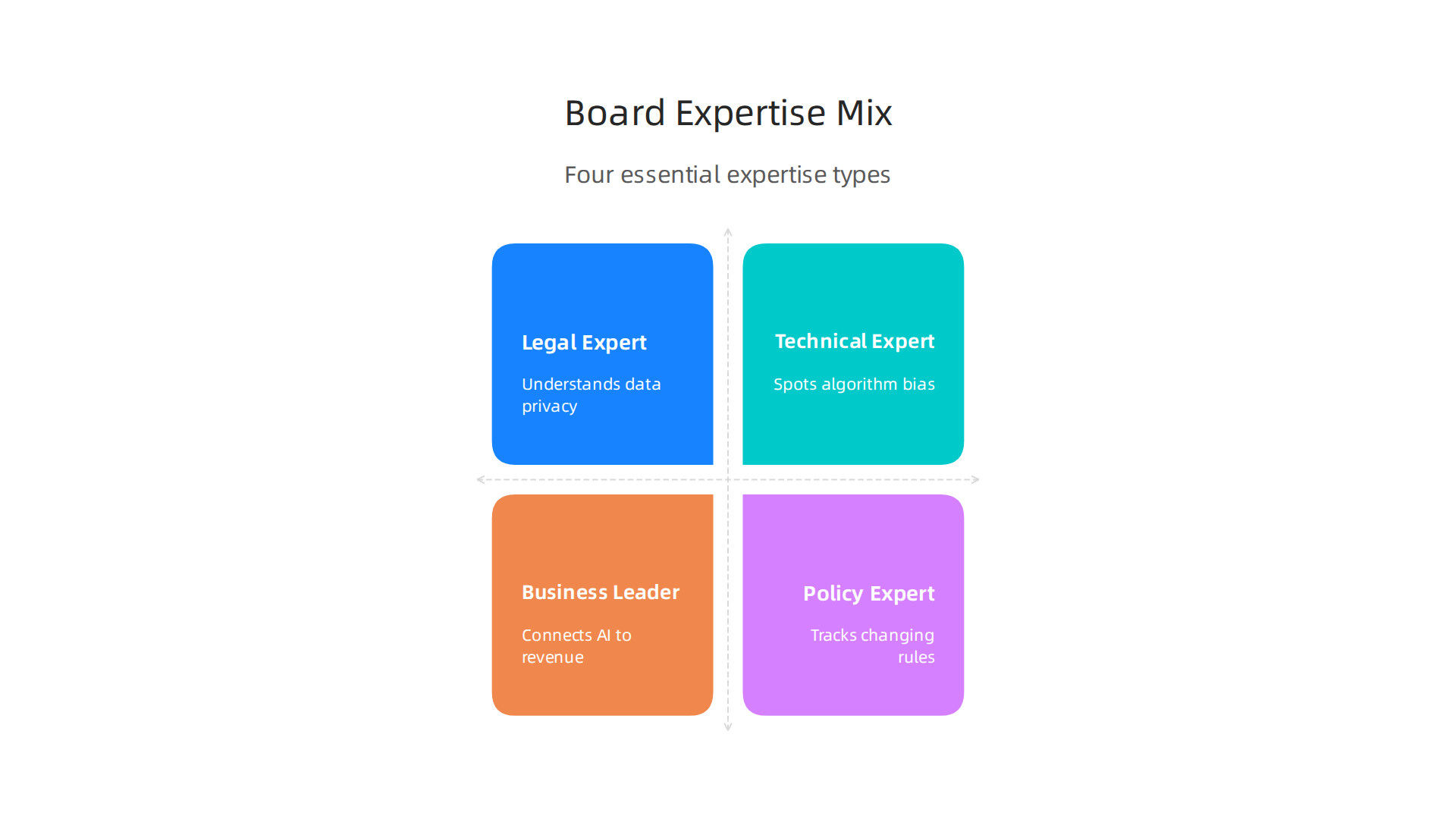
You need a lawyer who understands data privacy, a technologist who spots algorithm bias, a business leader who connects AI to revenue, and a policy expert who tracks changing rules.
Independent directors with strong AI literacy are especially valuable. They challenge assumptions and ask tough questions without being tied to internal politics. According to a 2026 decision intelligence benchmark on data strategy, most enterprise leaders are prioritizing AI skills when evaluating their teams. The same standard should apply in the boardroom.
Aim to meet at least quarterly, with clear reporting lines to the full board. This keeps everyone aligned without slowing things down. If your team needs a quick primer, our guide on artificial intelligence and machine learning explained for 2026 business leaders is a great starting point.
To stay ahead of fast-moving regulations, consider subscribing to The AI Newsletter Worth Reading for daily updates that your whole board can learn from.
Linking the Tech Board to Enterprise Risk Management
Once your technology strategy board is in place, you need to connect its work to your company’s overall risk management. AI risk should not sit in a silo. Instead, integrate it into your existing enterprise risk management (ERM) framework. Leading boards are already embedding AI oversight into their standard risk, audit, and strategy discussions, according to the Top 5 Corporate Governance Priorities for 2026.
This approach lets you use the controls you already have while spotting new risks like bias or automation errors.
Develop key risk indicators (KRIs) specifically for AI compliance. Track metrics like model accuracy, data privacy incidents, and regulatory audit findings. These numbers give your board early warning signs before small issues become big problems.
Finally, set up clear escalation protocols for regulatory breaches. If an AI system violates a rule, who needs to know and how fast? Your technology strategy board should have a direct path to the full board and legal team. For more practical strategies, read our guide on AI regulations 2026 compliance strategies to avoid million-dollar fines. This will help your board stay proactive.
Algorithmic Bias: Regulatory Scrutiny and Mitigation
Have you ever worried that an AI system might make unfair decisions without anyone catching it? In 2026, that fear is driving serious regulatory action. Governments now focus on fairness in hiring, lending, and criminal justice. The EU AI Act requires high-risk systems to undergo bias audits and disparate impact testing. Companies that ignore these rules face fines up to €35 million or 7% of global annual turnover, according to the EU AI Act 2026 Compliance Guide for US Companies.
Beyond fines, the reputational damage can be severe. Non-compliance signals that you do not take fairness seriously. Addressing bias is a key part of using AI for good, especially when AI replacing jobs depends on unbiased decisions. Many leaders now include fairness in their technology strategy board discussions to shape the future of AI responsibly.
To protect your organization, start with regular bias audits and document every test. Need help staying current on these rules? Sign up for The Deep View Newsletter for daily updates on AI regulation and ethics. Also read our guide on AI Regulations 2026 Compliance Strategies for Businesses for practical steps.
Transparency and Explainability: Meeting Regulatory Demands
New laws now demand that AI systems be transparent. Your technology strategy board must ensure every model has clear documentation and impact assessments. Europe’s AI Act requires high-risk systems to provide detailed records of training data, model logic, and risk classifications. California’s frontier AI laws also mandate safety frameworks and incident reports. Understanding these requirements is crucial, so explore our guide on AI regulations 2026 compliance strategies to stay ahead.
Explainability tools like LIME and SHAP help, but they have limits. They can show which features influenced a decision, yet they may miss deeper biases or fail with complex models. A full transparency approach includes full data lineage tracking and human-in-the-loop checkpoints as noted in this AI regulations and governance overview. Consumers now have a legal right to an explanation when automated decisions affect them. Building that capability now builds public trust and supports AI for good goals, especially as AI replacing jobs raises fairness questions. Getting transparency right shapes the future of AI governance and keeps your organization compliant.
Building an AI Governance Framework: A Step-by-Step Approach
So how do you actually build an AI governance framework that works? It sounds like a big task, but you can break it down into clear steps.
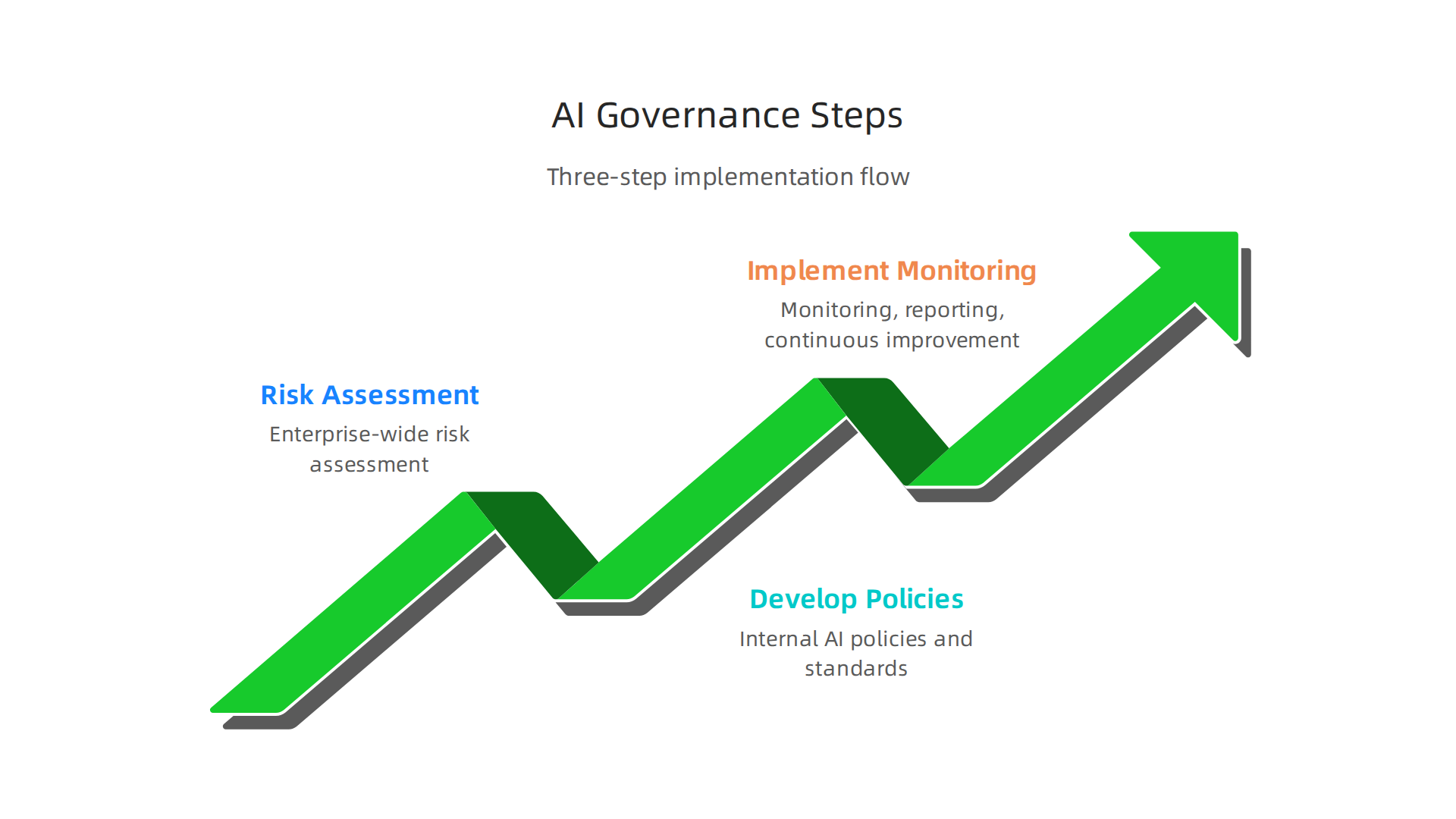
Your technology strategy board should guide this process, making sure every part of the business is on board.
Step 1: Conduct an Enterprise-Wide AI Risk Assessment
First, you need to know what AI you’re already using. Walk through every department and list every AI tool, model, and vendor system. Don’t forget the ones teams may have brought in without IT knowing. For each system, ask: What data does it use? What decisions does it influence? What risks could go wrong? This inventory gives you a clear picture of where the gaps are. As one guide explains, you can’t govern what you can’t see, so start with visibility.
Step 2: Develop Internal AI Policies and Standards
Once you know your risks, write clear policies. These rules should line up with laws like the EU AI Act and standards like ISO 42001. Your policies need to cover acceptable use, data privacy, human oversight, and bias checks. Make them easy for everyone to understand and follow. A solid approach here includes creating standard operating procedures for every phase of the AI lifecycle, from model development to retirement. Check out this Guide for Implementing an AI Governance Framework by IBM for a practical breakdown of the steps.
Step 3: Implement Monitoring, Reporting, and Continuous Improvement
Governance is not a one-time task. You need systems that watch AI performance every day. Set up dashboards that track model drift, bias, and compliance alerts. Build feedback loops where teams can report issues. Review your policies regularly and update them as rules change. This living approach keeps you compliant and builds trust. Understanding the basics of AI models is also helpful for your board. Learn about artificial neural network basics to support smarter governance decisions.
For daily updates on AI regulations that affect your strategy, consider subscribing to The AI Newsletter Worth Reading.
Conducting an AI Risk Assessment: Tools and Methodologies
Once you have your full list of AI systems, it is time to dig deeper. You need to map each tool to a regulatory risk category. For example, a chatbot that answers customer questions might be low risk. A hiring algorithm that screens job applicants could be high risk. Grouping systems this way helps your technology strategy board decide where to focus first. The NIST AI Risk Management Framework gives you a solid starting point. It breaks risk into four functions: govern, map, measure, and manage. You can use it to check if your controls are strong enough. When it comes to audits, you have a choice. Internal teams know your systems well and can run checks often. Third-party auditors bring fresh eyes and deeper expertise for high-risk systems. Many companies mix both approaches. A balanced plan keeps you compliant without slowing down innovation. For a practical breakdown of aligning systems to regulations, see this AI governance framework 10-step guide. And if you want to dig into specific rules that can cost you big, check out these AI regulation compliance strategies for 2026.
Policy Development and Employee Training
After you map your risks, you need to turn those findings into clear rules. Your technology strategy board should approve an AI acceptable use policy that tells every employee what they can and cannot do with AI tools. This policy covers things like using public chatbots for work, sharing data with AI vendors, and where human oversight is required.
Different roles need different training. Developers need to know about model documentation and bias checks. Product managers must understand risk classification and escalation paths. Executives need to grasp compliance obligations and liability. The IBM guide on AI governance implementation includes role-specific training as a key phase of a working framework.
You also need to document every policy decision. This creates a strong audit trail when regulators come knocking. For more on building a complete governance approach, check out this AI business and compliance roadmap.
And to stay on top of daily AI regulation changes, get The AI Newsletter Worth Reading from The Deep View.
From Compliance to Competitive Advantage: Proactive Regulatory Strategy
Once your policies and training are in place, the real question is whether you just check boxes or actually turn compliance into a weapon that helps you win. Many businesses still see regulation as a burden. But the smartest ones treat it as a design constraint that forces better thinking and faster, safer deployment.
Here is the thing. Companies that built their compliance foundations early are now deploying AI faster and winning contracts sooner.

They avoid the roadblocks that slow down competitors. This is exactly the idea behind treating regulation as a competitive advantage — not compliance for its own sake, but compliance as the platform that makes everything else move.
Compliance also becomes a powerful trust signal. Customers and partners want to work with organizations they can rely on. When you can show that your AI systems are governed, audited, and transparent, you build credibility. That reputation matters in 2026, where trust is scarce. Companies that embrace compliance early gain a reputation for trustworthiness and responsibility, as noted in a guide on navigating AI regulation strategically.
Some of the best examples come from companies that turned regulatory challenges into market opportunities. For instance, firms that adopted the EU’s strict “gold-standard” rules as their baseline found it easier to enter other markets. They used that rigor as a seal of quality. Others in healthcare used HIPAA-aligned AI governance to win contracts from hospitals that needed to see proof of data protection and explainability. In each case, the compliance work became the thing that opened doors.
To keep moving from pilot programs to full-scale deployment without running into regulatory surprises, it helps to have a solid scaling plan. That is where you can check out this guide on from pilot to scale with AI for business in 2026. It shows how the same compliance framework that protects you also helps you grow faster.
When your technology strategy board treats regulation as an advantage rather than a chore, the future of AI in your organization looks much brighter. You are not just avoiding fines. You are building something that customers, investors, and regulators all trust. And that trust is the real currency in the age of AI.
Building Trust Through Transparency
Trust does not happen by accident. Your technology strategy board needs to make it a deliberate goal. Start by publishing AI ethics reports and model cards. These documents show how your AI systems work, what data they use, and how you prevent harm. Sharing this openly builds real credibility with customers and regulators.
Another smart move is working with third-party auditors. Independent reviews carry more weight than self-assessments. Adopting standards like ISO 42001 signals serious, verifiable governance. As explained in the report on AI Governance & Global Regulation in 2026, organizations that embrace external validation gain faster approvals and stronger customer trust.
Finally, communicate your compliance efforts proactively. Share progress in stakeholder updates and public reports. For more strategies on building a transparent approach, read up on AI regulations 2026 compliance strategies for businesses. When transparency becomes routine, your board turns compliance into a lasting trust advantage.
Stay informed with The AI Newsletter Worth Reading for clear daily AI updates.
Leveraging Regulation for Market Access
That trust advantage is more than a nice to have. It is your ticket into regulated markets like the European Union, where strict AI rules are now mandatory. Your technology strategy board must see compliance as a gateway, not a barrier. Companies that build compliance foundations early can deploy AI faster and win contracts sooner. According to insights on regulation as competitive advantage, early movers turn compliance into a platform that speeds up everything else.
When new regulations raise the bar, being first to meet them gives you a clear edge over slower competitors. You also become a preferred partner for compliant AI vendors who need trustworthy collaborators. For a deeper look at moving from pilot projects to full-scale deployment after compliance, check out our guide on from pilot to scale with AI. Make regulation your market access strategy.
Future Trends: What Boards Should Prepare for by 2030
Looking ahead, the regulatory landscape will only get more complex. Your technology strategy board must prepare for several key trends shaping the next few years. One major shift is the convergence of global standards through frameworks like the OECD AI Principles. Countries are increasingly aligning their rules, which means compliance in one market often helps you enter another. According to UK government analysis on AI scenarios for 2030, AI capabilities will keep growing, and adoption will speed up unevenly across sectors. Your board needs to track these global standards to stay ahead.
New regulatory areas are emerging fast. AI in warfare, healthcare, and critical infrastructure will face stricter oversight. For example, rules around AI-driven medical devices and autonomous weapons are being drafted now. Boards must also consider societal impacts like ai for good and the future of ai workforce. The conversation around ai replacing jobs is real, and regulators will expect companies to address these concerns. Your strategy should include ethical guidelines and transparency measures.
Enforcement is ramping up too. Regulators are getting more resources and working across borders. Penalties for non-compliance can hit millions of dollars. To avoid these risks, review current compliance strategies to avoid million-dollar fines and ensure your board has a clear action plan.
Staying on top of these rapid changes is tough. That is why we recommend subscribing to The AI Newsletter Worth Reading. It delivers clear daily updates on AI regulation so your board never misses a critical development.
International Regulatory Convergence and Divergence
As your technology strategy board tracks global trends, a key challenge is the mix of harmonization and fragmentation in AI rules. Many countries align on definitions and risk categories, thanks to frameworks like the EU AI Act. This effort to create common ground helps multinational companies plan. An overview of AI regulations around the world shows regions moving toward similar risk-based approaches but still differing on details.
However, enforcement styles and penalties remain very different. The EU can fine up to €35 million or 7% of global turnover, while US states like New York threaten $3 million penalties. These differences create compliance headaches.
For multinational operations, your board needs a strategy that adapts to local rules. Review AI compliance strategies for businesses to build a flexible approach that works across markets.
Preparing for Sector-Specific AI Regulation
For your technology strategy board, the next step is drilling into rules that target specific industries. General AI laws are just the start. The EU AI Act, for example, treats high-risk AI systems differently depending on the sector. According to the official EU regulatory framework, rules for high-risk systems used in critical infrastructure, education, and employment will apply from December 2, 2027. Medical devices and other products have their own extended timeline until August 2, 2028.
In healthcare, expect FDA-like frameworks to govern AI tools used in diagnosis, treatment, and patient monitoring. Your team should review navigating artificial intelligence imaging regulations in 2026 to prepare for stricter conformity assessments.
Financial services face heightened scrutiny too. Regulators like the UK’s FCA and New York’s Department of Financial Services are demanding robust AI governance, especially for algorithms in lending, pricing, and fraud detection. The wave of sector-specific regulation is only accelerating.
To keep your board informed on these fast-changing rules, consider The AI Newsletter Worth Reading for daily updates that cut through the noise.
Conclusion: Turning Regulatory Complexity into Strategic Clarity
The regulatory landscape for AI is shifting fast. In 2025 alone, US states introduced 1,208 AI-related bills and enacted 145 into law. The EU AI Act is rolling out in phases, with high-risk system rules taking full effect by late 2027 and 2028. New York’s RAISE Act, which requires frontier model developers to publish safety protocols and report incidents within 72 hours, kicks off at the start of 2027. You can track this accelerating pace with resources like The AI Regulation Wave: What’s Actually Coming in 2026-2027 to stay ahead of deadlines.
Here is the simple truth: a strong technology strategy board is no longer optional. It is the central team that turns regulatory chaos into a clear, manageable plan. Your board can spot risks early, decide which rules matter most to your business, and guide your compliance investments. Without that group, you are left reacting to fines and enforcement actions instead of preventing them.
Proactive compliance does more than keep you out of trouble. It builds trust with investors, customers, and regulators. When stakeholders see that your company takes AI governance seriously, they feel more confident working with you. That confidence translates into faster deals, smoother audits, and stronger partnerships.
So what is your next step? Start building or improving your board’s AI oversight capabilities today. Even a small, focused team can make a big difference. Assign clear roles, set up regular review cycles, and tie every compliance action back to your business strategy. For a deeper dive into the practical steps, check out this guide on ai regulations 2026 compliance strategies to avoid million-dollar fines.
The rules are only going to get tighter. But with the right technology strategy board in place, your business can navigate the uncertainty with confidence. Turn complexity into clarity, one smart decision at a time.
Summary
In 2026 major AI rules—most notably large parts of the EU AI Act—are now enforceable, creating real legal and financial risk for any company whose systems affect EU citizens. This article explains why organisations need a focused technology strategy board to own AI decisions, track global regulatory timelines, and balance innovation with compliance. It walks through the board’s core responsibilities (risk oversight, policy alignment, ethical guidance), recommended membership (legal, technical, business, policy), and operational steps like enterprise-wide AI inventories, bias audits, and monitoring. The piece also shows how to link AI governance into existing enterprise risk management, build role-specific policies and training, and turn compliance into a market advantage that speeds deployment and builds trust. Finally, it flags future sector-specific rules and enforcement trends so boards can prepare for 2027–2030 changes.