

Why AI content creation matters now — the opportunity and the risk

In 2026, it’s clear that artificial intelligence, or AI, is changing how we do almost everything. One big change is in how we make content. AI content creation means using smart computer programs to help make text, pictures, sounds, and even videos. This is a very important tool for many types of businesses today.
For example, think about how product teams work. They can use AI to quickly create different ideas for new products or how they look. Marketing teams use AI to write ads, social media posts, and descriptions much faster than before. They might even use ai voice dubbing to make videos for different countries, or create realistic artificial intelligence images for their campaigns. Even making full videos on artificial intelligence has become simpler with these new tools. Reports show that content creation is one of the main ways businesses use generative AI, helping with ideas and making things happen faster. In fact, many organizations see "content generation" as a highly impactful area of generative AI right now, according to a 2026 AI report from Deloitte The State of AI in the Enterprise – 2026 AI report.
But with these new powers come new challenges. Many leaders worry about a few key things when they use AI to create content on a large scale.
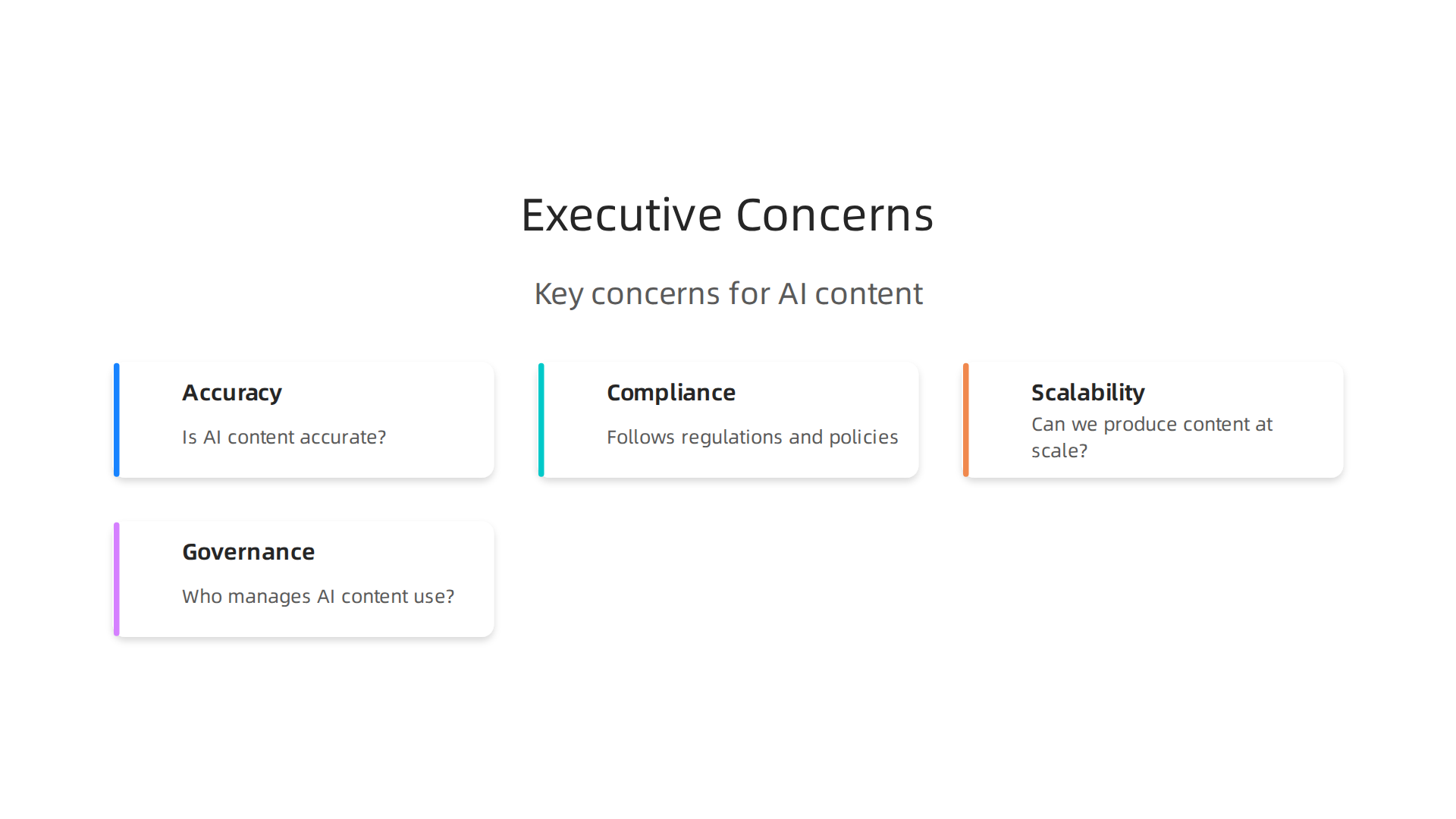
Common Worries for Executives
- Accuracy: Is the content AI creates always true and correct? We need to be sure it does not spread wrong information.
- Compliance: Does the AI-made content follow all the rules and laws? This includes rules about privacy, what you can say in ads, and making sure the content is fair. This is a big area where businesses need to be careful to avoid big fines AI regulations 2026 compliance strategies for businesses.
- Scalability: Can we make a lot more content without problems as our business grows? How do we make sure the AI tools can handle a huge amount of work?
- Governance: Who is in charge of how AI is used to create content? What are the rules inside the company to make sure AI is used safely and ethically?
Many companies are looking for ways to grow with AI while still keeping trust and meaning in their work AI in 2026: The AI-native enterprise. Staying on top of these fast changes and understanding the risks is key for any business in 2026.
To keep up with the quick pace of AI news and regulations, many professionals turn to trusted sources. You can get clear daily AI updates by subscribing to The AI Newsletter Worth Reading.
Using AI to create content for a business is more than just pushing a button. It involves different kinds of smart computer programs, each designed to do specific tasks. Understanding these tools helps companies use them best.
What AI Content Creation Really Means for Enterprises
When businesses talk about AI content creation, they are talking about using many types of AI to help make all sorts of materials. This can range from simple tools to very complex ones.
Let’s look at the different ways AI helps:
- Templates and Guided Tools: These are the simplest. Think of them as smart forms where you fill in a few blanks, and the AI helps create content based on a set pattern. For example, a marketing team might use a template to quickly write many social media posts with slightly different messages. This helps make content fast and keeps it sounding consistent.
- Large Language Models (LLMs): These are like very smart writers. LLMs can read huge amounts of text and learn how to write like humans. Businesses use them to create blog posts, emails, or even summaries of long reports. They are good at understanding a topic and creating new, helpful text from scratch.
- Multimodal Systems: These advanced AI tools can work with more than just text. They can understand and create
artificial intelligence images, generate human-likeai voice dubbing, and even put togethervideos on artificial intelligence. This means a business can use one system to make a full marketing campaign, from words to pictures to voice. Some AI tools, like those usingwhisper ai voice, can make voices sound very natural.
These different tools help businesses meet many needs. For example, many organizations want to increase how much content they make while also making sure it is good quality and consistent. Reports from 2026 show that a top reason for using generative AI is to make things faster and improve quality Content Creation in the Age of Generative AI: Implications ….
How AI Supports Different Workloads
AI content creation helps with a wide range of tasks across a company:
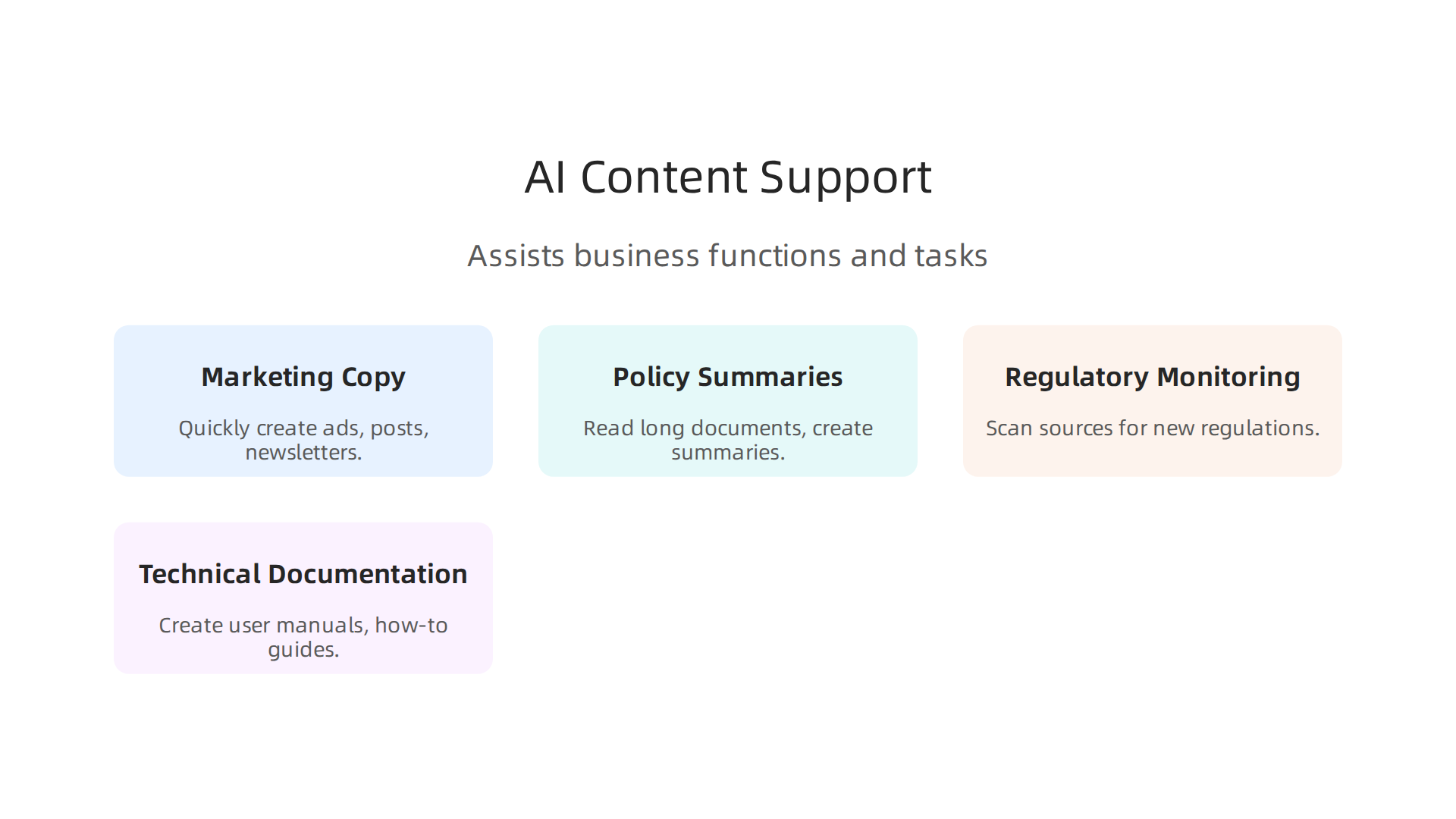
- Marketing Copy: AI can quickly create many versions of ads, social media posts, email newsletters, and website descriptions. This helps marketing teams try out different messages to see what works best.
- Policy Summaries: For legal and compliance teams, AI can read long policy documents and quickly create shorter, easy-to-understand summaries. This saves a lot of time and helps everyone stay informed about important rules.
- Regulatory Monitoring: AI can scan many news sources and official documents to find new regulations or changes that might affect the business. It can then summarize these changes, helping companies stay compliant without missing anything important. To truly grasp these capabilities, it’s helpful to understand the core concepts behind these intelligent systems. You can learn more by checking out artificial intelligence and machine learning explained for 2026 business leaders.
- Technical Documentation: Writing user manuals or how-to guides can be slow. AI can help create these documents by taking raw information and turning it into clear, step-by-step instructions.
Overall, content creation and generating computer code are the most popular ways companies use generative AI today, as noted in a 2026 AI survey The State of AI Adoption 2026. This shows how important AI is for making many different types of content for businesses.
Once companies understand what AI content creation can do, the next step is to make sure it works well on a large scale. This means setting up a clear process, or workflow, for how AI helps make content.

When a business wants to make a lot of content, it can’t just happen by magic. It needs a smart plan. Reports in 2026 show that to truly make AI work for a business, you need good data, clear plans, and ways to manage risks State of Enterprise AI Adoption.
For businesses to get the most out of AI, they need to design workflows that are "scalable." This means the process can easily handle more content as the company grows without breaking down.
Core Workflow Stages for AI Content Creation
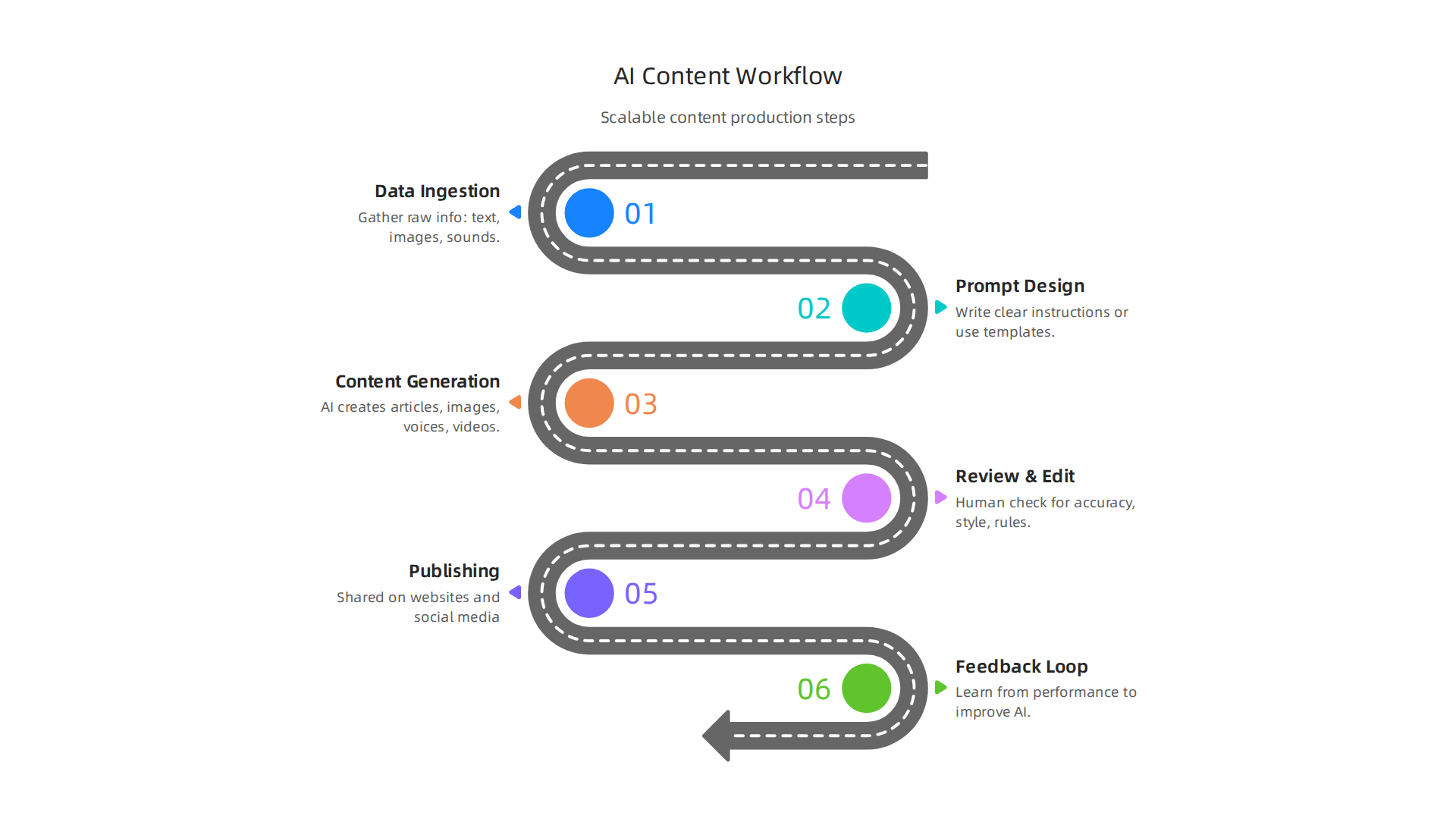
Making content with AI usually follows a few main steps:
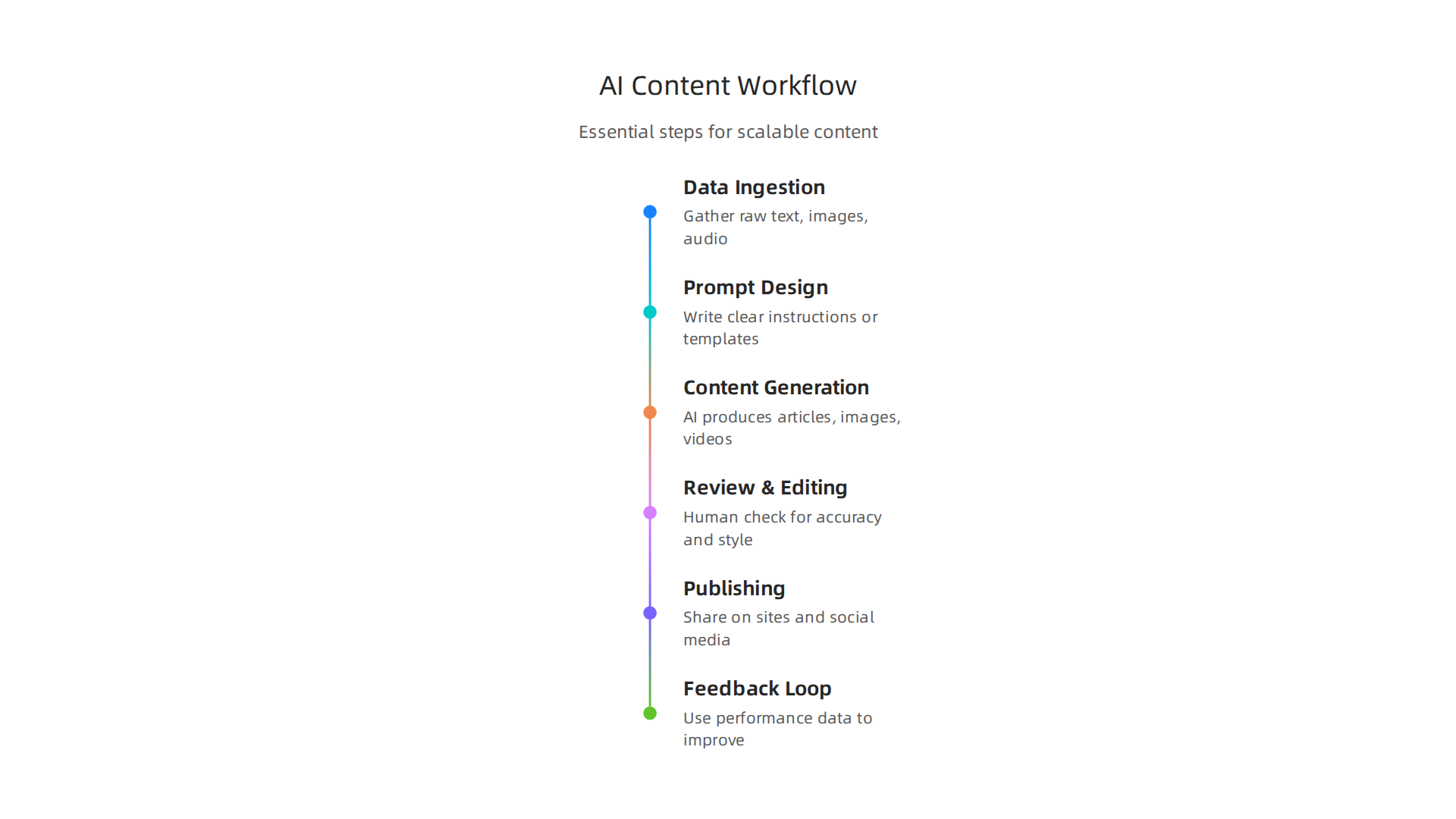
- Data Ingestion: This is like feeding the AI. It means gathering all the raw information needed, such as text, existing images, or sound files. This data helps the AI understand what to create.
- Prompt and Template Design: Next, people tell the AI what to do. They write clear instructions, called "prompts," or use pre-made "templates." These guides help the AI create the right kind of content. For example, a template can help create many social media posts with consistent messaging.
- Content Generation: This is where the AI does its work. It uses large language models (LLMs) to write articles, or multimodal systems to create
artificial intelligence images, performai voice dubbing, or even put togethervideos on artificial intelligence. Some tools even usewhisper ai voicetechnology to make voices sound very real. - Review and Editing: After the AI creates content, people must check it. This is a very important step to make sure the content is correct, matches the brand’s style, and follows all rules. A human eye is still key to making sure the AI’s output is perfect and trustworthy.
- Publishing: Once the content is approved, it’s ready to be shared. This means putting it on websites, social media, or in emails.
- Feedback Loop: This final step is about learning. Businesses watch how the AI-generated content performs. Did it get a lot of views? Did people like it? This feedback helps improve the prompts and templates for future
ai content creation.
Integrating AI with Other Business Tools
To make these workflows truly scalable, AI tools need to work smoothly with other systems a business uses. Think of it like a team where everyone shares information easily.
- Content Management Systems (CMS): AI can send finished articles or blog posts directly into a CMS like WordPress or HubSpot. This saves time and effort.
- Digital Asset Management (DAM): If AI creates new
artificial intelligence imagesorvideos on artificial intelligence, these can be automatically stored and organized in a DAM system, making them easy for other teams to find and use. - Analytics Tools: By connecting AI content output to analytics, companies can track how well their content is doing. This data helps refine future AI tasks and improve overall content strategy.
- Compliance Tools: This is very important. AI-generated content must follow all legal and company rules. Integrating with compliance tools helps check for problems, biases, or wrong information automatically. This helps keep the business safe. Having proper controls and oversight is vital for AI automation governance, as noted in 2026 reports AI Automation Governance: Controls, Oversight & Audit Trails. Establishing good audit trails for AI workflows is a key part of staying compliant Compliance-Ready AI Workflows: Audit Trails & Governance.
Building these kinds of smart workflows helps businesses manage how their AI creates content. It makes sure that as they make more content, the quality stays high and all rules are followed. It’s about organizing AI to get real value at a large scale AI in 2026: The AI-native enterprise. If you’re looking to take your AI strategy from initial tests to full-scale operations, it’s worth learning about from pilot to scale with AI for business in 2026.
Want to stay on top of the latest AI trends and rules? Get clear daily AI updates.
The AI Newsletter Worth Reading
To truly make artificial intelligence content creation work well and safely, businesses also need a strong plan for their data. This means being smart about where the data comes from, how it’s used, and what rules are in place to keep everything fair and legal. It’s not just about making content; it’s about making sure the AI uses good data in a good way.
Managing Data for AI Content Models
When training or fine-tuning AI models for content, the kind of data you use really matters.
- Data Sourcing: This is about where you get the information the AI learns from. Is it from your own company? Is it publicly available? Knowing the source helps you trust the content the AI creates.
- Data Labeling: For AI to understand what it’s seeing or reading, the data often needs "labels." For example, if you feed it
artificial intelligence images, someone might label what’s in each picture so the AI learns to identify things. Accurate labeling helps the AI make better content. - Data Provenance: This means keeping a clear record of where all the data came from, how it was changed, and when. Think of it like a history book for your data. In 2026, knowing the full story of your data is key for being able to trust AI outputs, especially for
ai content creation. It helps you trace back any issues. For instance, any item put into an AI’s memory should link back to its original source and how it was used AI Agent Memory Governance: Access, Audit, and Best …. - Consent: If you use data that belongs to people, like their voices for
ai voice dubbingor images, you need to make sure you have their permission. This is a very important part of using AI ethically.
Smart Risk Controls for Data
Using AI to create content, whether it’s text, artificial intelligence images, or videos on artificial intelligence, comes with risks. Businesses need smart ways to control these risks, especially concerning sensitive information.
- PII Filtering: PII stands for Personally Identifiable Information. This is data that can point to a specific person, like a name, address, or phone number. Businesses must have ways to filter out or remove PII from the data that AI uses. This protects people’s privacy.
- Retention Policies: This means having rules about how long you keep data. You can’t just keep everything forever. Clear policies help keep data storage organized and reduce risks.
- Cross-Jurisdictional Data Handling: Different countries have different rules about data. If your business works in many places, you need to be careful about how you handle data across these different regions. For example, some countries have strict rules about how you use
whisper ai voicetechnology if it’s based on personal recordings. This careful handling is part of good AI governance. Many companies in 2026 need a clear plan for AI governance that covers data rules AI governance checklist (updated 2026).
To make sure your AI content creation efforts stay safe and follow all rules, understanding and planning for these data steps is vital. It’s how businesses build trust and avoid problems in the long run. If you want to learn more about how companies are navigating privacy regulations with AI, you can read about ID Tech Privacy Regulations in 2026.
To truly make artificial intelligence content creation work well and safely, businesses also need a strong plan for their data. This means being smart about where the data comes from, how it’s used, and what rules are in place to keep everything fair and legal. It’s not just about making content; it’s about making sure the AI uses good data in a good way.
Ensuring quality, authenticity, and regulatory safety
Even with great data, AI content creation still needs careful checking to make sure it’s correct and fair.

Sometimes, AI can make mistakes, or even make things up. This is a big challenge for businesses in 2026.
Stopping AI from making things up (Hallucinations)
One big problem with AI is "hallucination." This is when the AI generates information that sounds believable but is actually false or not supported by its training data. Think of it like a confident guess that’s wrong. To fight this, businesses use special methods:
- Fact-Checking Tools: These tools compare the AI’s output to real, trusted sources. This helps confirm if the information is true.
- Consistency Checks: Experts measure how well the AI’s answer lines up with the information it was given. For example, some evaluations measure if an AI’s output is factually wrong or inconsistent with its sources. Metrics like the Hallucination Rate and Factual Consistency Rate are used to measure how often an AI makes things up versus stating facts correctly. In 2026, there are specific methods to evaluate these "AI hallucination evaluations," helping businesses understand how reliable their AI is.
- Multiple Attempts: Some techniques ask the AI the same question several times. If the answers are very different, it’s a sign that the AI might be "hallucinating." You can also check how confident the AI is in each word it uses to see if it’s guessing.
Dealing with Bias and Errors
Just like humans, AI can also have biases. If the data used to train the AI has unfair patterns, the AI might create artificial intelligence images or videos on artificial intelligence that show favoritism or stereotypes. This is why it’s important to:
- Test for Bias: Businesses must regularly check their AI models for unfair outcomes. This involves proactively testing to make sure the AI is fair across different groups of people. Fairness is a key part of AI compliance in 2026, especially for industries with strict rules.
- Correct Factual Errors: Beyond hallucinations, AI can just get facts wrong. This is similar to hallucination, and the same checking tools and consistency methods help catch these errors too.
Following the Rules: What Businesses Need to Know
Using ai content creation also means following important rules about what you create. These rules often differ by country and cover things like:
- Labeling and Disclosure: Many places now require that AI-generated content be clearly marked. This means if you create
ai voice dubbingorvideos on artificial intelligencewith AI, you might need to tell your audience it wasn’t made by a human. Being open about how AI systems work and what data they use is a key part of transparency. - Intellectual Property (IP) and Attribution: Who owns the content an AI creates? Who gets credit when an AI uses existing works to learn? These are big questions in 2026. Businesses need clear ways to track where all content comes from and how it’s used. This is called an "audit trail" and helps ensure transparency and compliance. Having a proper AI audit trail means logging everything the AI does, from the instructions it receives to the content it produces. This helps solve tricky IP questions.
- Different Rules Everywhere: The laws around AI are still new and change a lot. What’s okay for
whisper ai voicein one country might not be in another. Businesses operating globally need to understand how to make an AI compliant with global regulations in 2026. This includes specific rules for AI generated visuals and even AI voice generation.
Keeping track of all these rules and ensuring your AI produces quality, unbiased content is a big job. But it’s essential for building trust and avoiding problems as AI continues to grow. If you’re creating content, especially videos on artificial intelligence regulations, staying informed is a must.
After making sure your ai content creation is truthful and follows the rules, the next big step is choosing the right tools and partners. It’s like picking the best helper for your team. You need to be smart about who you work with to keep your business safe and successful in 2026.
Selecting tools and vendors: checklist for decision-makers
Picking the right AI tools means looking at a few key things. You want partners who are open, give you control, promise good service, keep your information safe, and fit well with what you already use.
- Model Transparency: How clear is the AI company about how their tools work? Do they tell you where the data comes from and how they try to avoid mistakes or unfairness? You want to understand what’s under the hood, not just see the finished
artificial intelligence imagesorvideos on artificial intelligence. - Controls: Good AI tools let you guide them. Can you easily change what the AI creates? Can you set rules for it? The best tools give you power to steer the
ai content creationin the right direction. This includes making sure the content is fair and correct. - Service Level Agreements (SLAs): This is like a promise from the company. It tells you how often their AI tools will be working, how fast they will fix problems, and what kind of help you can expect. You want a vendor who stands by their product.
- Privacy Guarantees: Your information and your customers’ information must be kept private and safe. Ask vendors how they protect data. This is super important with all the new privacy rules in 2026.
- Integrations: Will the new AI tools work smoothly with your existing computer programs and workflows? You don’t want a tool that causes more problems than it solves. It should connect easily, whether you’re using
ai voice dubbingor other AI features.
Testing AI tools for your business
Once you have a few good choices, you need to test them. This helps you see if they really work for your business.
- Pilot Programs: Think of this as a trial run. You take a small part of your work and try out the AI tool. This helps you see how well it works, if it helps your team, and if the quality of the
ai content creationis good enough. You can see how fast it makes content or if awhisper ai voicesounds natural. This is a smart way to learn before going all in. If you want to take your AI from these first tests to bigger uses, you can learn more about how to From pilot to scale with AI for business in 2026. - RFPs (Request for Proposal): For bigger projects, you might send out an RFP. This is a formal document where you ask different AI companies to explain how their tools can meet your exact needs. You’ll ask about how they ensure good output quality, how they help you stay compliant with regulations, and if their tools fit well with your team’s daily tasks. When testing and looking at proposals, it’s also key to think about how you will measure if the AI is truly helping your business. You want to see real value. You can find out more about measuring success in an AI Content ROI Measurement Guide for Marketers 2026.
Choosing the right AI partners is a big decision, but with a clear checklist and careful testing, you can find tools that truly help your business grow and stay safe in the ever-changing world of 2026.
Staying updated on the fast-paced world of AI rules and technology can feel like a full-time job. For daily, clear insights, you might enjoy The AI Newsletter Worth Reading.
After choosing the best AI tools and making sure they work for your business, the next big step is to understand how people will work with these tools every day. It’s really important to have humans check the AI’s work and to have clear jobs for everyone on the team. This helps your business use AI safely and smartly in 2026.
Human review, roles, and organizational change
Even the smartest AI tools, like those used for ai content creation, still need human eyes on their work. This is called "human-in-the-loop" processes. It means people are involved at key steps to make sure everything is right. This helps keep things fair, correct, and in line with rules.
Here’s how human review works:
- Editorial Review: After an AI creates content, like text for a website or a social media post, a human editor checks it. They make sure the words sound like your brand, are easy to read, and share correct information. This is especially true for
artificial intelligence imagesandvideos on artificial intelligence, where humans check for proper branding and messaging. This review also ensures the content matches your company’s rules and goals, a key part of good content governance in 2026. You can find more details on these practices in an AI-Generated Content Governance Best Practices (2026 Guide). - Legal Sign-off: For some content, like things that deal with health, money, or privacy, a lawyer needs to give the final okay. They make sure the AI’s output follows all the laws and regulations. This is super important to avoid big problems and fines. Businesses often set up clear rules about when human review is a must, versus when it’s just an option, especially for marketing teams using AI content.
- Subject-Matter Verification: Sometimes, the AI creates content about very specific topics. An expert in that field, like a doctor for health content or an engineer for technical content, will check it. They make sure the AI got all the facts right and that the information is useful and makes sense.
New jobs for an AI-powered world
As businesses use more AI, new kinds of jobs are popping up. These roles help guide AI and make sure it’s used wisely. Actually, having specific people in charge of AI governance is really important for businesses today.
- Content Engineers and Prompt Designers: These people are like AI whisperers. They know how to write the best instructions, called "prompts," to get the AI to create exactly what’s needed. They help fine-tune the
ai content creationprocess. - Compliance Liaisons: This role focuses on making sure all AI tools and their outputs follow local and global laws. They keep up with the changing rules for AI in 2026. This is vital, especially when using things like
ai voice dubbing, where legal and ethical risks need careful attention. You can learn more about these concerns in an article on AI Voice Generation Legal Ethical Risks and 2026 Business Compliance. Every organization needs dedicated roles to ensure proper AI Governance. - Data Stewards: They manage the information that AI learns from and creates. They ensure data is safe, fair, and used correctly, which is a big part of how to make an AI compliant with global regulations in 2026.
By setting up these human roles and clear review steps, businesses can make sure their AI tools are helpful, trustworthy, and stay within the lines of the law.
After setting up who does what and how AI tools are checked by people, the next important step is to see if these tools are actually helping your business. This means looking at how well they are working and if they are worth the money and effort. We call this "measuring impact."
Measuring impact: KPIs, ROI, and MLOps for content
To know if your ai content creation is a success, you need to track certain numbers. These numbers help you understand if the AI is doing its job well and bringing good results. This is part of what we call AI governance, which ensures that using AI helps your business grow.
What to look at: Key measures
Here are some important things to measure:
- How accurate is the AI? For tasks where the AI gives specific answers, like sorting information, you’d look at things like "accuracy," "precision," and "F1 score." These are fancy words for how often the AI gets it right. For example, if an AI is identifying objects in
artificial intelligence images, how often is it correct? - Do people like what the AI creates? When AI makes content like blog posts, social media updates, or
videos on artificial intelligence, you want to see if readers or viewers engage with it. This could mean how many people click on it, how long they stay on the page, or if they share it. If you’re usingai voice dubbingor awhisper ai voicefor videos, do people find it clear and easy to understand? - Are there any problems? It’s super important to track if the AI causes any issues. This includes legal problems or anything that hurts your brand’s good name. A key part of AI governance is to set up rules about when human review is a must for content, as mentioned in guides on AI Content Governance: Rules Every Marketing Team Needs. Keeping an eye on these "incident rates" helps you avoid big fines and bad press. In 2026, making sure your AI follows all the rules is a must, and you can learn more about AI regulations 2026 compliance strategies for businesses.
- How much does each piece of content cost? Compare the cost of making content with AI versus making it with humans. This helps you see if the AI is truly saving you money.
How to measure things every day
Just like a chef tastes their food while cooking, you need ways to check your AI’s work regularly. This is often part of MLOps, which stands for Machine Learning Operations. It means having a plan for how you develop, use, and keep track of your AI models.
- Feedback loops: When humans review AI-created content, their corrections and suggestions can go back to the AI. This helps the AI learn and get better over time. It’s like a teacher giving feedback to a student.
- A/B tests: You can try two different versions of content: one made by AI and one by a human (or two different AI versions). See which one performs better with your audience. This helps you understand what works best.
- Attribution models: This is about figuring out exactly how much the AI helped reach a goal. For example, did the AI-generated ad directly lead to a sale?
- Versioning for tracking: Keep records of different versions of your AI models and the content they create. This way, if something goes wrong, you can go back to an earlier version or find out exactly what changed. An effective AI governance program requires clear ownership and careful tracking of these processes, as outlined in guides like How to Build an AI Governance Program in 2026.
By carefully measuring these things, businesses can make sure their AI efforts are truly making a positive impact. They can prove that using AI isn’t just a trend, but a smart business move that brings real value.
To stay on top of the latest in AI and tech rules, make sure you get clear daily updates.
The AI Newsletter Worth Reading
Summary
This article explains why AI content creation is a strategic priority for businesses in 2026, outlining both the opportunities—faster content, richer multimodal campaigns, and scalable workflows—and the risks around accuracy, compliance, and governance. It walks through the main types of tools (templates, LLMs, multimodal systems), the core workflow stages from data ingestion to feedback loops, and how AI integrates with CMS, DAM, analytics and compliance tools. The piece also covers practical data controls like provenance, PII filtering and retention rules, plus methods to detect hallucinations and test for bias. Readers learn vendor selection criteria, how to run pilots and RFPs, the new human roles needed (prompt designers, data stewards, compliance liaisons), and how to measure success with KPIs and MLOps practices. Overall, the article gives a balanced, actionable guide for moving from pilot projects to large-scale, compliant AI content operations while protecting trust and legal exposure.