

Introduction
The world of artificial intelligence moves fast. But in 2026, the speed of regulation is catching up. New laws are rolling out across the globe, creating both big opportunities and real uncertainty for tech hubs everywhere.
If you are an executive, an investor, or part of a compliance team, you have felt the pressure. One day a new rule appears in Europe.

The next week, a state in the U.S. passes its own law. Keeping up feels impossible.
That is where smart AI predictions come in. By understanding what is coming next, you can plan ahead instead of playing catch up. You can spot risks before they turn into fines. You can find the innovative technology solutions that keep you ahead of the curve.
Right now, the landscape is shifting fast. The European Union’s AI Act is fully taking effect in phases, with high-risk obligations kicking in by August 2026. Meanwhile, the U.S. is pushing toward a unified federal framework, and countries like Vietnam, Japan, and South Korea are activating their own rules. For a full breakdown of current and upcoming rules, check out this detailed update on 2026 AI laws and regulations.
This makes it a critical moment to understand the AI predictions that matter most. In this article, we bring together expert insights and real data to give you a clear roadmap. We cover the key regulatory shifts, what they mean for tech hubs, and how to stay compliant while driving innovation.
If you want to keep receiving clear, daily updates on all these changes without the noise, consider subscribing to The AI Newsletter Worth Reading. It delivers the essential news straight to your inbox so you never miss a critical development.
And if you need a practical starting point for your compliance strategy, read our guide on AI regulations 2026 compliance strategies to avoid million dollar fines. It will help you turn regulatory pressure into a smart business advantage.
The Current State of AI Regulation in 2026
It is a pivotal moment. As of mid-2026, dozens of major regulations are taking effect around the world. The EU AI Act, the first comprehensive AI law, now fully applies for high-risk systems as of August 2, 2026. That is a big deadline for any business using AI in hiring, credit scoring, or healthcare decisions.
The global picture is a patchwork. The U.S. is pushing toward a unified federal framework, but many states have already passed their own laws. In Asia, Vietnam, Japan, and South Korea have their own active rules.
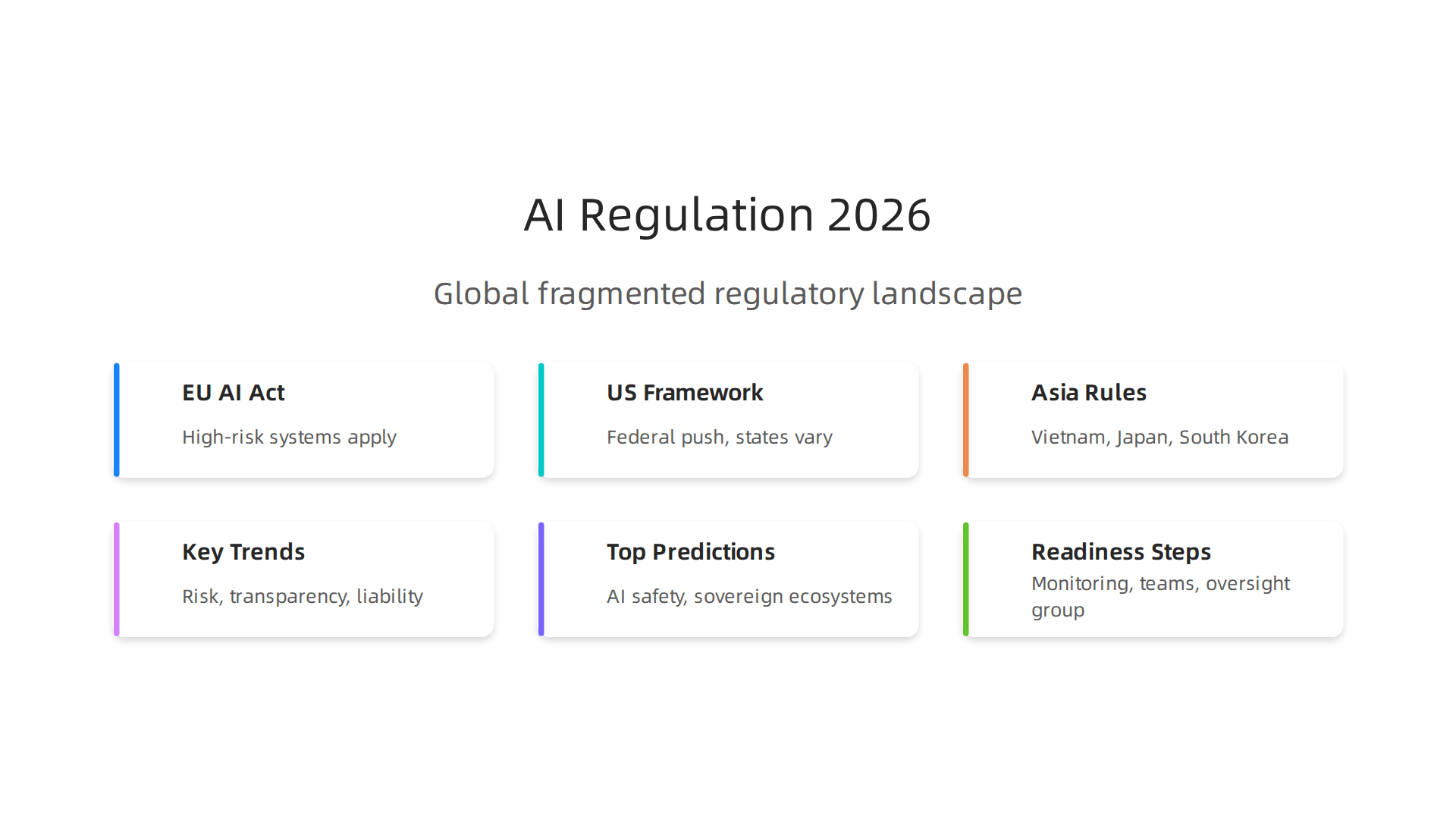
You can see the full scope in this breakdown of AI regulations around the world in 2026.
For tech hubs, this patchwork creates real challenges. Companies have to track different rules in every market they serve. The smartest teams are already using innovative technology solutions to automate compliance, from AI-powered document review to risk dashboards.
Making accurate AI predictions about where new rules will land is now a competitive advantage. Some firms are even exploring stealth AI strategies, keeping certain models or use cases under the radar until regulations become clearer. If you are still figuring out how to move forward without breaking rules, check out our guide on scaling AI for business in 2026.
Key Regulatory Trends
Looking closer at what these rules actually require, several key trends stand out. The first is mandatory AI risk assessments. Nearly every major regulation now demands that companies classify their systems by risk level and document how they manage those risks. This is central to the EU AI Act, which imposes strict requirements for high-risk systems covering data quality, transparency, and human oversight, as detailed in this 2026 AI Laws Update. Another trend is transparency. Regulators want users to know when they are interacting with AI. Liability frameworks are also emerging, making companies responsible for harm caused by their AI tools. For tech hubs operating across borders, these overlapping rules create real complexity. One system might be low-risk in one country and high-risk in another. Staying on top of these differences is hard but essential. If you want a deeper look at navigating these compliance challenges, read our guide on AI regulations 2026 compliance strategies to avoid million dollar fines. And to keep up with daily changes across the globe, consider subscribing to The AI Newsletter Worth Reading for clear daily AI updates.
Impact on Tech Hub Development
Not all tech hubs are reacting the same way to these new rules. Some places are turning their early regulations into a big advantage. According to a comprehensive guide to AI laws and regulations worldwide, over 70 countries now have active AI policies. Cities that wrote clear, business-friendly rules first are seeing a surge in investment. This clarity attracts funding and talent. For example, hubs with straightforward rules for high-risk systems pull in more AI prediction companies because they can plan ahead.
On the other hand, other hubs are struggling. When regulations are confusing or too strict, talented people and innovative startups start looking elsewhere. This brain drain can weaken a local tech scene fast. Many skilled workers move to places with lighter rules and more opportunity.
Staying ahead requires smart planning. If your company operates across multiple hubs, understanding local rules is key. Read more about building a technology strategy board for EU AI Act 2026 compliance to keep your team ready.
Top AI Predictions for Tech Hubs in 2026-2027
Looking ahead to 2026 and 2027, two big predictions stand out for anyone watching tech hubs.
Prediction 1: More rules around AI safety and alignment. Governments are getting serious about making sure AI systems are safe. The days of loose guidelines are fading. We see this shift in the AI moves from hype to hard hat work trend. New standards will demand that companies prove their AI is aligned with human values. Hubs that help businesses meet these safety rules will attract more funding and talent.
Prediction 2: Nations build their own AI ecosystems. Countries are racing to build domestic AI capabilities. They want less dependence on foreign tech. This means more national clouds, local data centers, and homegrown models. The 2026 AI Index Report from Stanford shows how governments are investing heavily in their own AI infrastructure. Tech hubs that support these sovereign goals will become key players.
For leaders navigating these changes, staying informed is critical. You can also check out our guide on global privacy and AI regulation landscape for a deeper look.
And if you want clear, daily updates on AI rules and trends, consider subscribing to The AI Newsletter Worth Reading. It helps you stay ahead without the noise.
Prediction 1: Increased Focus on AI Safety
But there is another major prediction for tech hubs: a much stronger focus on safety.
Regulators are moving from guidance to enforcement. In 2026, they demand verifiable safety measures before any major AI system goes live. This trend is highlighted in the AI 2027 report, which explores how safety-first approaches can prevent catastrophic outcomes. Tech hubs that prioritize safety research and develop innovative technology solutions for alignment are set to become the next centers of gravity. Even some stealth AI startups are quietly building verification tools, hoping to lead this new wave.
For business leaders, the message is clear: build compliance into your AI strategy now. Check out our practical guide on AI regulations and compliance strategies to protect your company from fines and reputational damage.
Prediction 2: Rise of Sovereign AI Ecosystems
While safety dominates the conversation in some circles, another powerful trend is reshaping tech hubs around the world. Countries are racing to build their own complete AI stacks, from semiconductor fabs to massive data centers to national AI models. They do not want to rely on foreign technology for something so critical.
This push for homegrown infrastructure is already visible in global spending patterns. According to the 2026 AI Index Report from Stanford HAI, nations are investing heavily in domestic AI capabilities, creating new centers of technological gravity. The result? A more fragmented global AI market where access to chips and data becomes a strategic advantage.
For business leaders, this means you may need to work with multiple regulatory regimes and local tech ecosystems. Understanding how to build a technology strategy board for EU AI Act 2026 compliance can help you navigate these regional differences.
Stay ahead of these rapid shifts. Get clear daily AI updates from The Deep View Newsletter to track sovereign AI developments in real time.
Investment Implications of AI Predictions
All this activity around sovereign ecosystems creates big shifts in where money flows. Investors are watching closely. They want to back startups that fit neatly inside new rules rather than fight against them.

The numbers back this up. Global venture funding records from Q1 2026 show that AI companies captured roughly 80% of all VC dollars that quarter. That is an all-time high. Much of that money went to startups building infrastructure and compliance friendly tools. If your business plan aligns with where regulators are heading, capital finds you faster.
This is where regulatory arbitrage comes in. Some tech hubs attract more investment simply because their local rules make it easier to launch. Investors look for markets with clear, supportive frameworks. They move money away from places with confusing or hostile regulations.
Understanding these patterns helps you decide where to build. If you are looking to expand, start with a location that matches your compliance needs. You can learn more about scaling AI for business in 2026 to see how other companies are making the jump.
Venture Capital Flows Into AI-Native Startups
That advice is especially true when you see where the money is going right now. Venture capital is flowing heavily into AI-native startups that focus on compliance and safety tools. These companies are not just building cool tech. They are building trust. And that trust comes with premium valuations.
Why the shift? Investors are following the rules. They want startups that fit cleanly inside new regulations rather than work around them. If your product already meets safety standards before launch, you skip costly delays. That advantage lifts your valuation right out of the gate.
This pattern shows up clearly in the market. What Legendary VC Expects From AI In 2026 shows that investors are betting on companies that align with regulatory trends. The winners will be the ones who plan for compliance from day one.
Geography also matters. Tech hubs with clear regulatory frameworks are seeing higher VC concentration. Companies setting up in those locations get funding faster. If you are building an AI-native business, pick a hub that supports your compliance goals. You can start with strategies for AI regulations 2026 compliance strategies to avoid million-dollar fines.
These ai predictions about regulatory clarity are already shaping where money lands. Core markets favor startups that prioritize safety. If you want to stay ahead of these shifts, subscribe to The AI Newsletter Worth Reading for daily updates.
Regulatory Arbitrage and Hub Selection
This pattern is also creating a new game among cities. Startups are actively choosing hub locations based on how permissive local rules are. The logic is simple. If your product is a stealth AI project that needs room to experiment, you pick a city with lighter rules. If you are building innovative technology solutions for regulated industries, you pick a hub with clear frameworks.
Cities are noticing. They are racing to offer AI-friendly rules to attract talent and funding. Some are writing new laws to become the go-to destination for AI startups. This competition between tech hubs is reshaping the startup map in real time.
The data backs this up. Record shattering venture funding in Q1 2026 highlighted that most AI capital flows to a few key locations. These ai predictions point to even more geographic concentration as the regulatory race accelerates. If you are choosing where to set up shop, pay close attention to local regulations. They could make or break your funding timeline.
For a deeper look at how to navigate these choices, check out our guide on AI regulations 2026 compliance strategies for businesses.
International Standards and Governance Frameworks
The EU AI Act is now the closest thing we have to a global rulebook. It officially entered into force in August 2024, and by August 2026 key parts become fully applicable. Other regions are paying close attention. Japan, Canada, and parts of South America are already modeling regulations after this framework. The detailed EU AI Act implementation timeline shows just how carefully this phased approach has been designed.
For startups building innovative technology solutions, this is actually good news. Harmonized standards mean you do not have to rewrite your compliance playbook for every country you enter. A single set of rules can open doors across the European market of 450 million people.
These ai predictions suggest that more regions will adopt similar frameworks over the next few years. If you are building a stealth AI project right now, aligning with EU standards early gives you a huge head start when expanding globally.
For a practical look at setting up internal compliance, read our guide on building a technology strategy board for EU AI Act 2026 compliance.
Rules are shifting fast. To keep up with daily regulatory changes, you need a steady stream of clear updates. That is exactly why The AI Newsletter Worth Reading exists. It delivers short, practical briefings on AI governance and compliance straight to your inbox.
The EU AI Act and Global Ripple Effects
The EU AI Act is not just a European rule. Companies in the US, Asia, and beyond are already changing how they build AI to match its standards. This global influence confirms what companies need to know about the EU AI Act in 2026: compliance is becoming a competitive must.
Tech hubs across Europe, including Paris, Berlin, and Amsterdam, now market themselves as safe places for innovative technology solutions. They offer a clear compliance path under the new rules, attracting startups that want to avoid legal surprises later.
For non-EU businesses, ignoring the Act means risking access to 450 million customers. Smart leaders adopt robust compliance strategies to avoid million-dollar fines before expanding.
These ai predictions point in one direction: following the EU lead is no longer optional. It is smart business.
Emerging Standards in the US and Asia
While Europe leads with a broad law, the United States is taking a different path. It uses a sectoral approach, meaning rules apply industry by industry. Health AI follows one set of rules, while finance AI follows another. This gives companies more flexibility but also creates a patchwork of requirements.
China, on the other hand, emphasizes state-led standards. The government sets clear expectations for AI developers, especially around security and social values. This top-down approach moves fast but leaves less room for debate.
In between, Asian tech hubs like Singapore and Tokyo are building unique hybrid models. They mix features from both the EU and US approaches to attract global businesses while keeping rules manageable. These innovative technology solutions aim to stay competitive without sacrificing safety. Staying on top of these fast-moving ai predictions and regional differences is critical. Reading a dedicated source like our guide to AI regulations 2026 compliance strategies can help you prepare. For daily updates on these shifting rules, get clear daily AI updates from The AI Newsletter Worth Reading.
Strategic Readiness: How to Prepare for AI Regulation
Waiting until the last minute to get ready for AI rules is a mistake. Organizations that act early on compliance consistently outperform those that wait. That’s not just a guess, either. According to this EU AI Act 2026 Compliance Guide for US Companies, early adoption helps build trust with customers and reduces vendor risk.
So what does being proactive actually look like? Start by picking the right regulatory monitoring tools. These tools track changes across regions and flag new requirements before they become urgent. Pair that with a cross-functional team that includes legal, tech, and business leaders. Together they can figure out how new rules affect your actual product decisions.
One smart move is to set up a dedicated oversight group. You can learn how in our guide on building a technology strategy board for EU AI Act compliance. This kind of group keeps everyone on the same page and makes audit readiness easier.
Your ai predictions about the regulatory landscape will be more accurate when you use real data and expert analysis. Tech hubs like Singapore and London are already showing that innovative technology solutions can thrive inside clear rules. The key is to start now, not when the deadline hits.
Building a Proactive Compliance Culture
Making compliance part of your daily work starts with product design. When you build AI systems with rules in mind from day one, you avoid costly fixes later. Embedding compliance into the design phase reduces friction and makes audits smoother.
Regular training keeps everyone aware of new requirements. Cross-departmental alignment ensures legal, product, and engineering teams speak the same language. If your team does not understand the rules, they cannot follow them. That is why ongoing workshops and clear documentation matter. For deeper guidance, check out this 2026 AI Regulation guide for legal and compliance leaders which explains how to embed compliance into development lifecycles.
Be aware of stealth AI systems that run without oversight, as they pose hidden compliance risks. Your ai predictions about what regulators will do next become sharper when your whole team is informed. Compliance should not stifle innovative technology solutions; it should guide them. For more on avoiding pitfalls, read these compliance strategies to avoid million dollar fines.
Get clear daily AI updates from The Deep View Newsletter to stay ahead of regulatory changes.
Leveraging AI for Regulatory Monitoring
Keeping up with new rules across multiple states and countries is tough. Laws change fast, and missing one update can lead to big fines. But here is the good news: you can use AI tools to do the heavy lifting.
AI-powered platforms now track regulatory changes in real time. They scan government websites, legal databases, and policy announcements across different jurisdictions.

Instead of your team manually checking dozens of sources every week, a smart system flags what matters. This automation cuts down the workload on your compliance team and reduces human error.
Your ai predictions become more accurate when you have fresh data flowing in constantly. For example, you can monitor shifting rules in major tech hubs like California and Texas without hiring extra staff. These innovative technology solutions let you spot changes before they become problems.
To get started, review this list of AI websites for compliance teams. Also, check out the US AI regulations for 2026 to see which state laws you must track now.
Expert Perspectives and Future Outlook
As you set up your monitoring systems, it helps to hear what industry leaders think about the bigger picture. Many experts stress that the future of AI depends on stronger collaboration between policymakers and innovators. When these two groups work together, they can create rules that protect people without slowing down progress.
Some leaders point to the growing push for trustworthy AI. Regulation, they say, can actually be a catalyst for building that trust. When companies follow clear rules, customers and partners feel more confident using their products. That trust becomes a competitive advantage. A recent analysis from legal experts highlights that companies with EU exposure must prepare for the EU AI Act’s full enforcement in August 2026, as noted in preparing for new global and state AI laws.
But challenges remain. One concern is the rise of stealth ai systems that operate without transparency. Experts warn that these hidden tools could face harsh penalties as enforcement tightens. Meanwhile, states like California and Texas continue to set their own strict standards, creating a patchwork of rules.
The long-term outlook suggests that compliance will no longer be an afterthought. Instead, it will drive product design from the start. For ai predictions to stay accurate, your models need to be trained on data that meets regulatory standards from day one.
To stay ahead, consider how to build a technology strategy board for EU AI Act 2026 compliance. This kind of forward planning helps you turn regulation into an asset.
As you track these fast-moving changes, getting daily insights can keep you informed. Subscribe to The AI Newsletter Worth Reading for clear daily AI updates.
Insights from Industry Leaders
Beyond building strategy boards, it helps to hear directly from the people creating the technology. Many CEOs of top AI labs argue that regulation must be risk-based and flexible. A one-size-fits-all approach would slow down progress. Instead, they want rules that focus on the highest-risk uses first. This idea is already shaping how companies prepare. According to a recent guide, many multinational firms now treat early compliance as a strategic priority for compliance rather than a burden.
Leaders at tech hubs also push for sandbox environments. These are safe spaces where companies can test innovative technology solutions without fear of breaking rules right away. Sandboxes let you try out your ai predictions against real-world scenarios and adjust before full launch. For example, companies working on self-driving cars use these controlled tests to prove safety. You can see how this approach works in practice by reading about navigating autonomous vehicle regulations. The key takeaway is clear: smart leaders design for compliance from the start, not as an afterthought.
Long-Term Scenarios for AI Innovation
Looking ahead, two major scenarios could shape how AI innovation and compliance evolve.
Scenario 1: Fragmented regulation leads to specialized hubs.
Instead of a single global rulebook, different regions and states create their own laws. In the US, state‑level AI rules are already diverging. Companies may concentrate ai predictions and high‑risk development in a few tech‑friendly hubs. This patchwork forces businesses to tailor innovative technology solutions for each market. As a recent report explains, the 2026 US AI regulatory landscape is defined by tension between federal and state mandates, making agility a survival skill.
Scenario 2: Global standards emerge for seamless collaboration.
On the other hand, international frameworks like the EU AI Act and ISO 42001 could push toward harmonized rules. When companies follow one set of compliance requirements, ai predictions and data can move freely across borders. This encourages tech hubs to cooperate rather than compete. To stay ready for either future, it helps to understand the global privacy and AI regulation landscape that may soon unify standards.
Whichever path unfolds, staying informed is your best strategy. Get clear daily AI updates from The AI Newsletter Worth Reading to track these shifts in real time.
Summary
This article explains how the fast-moving wave of 2026 AI regulations is reshaping tech hubs, investment, and product strategy worldwide. It surveys the current patchwork of rules — led by the EU AI Act and a mix of state and national regimes — and gives data-driven predictions about safety requirements and the rise of sovereign AI ecosystems. You’ll learn how regulators are prioritizing risk assessments, transparency, and liability, why hubs with clear, business-friendly rules attract capital, and how fragmented regulation drives geographic arbitrage. The piece explains practical steps for leaders: build cross‑functional oversight (a technology strategy board), embed compliance into design, and deploy AI monitoring tools to track rule changes. It also covers investor behavior favoring compliance-ready startups and offers scenarios for future global standards. After reading, executives, compliance teams, and founders will know where to focus resources, which tools to adopt, and how to prepare for enforcement deadlines like the EU high‑risk application phase.