

Introduction
You have probably heard about artificial neural networks changing the way healthcare, finance, and even transportation work. But if you are not a technical person, the details can feel like a foreign language. Here is the thing: you do not need to be an engineer to understand the basics. In fact, the artificial neural network market is already worth billions. The neural network software market was valued at USD 45.63 billion in 2026 and is growing fast. That kind of money means this technology is not going away.
So why should you care about the nuts and bolts? Because when you understand how an artificial neural network learns and makes decisions, you can spot real risks.

You can ask better questions about data privacy, bias, and regulatory compliance. You can talk to your technical team without feeling lost. And you can make smarter choices about where to invest or where to slow down.
This guide gives you a clear, practical foundation. No heavy math. No jargon. Just the facts you need to assess opportunities, understand the AI and machine learning explained for 2026 business leaders, and keep your organization on the right side of regulation. Whether you are an executive, an investor, or a policy watcher, the next few sections will help you see what is really happening under the hood of modern AI.
If you want to stay ahead of the rapidly shifting rules around AI, consider subscribing to The AI Newsletter Worth Reading for clear daily updates straight to your inbox.
What is an Artificial Neural Network?
Think of a simple computer program. It follows a fixed set of rules, step by step. If you type "2 + 2," it gives you "4." That is traditional programming.
An artificial neural network works differently. It does not follow fixed rules. Instead, it learns from examples.
Here is a simple way to picture it. Your brain has billions of nerve cells called neurons. Each neuron connects to many others. When you learn something new, the connections between certain neurons get stronger. Over time, your brain gets better at recognizing patterns.
An artificial neural network mimics this idea using software. Instead of biological neurons, it uses simple processing units called "nodes" or "artificial neurons." These nodes are organized into layers. The Stanford HAI definition explains it clearly: a neural network is a computational model inspired by the structure of the human brain, made up of interconnected layers of artificial neurons that process and transmit information.
A basic network has three types of layers:
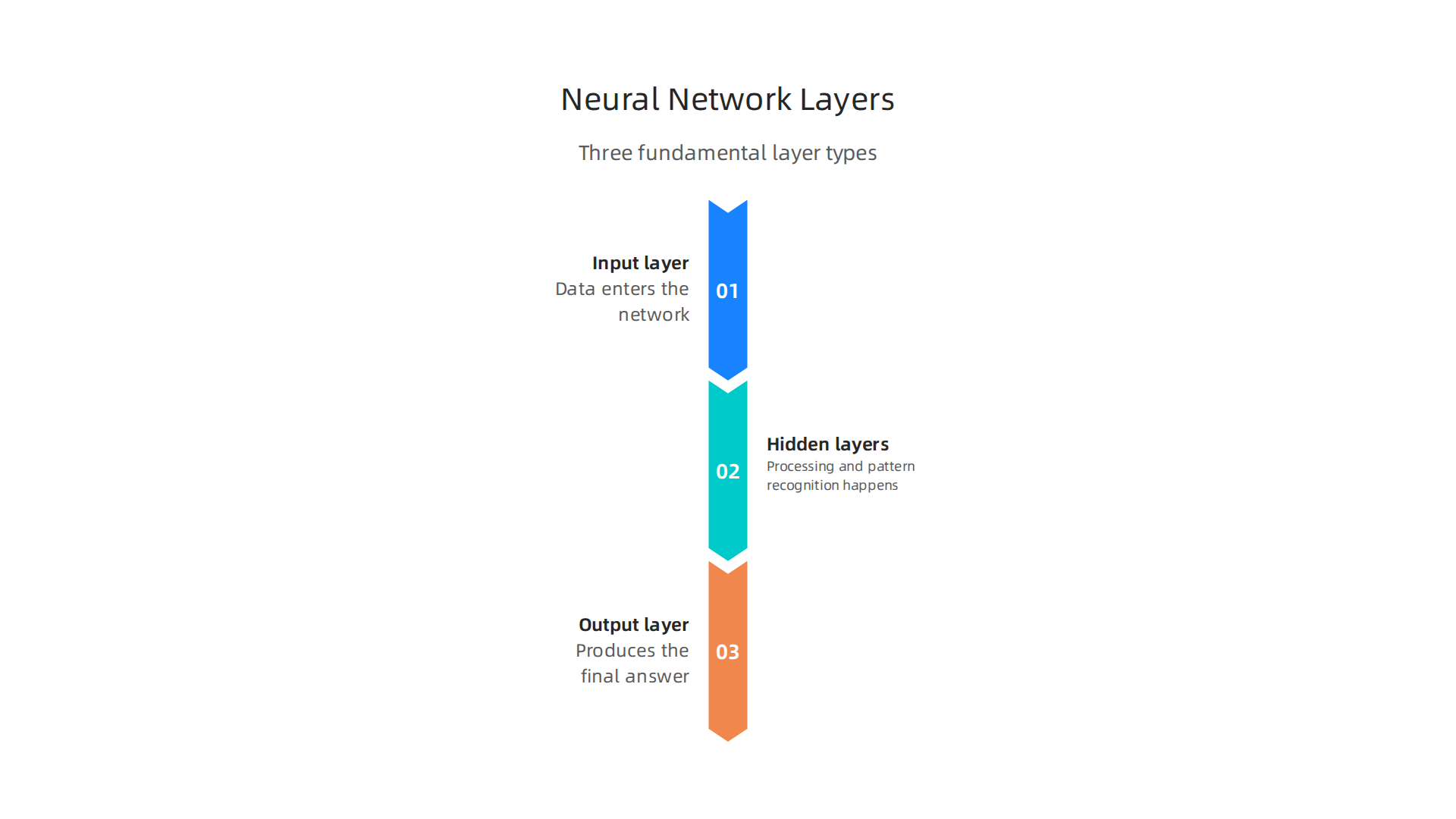
- Input layer: This is where data enters the network. Think of it as your eyes or ears receiving information.
- Hidden layers: These layers do the real processing. Most networks have one or more hidden layers where pattern recognition happens.
- Output layer: This produces the final answer. Is that a cat or a dog? Should this email go to spam or your inbox?
Each connection between nodes has a "weight." Weights determine how important one signal is compared to another. During training, the network adjusts these weights. It keeps tweaking them until its predictions get more accurate. The process is called "feedforward," and it is how the network turns raw data into a meaningful output.
If you want to see how these concepts connect to real business planning, check out the artificial intelligence a modern approach by Russell Norvig guide on our site. It bridges the gap between neural network basics and practical compliance strategy.
Here is the key takeaway. An artificial neural network is not magic. It is a system that learns by practicing on data. It makes mistakes. It adjusts. It gets better. That is the whole idea in a nutshell. When you understand this core concept, you can start asking smarter questions about how AI makes decisions and what risks come with it.
How Neural Networks Learn: The Training Process
So how does an artificial neural network actually get smart? It doesn’t wake up knowing anything. It starts totally blank, with random connection weights. Then the training begins.
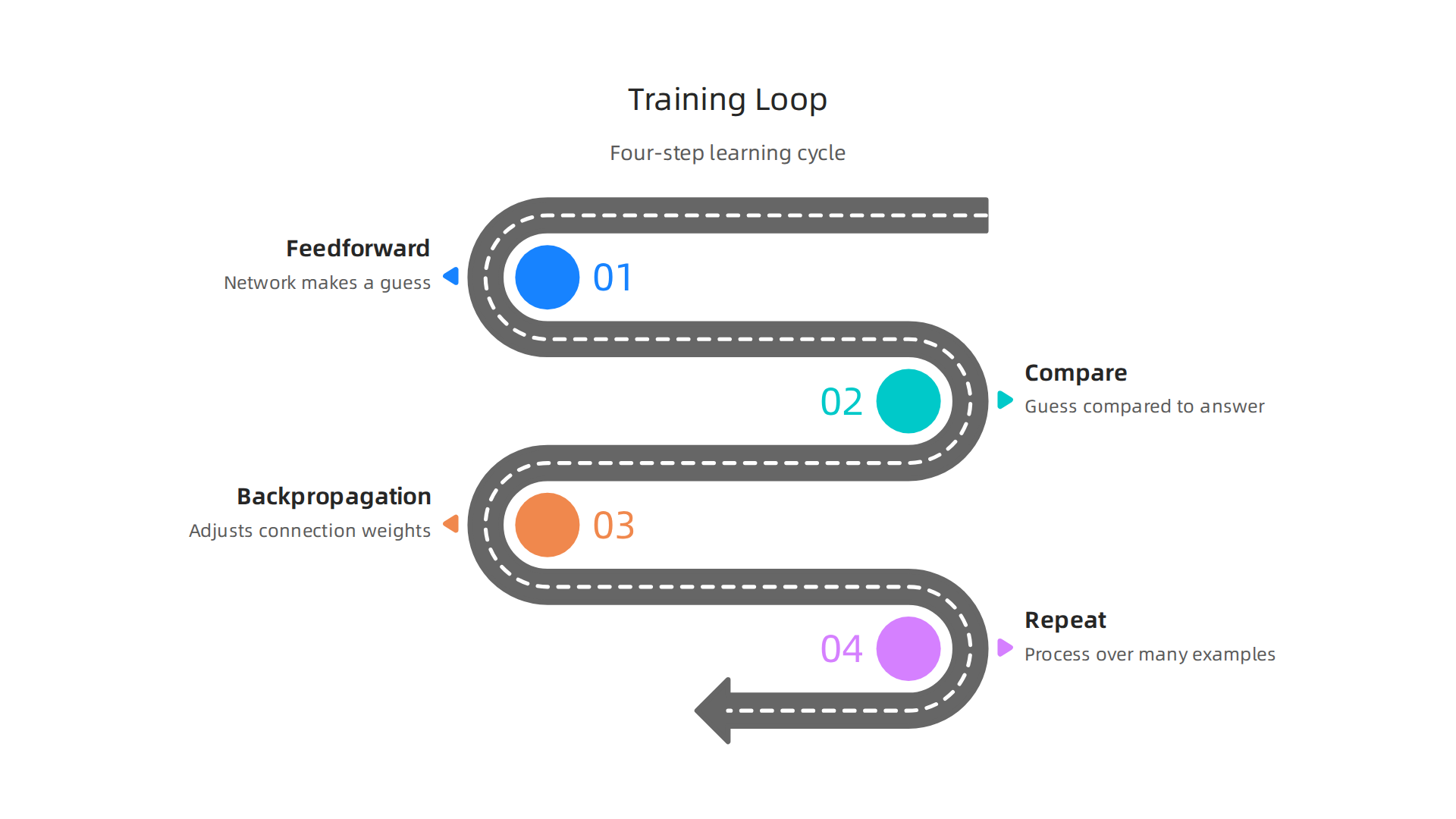
Training works in a loop with four steps:
-
Feedforward: You feed the network a piece of training data. The data travels through the input layer, across the hidden layers, and out the output layer. The network makes a guess.
-
Compare: You look at the network’s guess and compare it to the correct answer. The difference between the two is measured by something called a "loss function." A big loss means a bad guess. A small loss means a good one.
-
Backpropagation: This is where the magic happens. The network sends that error backward through its layers. It figures out which connection weights contributed most to the mistake and adjusts them slightly. It uses a method called "gradient descent" to find the direction that reduces the loss the fastest.
-
Repeat: The network does this over and over with many examples. After each full pass through the training data, called an "epoch," the network gets a little better. After dozens or hundreds of epochs, it starts making accurate predictions.
As the MIT News article on neural network training explains, all weights and thresholds start random. The network gradually tunes them until similar inputs consistently produce similar outputs.
Here is the important distinction for business leaders. "Training" is the learning phase. "Inference" is when the trained model is put to work on new data. A model that performs well on training data might fail on real-world data if it has learned biases instead of true patterns.
Understanding this process is key to evaluating how reliable any AI system actually is. If you want to dig deeper into the dangers of models that learn bad patterns, check out our guide on the real risks of unrestricted AI.
Most people think AI just "knows" things. Now you understand the truth. It learns through trial and error, one tiny weight adjustment at a time. That is both its strength and its vulnerability.
If you want to stay ahead of how AI is evolving and what it means for compliance, subscribe to The AI Newsletter Worth Reading for daily, clear updates.
Key Components: Neurons, Layers, and Activation Functions
Now that you understand how an artificial neural network trains itself, let us look under the hood at the parts that make it work.

Every neural network, no matter how powerful, is built from just a few simple pieces.
The most basic unit is the neuron (also called a node). Think of it as a tiny decision maker. As the Stanford HAI definition of neural networks explains, each neuron receives input signals, applies math to them, and passes a result to the next neuron.
Here is what happens inside one neuron:
- It takes in numbers from the neurons connected to it.
- It multiplies each input by a weight. Weights decide how important that input is.
- It adds up all the weighted inputs plus a bias. The bias helps the neuron fire more easily or not.
- It runs the total through an activation function. That function decides what the neuron actually sends forward.
Activation functions are the secret sauce. They add non-linearity, which lets the network learn complex patterns instead of just straight lines. The three most common ones are:
- ReLU (Rectified Linear Unit): Returns the input if it is positive, otherwise returns zero. It is fast and works great in hidden layers. But it can "die" if too many neurons stop firing.
- Sigmoid: Squashes the output between 0 and 1. Good for yes/no decisions. But it can get stuck at the extremes, slowing down learning.
- Tanh: Similar to sigmoid but outputs between -1 and 1. Often used in older networks, but ReLU has mostly replaced it.
Now for layers. Neurons are grouped into three types of layers:
- Input layer: The first layer. It receives raw data, like pixel values from an image or words from a sentence.
- Hidden layers: The middle layers where all the learning happens. When a network has many hidden layers, we call it "deep learning." The more layers, the more complex patterns it can recognize.
- Output layer: The final layer that produces the answer, like "cat" or "dog."
A network with one hidden layer can solve simple problems. A network with dozens of hidden layers can recognize faces, translate languages, and drive cars. That depth is what makes an artificial neural network truly powerful.
If you want to see how this all connects back to real business applications, check out our guide on artificial intelligence and machine learning explained for 2026 business leaders.
Types of Neural Network Architectures
Not every artificial neural network is built the same way. Engineers arrange the neurons and layers in specific patterns to solve different kinds of problems. Matching the right architecture to your task is one of the smartest decisions you can make as a business leader.
Here are the four main types you need to know.
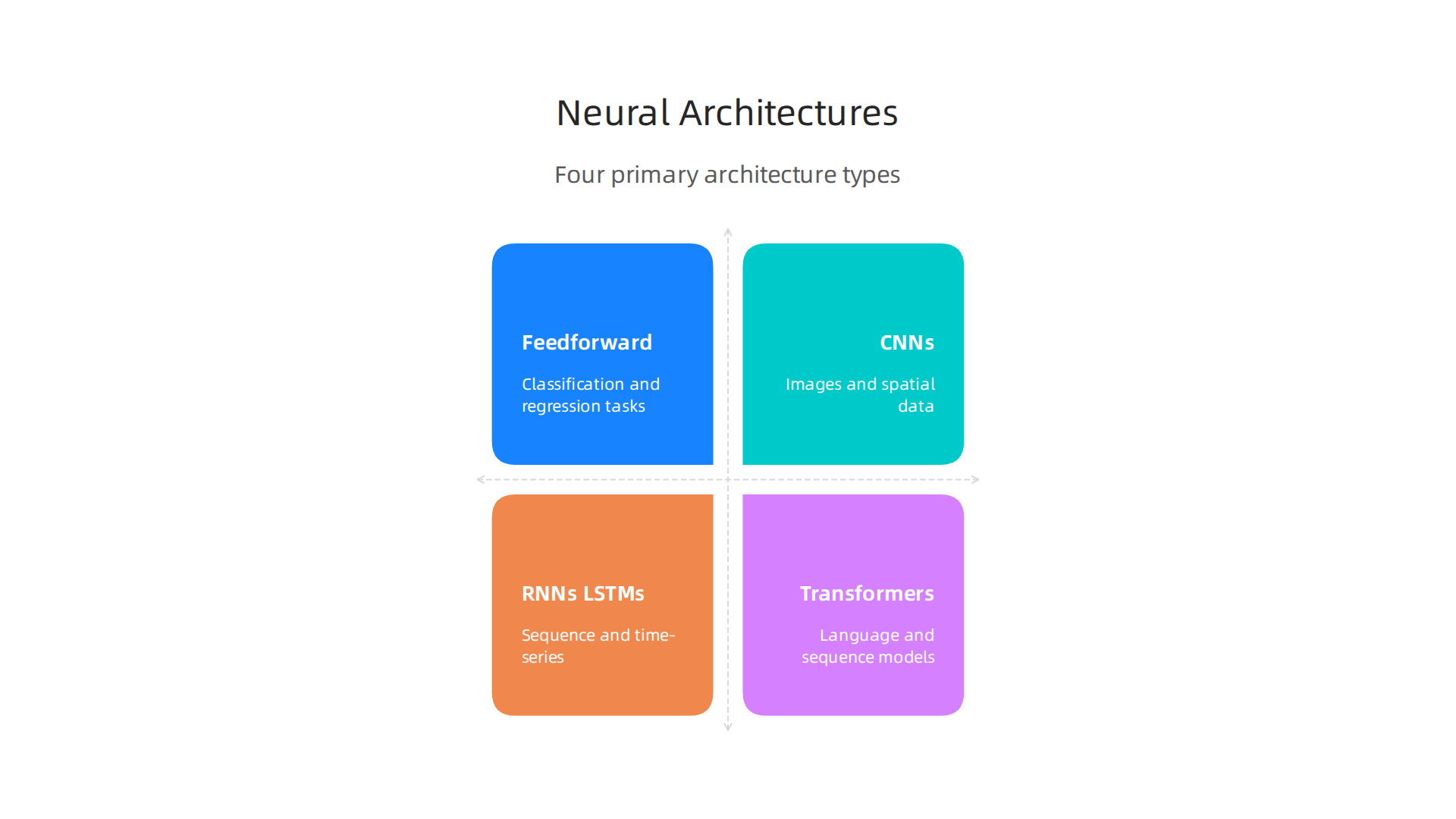
Feedforward Neural Networks are the simplest design. Data moves in one direction from input to output with no loops. They work well for basic classification and regression tasks like predicting sales or sorting customer feedback. But they cannot handle sequences or remember past inputs.
Convolutional Neural Networks (CNNs) are built for spatial data like images, videos, and even some types of medical scans. They use filters that slide across the input to detect patterns like edges, shapes, or textures. As the deep learning architectures comparative analysis from aman.ai explains, CNNs accept fixed-size inputs and are highly sample efficient. This makes them ideal when you have limited data. Think of object detection in manufacturing, quality control, or satellite image analysis. CNNs are the backbone of most computer vision systems today.
Recurrent Neural Networks (RNNs) and LSTMs are designed for sequences. They have a hidden state that acts like a memory, passing information from one step to the next. This makes them great for time series data, speech recognition, and language modeling. But they process data one element at a time, so they can be slow and struggle with very long sequences. According to the RNN vs Transformer comparison from Baeldung, RNNs are still valuable when temporal dependencies matter most.
Transformers changed the game starting in 2017. Instead of processing data step by step, they use a mechanism called self-attention to look at the entire sequence at once. This allows parallel processing, making them much faster to train on modern hardware. Transformers excel at long-range dependencies and are the foundation of large language models like GPT and BERT. The tradeoff is they need a lot of data and computing power, as noted in the same CNN vs RNN vs Transformer analysis.
So which one should you pick? For images, start with a CNN. For text or time series with short patterns, try an RNN or LSTM. For complex language tasks or any sequence where context matters across long distances, go with a Transformer. And for simple classification without memory, a feedforward network is often enough.
Understanding these differences helps you choose the right tool before you start building. If you want to go deeper on how these architectures apply to real business problems, check out our guide on from pilot to scale with AI for business in 2026.
And if you want to stay ahead of the latest trends in AI and neural networks, consider subscribing to The AI Newsletter Worth Reading for clear daily updates delivered straight to your inbox.
Real-World Applications and Use Cases
You might not realize it, but artificial neural networks already shape your daily life. Every time you unlock your phone with your face, get a movie recommendation, or use voice typing, a neural network is working behind the scenes.

But the really exciting stuff is happening in industries where these systems are saving lives, reducing costs, and opening doors we never knew existed.
Here are some of the biggest real-world applications right now.
Medical imaging and diagnostics rely heavily on CNNs. These networks scan X-rays, MRIs, and CT images to spot tumors, fractures, and early signs of disease faster than many human radiologists. Hospitals in North America and Europe now use CNN-based tools as a second set of eyes. If your organization works in healthcare, you need to understand the legal side too. Our guide on AI imaging compliance guidance breaks down what you need to know.
Autonomous vehicles use a mix of CNNs and Transformers. CNNs handle object detection in real time, spotting pedestrians, stop signs, and other cars. Transformers help the vehicle understand the bigger picture like predicting where a pedestrian might walk next. Companies like Tesla, Waymo, and Aurora are racing to get this right. But as our coverage of autonomous vehicle regulations in 2026 shows, the technology is only half the battle.
Natural language processing is almost entirely Transformer-driven now. Chatbots, virtual assistants, translation tools, and content generation systems all use this architecture. When you ask ChatGPT a question or use Google Translate, you are talking to a Transformer model. It can handle long conversations and understand context in ways older RNN models could not.
Financial modeling still leans on RNNs and LSTMs for time series predictions. Banks use them to forecast stock prices, detect fraud, and assess credit risk. The sequential nature of financial data makes RNNs a natural fit. But more firms are blending RNNs with Transformers to get the best of both worlds.
The market numbers back up this explosion. The global artificial neural network market was valued at about USD 179 billion in 2026, according to recent Artificial Neural Network Market data for 2026. That number is expected to triple in the next seven years. Every major industry is investing.
But not every story is a success. Some early adopters rushed to deploy neural networks without proper testing. A well known hospital system had to pull an AI diagnostic tool after it missed critical findings in certain patient groups because the training data lacked diversity. Another company launched a chatbot that gave harmful advice because the team skipped safety checks. These cautionary tales remind us that building a neural network is one thing. Deploying it responsibly is another.
The lesson is clear. Neural networks offer incredible power, but only when matched with the right data, the right oversight, and the right understanding of the risks.
Challenges and Limitations
These cautionary tales reveal some stubborn problems that every artificial neural network still faces. No matter how powerful the model, these challenges do not go away.
Data hunger is perhaps the biggest barrier. Most neural networks need massive amounts of labeled data to learn well. If you do not have thousands of examples, your model will struggle. And even with enough data, overfitting can happen. That is when the model memorizes the training data instead of learning general patterns. It scores high on tests but fails in the real world.
Interpretability is another headache. Many neural networks act like black boxes. You can see the input and the output, but understanding why the model made a particular decision is extremely difficult. This becomes a real problem in high stakes fields like medicine or criminal justice.
Adversarial vulnerability adds more risk. Tiny changes to an image or a text that humans would never notice can fool a neural network completely. A stop sign with a small sticker might suddenly look like a speed limit sign to an autonomous car.
Bias and fairness issues have drawn serious regulatory attention. If the training data contains historical biases, the model will amplify them. This can lead to discriminatory outcomes in hiring, lending, and law enforcement. To stay ahead of these risks, compliance teams need to understand the real risks of unrestricted AI.
Energy consumption and environmental impact are growing concerns. Training a single large language model like GPT-3 can produce over 500 metric tons of CO2, which is about the same as the lifetime emissions of five cars. According to research on the AI’s Growing Carbon Footprint, inference also consumes massive energy once models are live.
These limitations do not mean we should stop using neural networks. But they do mean we need smarter, greener, and fairer approaches. Staying on top of these challenges is critical for anyone using AI. Get clear daily AI updates from The Deep View Newsletter.
The Regulatory Landscape for Neural Networks
But understanding the technical challenges is only half the battle. The other half is navigating the rules that govern these systems. In 2026, governments around the world are writing laws specifically aimed at artificial neural networks and other high-risk AI systems.

The biggest regulation on the map is the EU AI Act. This law sorts AI systems by risk level. Systems that pose serious threats to health, safety, or people’s rights are labeled "high risk." Many neural networks fall into this category, especially those used in hiring, banking, and law enforcement. The requirements are strict. Providers must set up a risk management system, keep detailed technical records, allow human oversight, and log activity to ensure traceability of results.
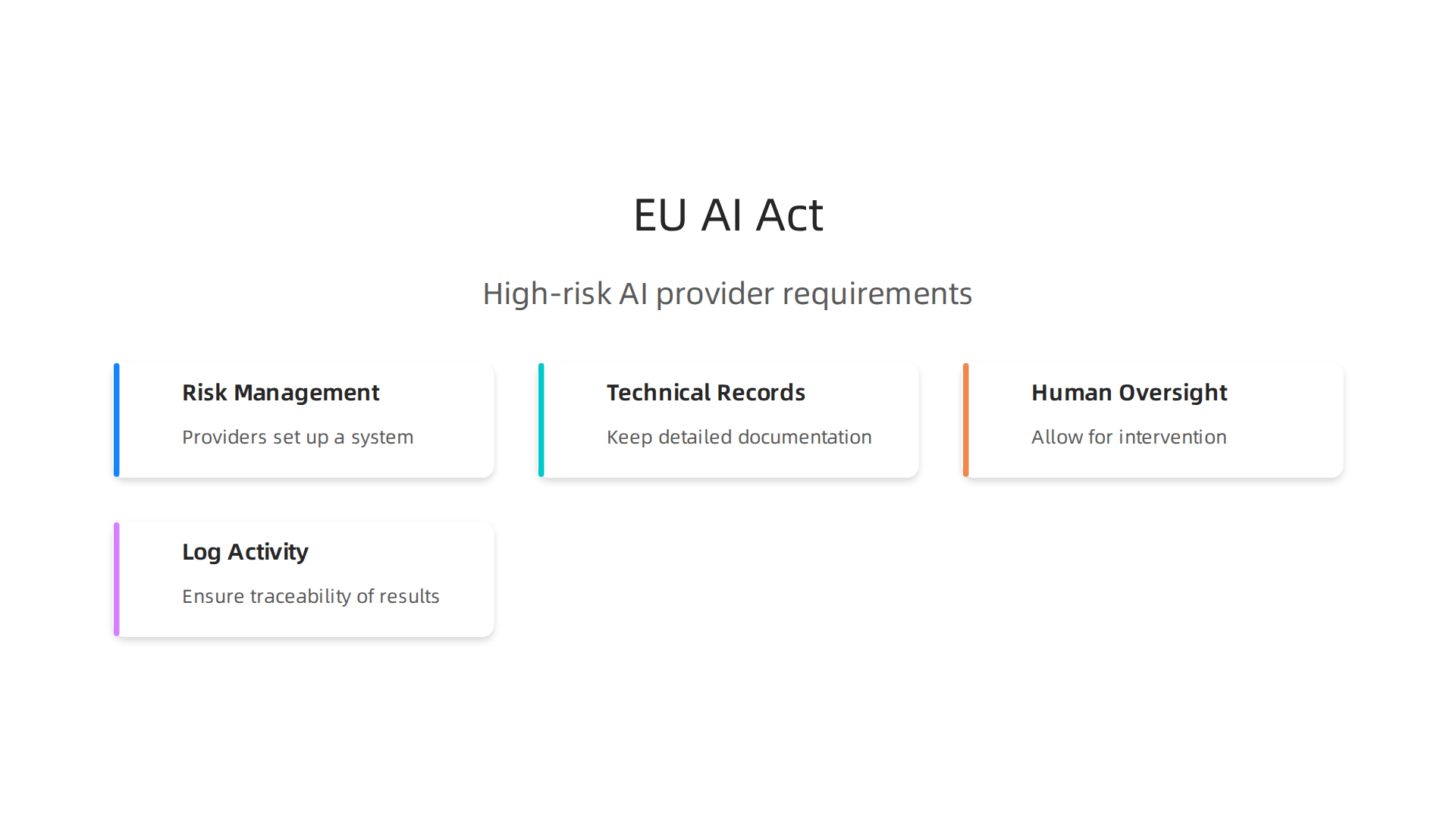
You can explore the full details in the High-level summary of the AI Act.
Here is the tricky part. Neural networks are famously hard to explain. Regulators want transparency. They want to know why a model made a specific decision. But if your artificial neural network is a black box, proving compliance becomes a nightmare. This is why the whole explainability problem is no longer just a technical headache. It is now a legal one too. Businesses that cannot show how their models work face serious fines and lost trust.
The timeline for enforcement matters a lot in 2026. For example, the EU AI Act’s transparency rules take effect in August 2026. Rules for high-risk systems used in biometrics and employment apply from December 2027. Systems integrated into products like lifts have until 2028. That might sound like plenty of time, but building compliant systems takes months or years. Companies need to start now. If you want a deeper look at how to avoid penalties, read our guide on AI regulations 2026 compliance strategies.
Investors and executives must pay close attention to enforcement trends. Regulators are getting tougher. They are watching for models that amplify bias, lack proper documentation, or fail to protect user data. Getting caught off guard can cost millions and damage reputations. Staying on top of these regulatory shifts is critical. The Deep View Newsletter provides daily updates so you never miss a key development.
Summary
This article explains artificial neural networks in plain language for non-technical leaders, investors, and policy watchers. It describes how networks are structured (input, hidden, output layers), how they learn via feedforward, loss measurement, backpropagation, and repeated epochs, and why training versus inference matters. You’ll learn the role of neurons, weights, biases, and activation functions like ReLU, sigmoid, and tanh, plus how different architectures (feedforward, CNNs, RNNs/LSTMs, Transformers) suit images, sequences, and language tasks. The guide highlights real-world use cases from medical imaging to autonomous vehicles and finance, and it outlines key limitations—data hunger, overfitting, interpretability, adversarial vulnerability, bias, and energy costs. Finally, it summarizes the 2026 regulatory landscape, including the EU AI Act’s requirements for high-risk systems, and offers practical points to help you evaluate, deploy, and govern neural networks responsibly.