

When businesses think about adding new artificial intelligence, it’s easy to get excited about what AI can do. But beneath that excitement is a big question: How much will it actually cost? Getting a precise artificial intelligence cost estimation is not just a good idea, it’s a must for leaders, investors, and teams who make sure rules are followed in 2026.
AI projects are not like simple purchases. They often come with large costs that last for many years. These costs can really change how a company plans its future, how much it is worth, and if it is following all the important rules. For example, a report from Goldman Sachs in 2026 shows that annual spending on AI could reach $765 billion this year and grow to $1.6 trillion by 2031 The Assumptions Shaping the Scale of the AI Build-Out. That’s a huge amount of money that needs careful planning.
Executives need to know these costs to make smart decisions about where to put company money.

Should they build their own AI or buy existing tech solutions? How will these AI projects fit into their long-term plans? Without a clear artificial intelligence cost estimation, it’s like trying to build a house without knowing how much the materials will be.
Investors, too, watch these numbers closely. They want to know if a company’s AI plans are sensible and will bring in good returns, not just soak up cash. Understanding the total cost of owning AI helps them see the true value of a company.
Then there are the compliance teams. As AI rules change quickly in 2026, there are costs linked to making sure AI systems follow those rules. This can include setting up ways to check the AI, making sure data is private, and having clear records. Not knowing these costs can lead to big problems and fines. You can learn more about these rules by reading about AI Regulation 2026: Navigate Compliance and Avoid Risks.
This article will help you understand these complex costs. We will share a clear and practical way to estimate all kinds of AI expenses. This includes the money you spend at the start, the money it takes to keep AI running every day, and the money needed to meet all the regulations. By the end, you will have a better idea of how to make good investment and budgeting choices for your AI projects.
To stay on top of the rapidly evolving AI landscape, consider subscribing to The AI Newsletter Worth Reading for daily updates.
To get a clear artificial intelligence cost estimation, we need to look at the main things that drive up expenses. These are data, compute power, the people who build and manage the AI, and the software licenses needed.
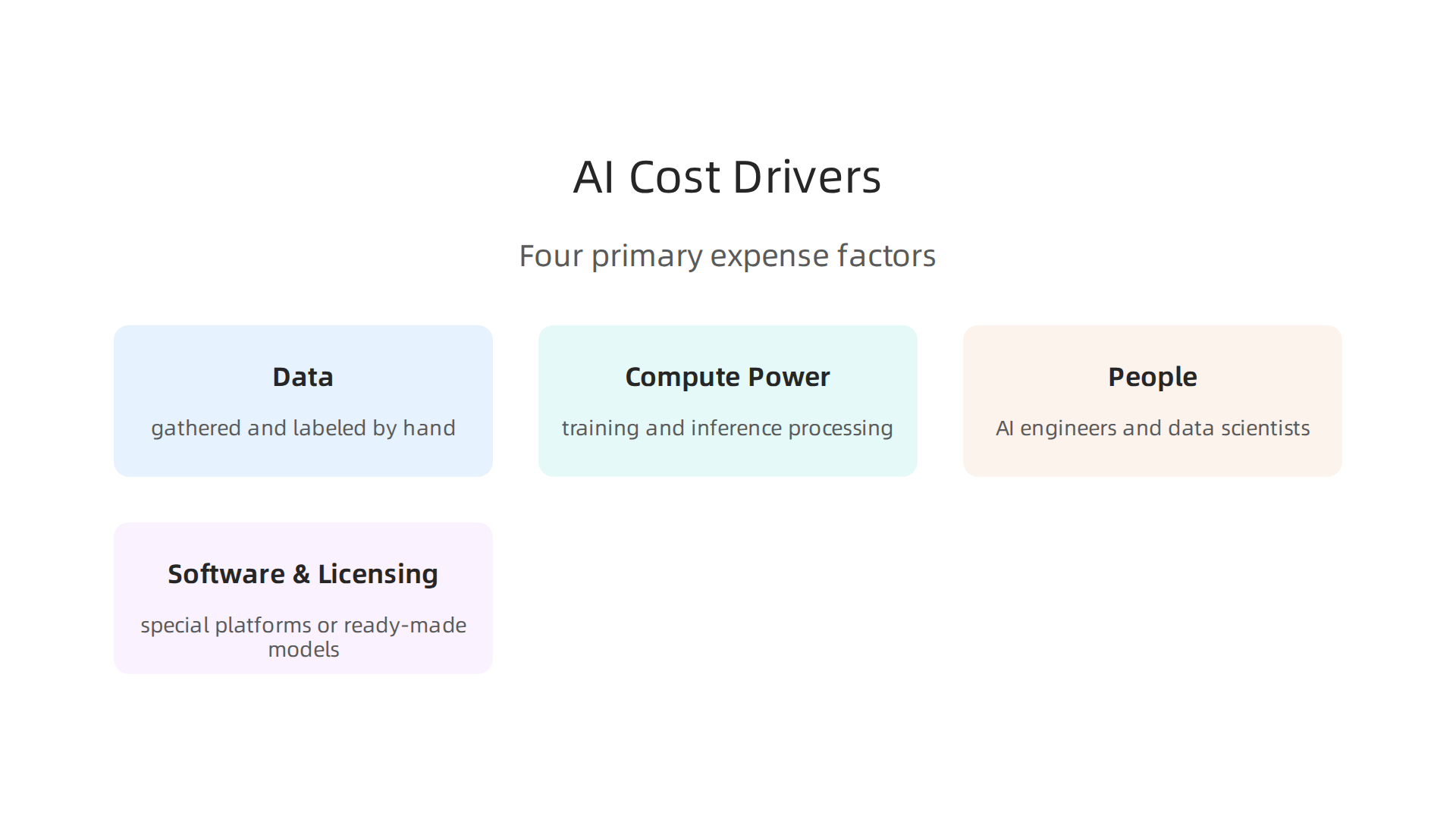
Each of these parts changes in cost based on how big your AI project is, how much data it uses, and how often it runs.
Data: The AI’s Food
Every AI needs data to learn. This data must be gathered, cleaned up, and sometimes labeled by hand. Think of labeling as teaching the AI what it’s looking at, like telling it "this is a cat" in thousands of pictures. The more data you need, and the more complex that data is, the more money it will cost. For example, building a dataset with about 100,000 samples can cost anywhere from $10,000 to $90,000, depending on how hard it is to get and label that data The AI Cost Stack in 2026: Data, Talent, Compute, and …. If your AI project requires huge amounts of unique data, these costs will climb fast.
Compute Power: The AI’s Engine
Compute power refers to the actual computer processing needed for AI. There are two main parts:
- Training Compute: This is the power needed to teach the AI model. Training a very large AI model from the ground up can cost a lot of money, sometimes reaching hundreds of millions of dollars. For instance, training a powerful model like GPT-4 might cost around $78 million, while Google’s Gemini Ultra could be as much as $191 million The Real Cost of AI Compute: Training vs. Inference. These costs get higher with bigger, more complex AI models that need more time and processing chips like GPUs to learn.
- Inference Compute: After an AI model is trained, it needs compute power to actually work and answer questions or make predictions. This is called inference. In 2026, inference costs are a huge part of the total bill, often making up 80% to 90% of all compute spending over the life of an AI model Inference Economics: AI Agent Compute Markets in 2026. The more people use your AI, or the more often your AI system runs, the higher your inference costs will be.
People: The AI’s Brains Behind the Scenes
You need skilled people to build, train, and keep AI systems running. This includes AI engineers, data scientists, machine learning experts, and project managers.

These roles often come with high salaries because the talent is in high demand. The more complex your AI project, the more specialized people you’ll need, and the higher your staffing costs. If you are looking to add to your team, understanding how to find and engage top artificial intelligence experts in 2026 is a smart first step.
Software and Licensing: The AI’s Tools
Beyond your own team’s work, you might need to pay for special software, platforms, or even ready-made AI models. These are often called tech solutions. For example, you might use a special "ai foundry" to help develop your AI, or pay for services from companies like deepbrain ai to use their advanced models. These costs can be monthly fees, yearly licenses, or based on how much you use the software. The more advanced the tools or models you need, and the more users you have, the higher these software and licensing costs will be.
After understanding what makes AI projects expensive, the next big step is figuring out how to actually put numbers to those costs. This is where artificial intelligence cost estimation comes in.

It’s about knowing how much money you need to set aside, both at the start and for keeping things running over time.
We usually split costs into two groups: upfront costs and ongoing costs. Upfront costs are what you pay to get your AI project off the ground, like building the first version of your model or buying initial equipment. Ongoing costs are the regular payments needed to keep your AI working well, such as for compute power, maintenance, and updates.
There are two main ways to estimate these costs:
Top-Down Estimation: Looking at the Big Picture
This method is like looking at past projects that are similar to yours. You compare your new AI idea to older, finished ones and use their costs as a guide. For example, if you want to build an AI that sorts customer emails, you might look at how much it cost another company to build a similar email-sorting AI. This approach works best when you don’t have many details yet or when your project is much like something that has been done before. It gives you a quick, rough estimate. Think of it as getting a ballpark figure by comparing apples to slightly different apples.
Bottom-Up Estimation: Breaking it Down
This way is more detailed. You break your AI project into many small pieces and estimate the cost for each one. For example, you might figure out how much data you need, how much compute power each part of the AI will use, and how many hours your team will spend on specific tasks. Then, you add up all these tiny costs to get a grand total. This method gives a much more exact artificial intelligence cost estimation, but it takes more time and you need clearer plans from the start. Tools like an AI software development cost estimation tool can help you manage all these small details.
Common Estimation Techniques
When you use the bottom-up method, you’ll often use these specific techniques:
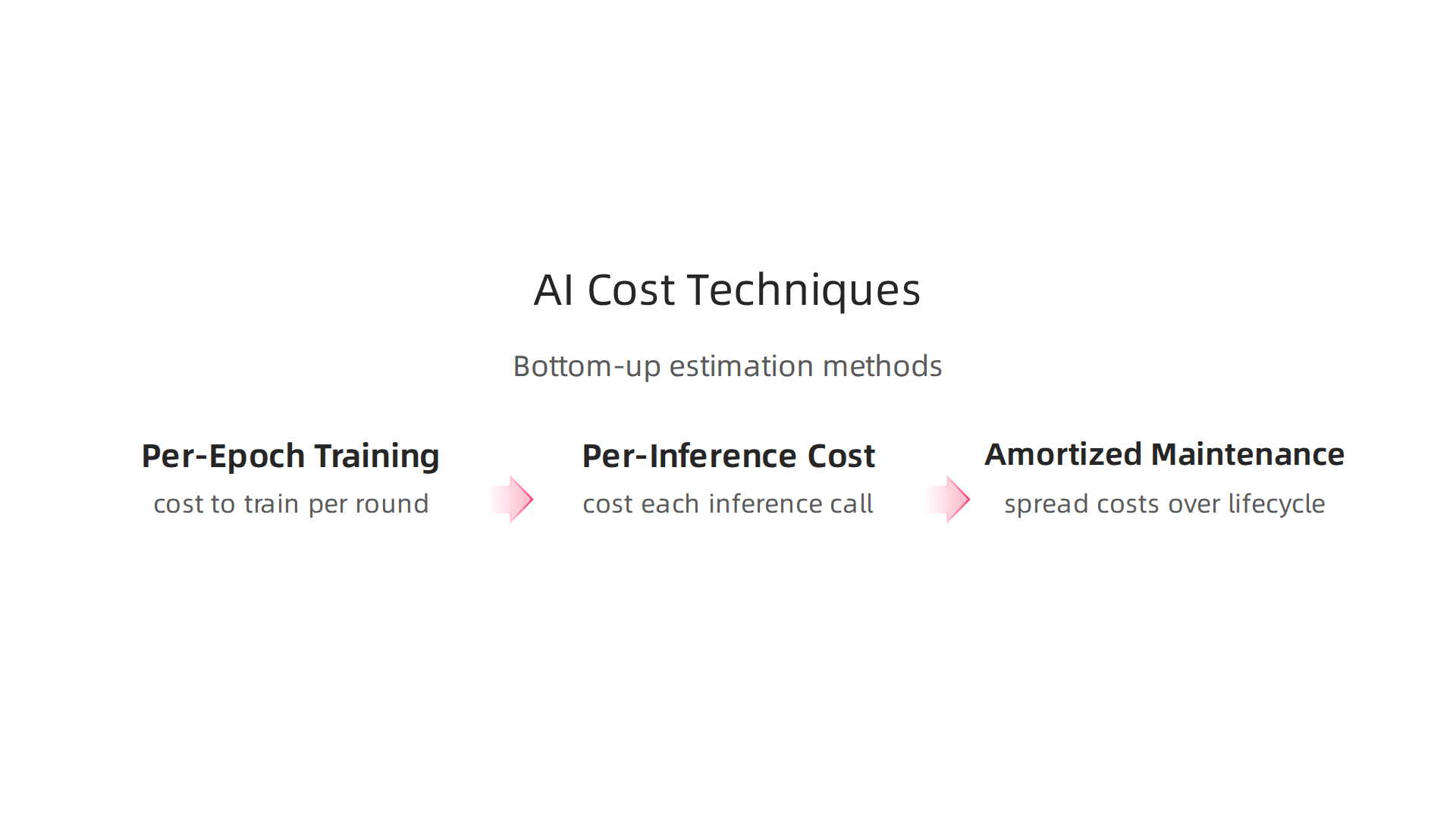
- Per-Epoch Training Cost: This looks at how much it costs to train your AI model for one "round" of learning. Training a powerful AI needs special computer chips called GPUs. For example, a single A100 GPU can cost anywhere from about $0.90 to $2.50 per hour, depending on where you rent it from LLM Inference On-Premise vs Cloud: A 2026 Cost. Newer, more powerful GPUs like the H100 can cost between $2.50 to $12.29 per hour or more GPU Cloud Pricing Comparison 2026. If your AI needs many hours of training on these expensive chips, the costs can add up fast.
- Per-Inference Cost: After your AI is trained, it needs to be used. Every time someone asks your AI a question or it performs a task, that’s an "inference." You can estimate this cost by thinking about how often the AI will be used and how much compute power each use takes. For instance, using AI models might involve costs per million "tokens" (small pieces of text) for both input and output AI Cost Estimation: A Practical Guide for 2026. This helps you predict ongoing running costs.
- Amortized Model Maintenance: AI models aren’t "set it and forget it." They need to be updated, checked for problems, and sometimes re-trained with new data. This is like maintaining a car. You spread these expected maintenance costs over the life of the AI model.
Using these methods helps you create a clearer picture of your overall artificial intelligence cost estimation. Remember that good planning, with clear project goals and details, is key to getting an accurate estimate AI Cost Estimation: Calculate Project Budgets with AI [2026]. If you want to dive deeper into how different components of an AI system affect overall expenses, it’s helpful to understand artificial intelligence basics first.
Keeping up with all the changes in AI costs and regulations can be a lot of work. To help you stay informed, we recommend:
The AI Newsletter Worth Reading
Get clear daily AI updates from The Deep View Newsletter.
Beyond the direct costs of building and running your artificial intelligence (AI) systems, there are other important expenses that many companies forget to consider. These hidden costs are about making sure your AI plays by the rules and doesn’t cause problems. When you do your artificial intelligence cost estimation, it’s really important to think about these too.
Hidden and often-overlooked costs: compliance, data governance, and legal risk
Using AI means you need to follow many rules. These rules are about things like keeping data safe, making sure your AI is fair, and being clear about how your AI works.

If you don’t plan for these, the costs can be much higher later.
Here are some of these often-missed costs:
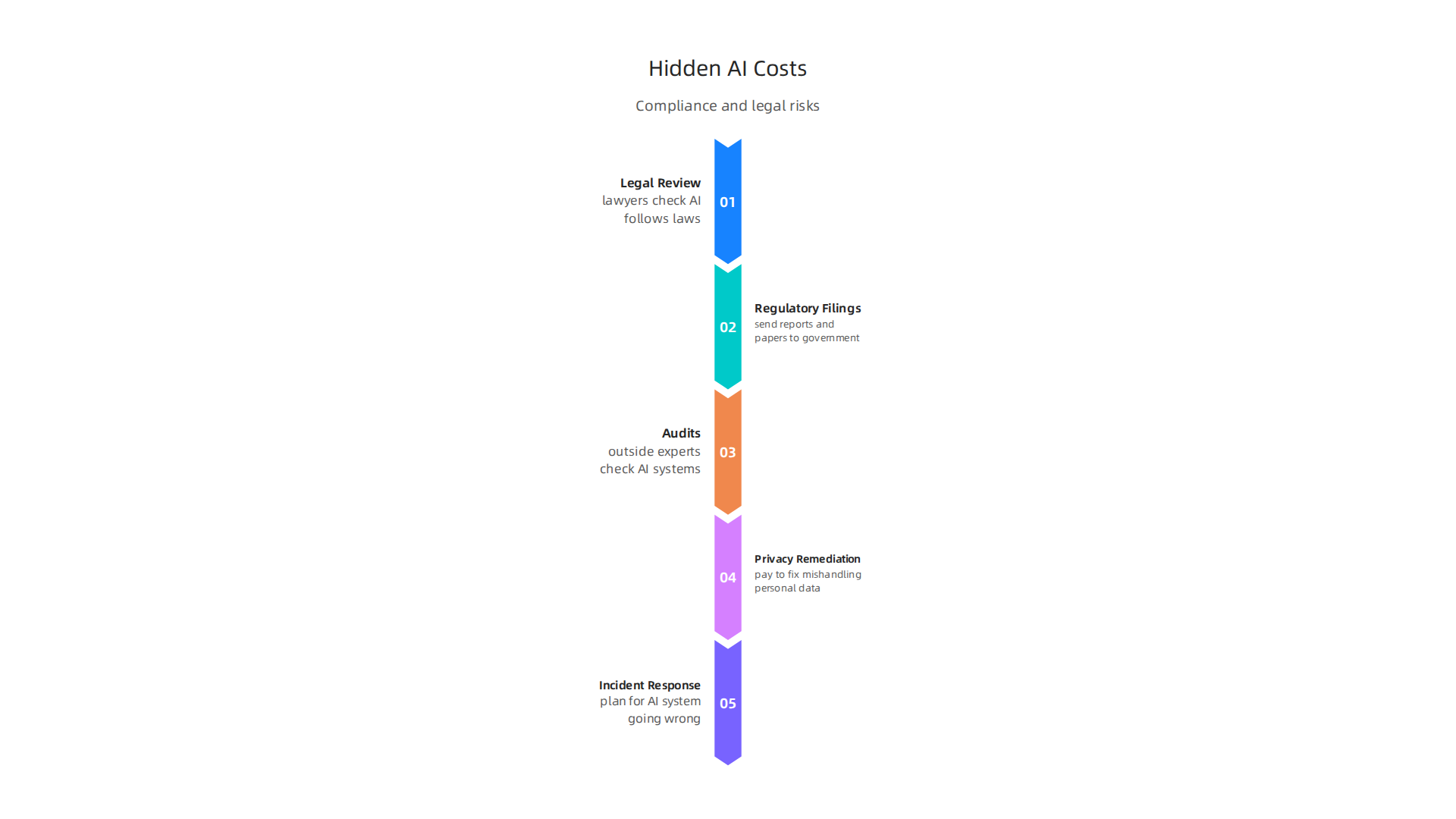
- Legal Review: Before you launch an AI, lawyers need to check it to make sure it follows all the laws. This can cost a lot of money, especially for new AI tech solutions.
- Regulatory Filings: For some AI systems, especially "high-risk" ones, you have to send reports and papers to the government. For example, high-risk AI systems under the EU AI Act can cost around €29,277 each year just for compliance tasks related to things like how robust and accurate they are, human oversight, and keeping good records Enterprise AI Governance Cost 2026: Expert CFO Benchmark.
- Audits: Sometimes, outside experts or government bodies will need to check your AI to make sure it’s working as it should and following all rules. These checks can cost between $25,000 and $150,000 per audit cycle, depending on how complex your AI system is AI Compliance Cost Statistics 2026: How to Cut …. You also need to keep records for these audits, like operational logs for at least six months for high-risk AI systems under the EU AI Act AI Audit Logging: EU AI Act Article 12, ISO 42001 | Claire.
- Privacy Remediation: If your AI accidentally mishandles personal data or makes a mistake that invades someone’s privacy, you’ll have to pay to fix the problem. This could involve changing the AI, telling affected people, and sometimes paying fines.
- Incident Response: What happens if your AI system goes wrong? Maybe it shows bias, makes a big error, or even gets hacked. You need a plan and a budget to respond quickly to these problems. Fixing an AI system that isn’t compliant can cost three to five times more than building it correctly from the start What AI Governance Inaction Actually Costs.
How different rules affect your budget
The cost of compliance can change a lot depending on where you use your AI. Different countries and even different states within a country have their own rules. This is called jurisdictional variation. For example, the EU AI Act is very strict and can mean big fines if you don’t follow it. In 2026, breaking these rules could lead to fines of up to €35 million or 7% of a company’s total yearly earnings, whichever is higher EU AI Act compliance audit log: what regulators expect and ….
Also, the risk of getting caught and punished, known as enforcement risk, affects how much you need to budget. Some areas are more active in checking AI systems and giving out fines. Not having a strong plan for AI governance can lead to huge costs, including regulatory fines, legal settlements, and even lost business because people lose trust in your company. For a mid-sized company, these costs could be tens of millions of dollars The real cost of ignoring responsible AI compliance: Risk ….
To keep your artificial intelligence cost estimation realistic, always remember to include these hidden costs. Ignoring them is like building a house without thinking about the cost of permits or insurance. Companies like ai foundry and deepbrain ai that offer robust tech solutions often have built-in compliance features, but understanding the regulatory landscape is still key for your own planning. Staying on top of these rules is vital for any business in 2026. For more detailed insights into AI regulations, you can learn about how to make an AI compliant with global regulations in 2026.
Staying on top of these rules is vital for any business in 2026. Beyond just following regulations, how you choose to set up and run your AI is another big factor in your overall artificial intelligence cost estimation. Different ways of building and running AI, known as architecture and deployment choices, come with different price tags.
Let’s look at the main ways to deploy AI and how they affect your budget:
How architecture and deployment choices change cost profiles (cloud, edge, on-prem)
When you plan for AI, you have to pick where it will "live" and do its work. Will it be in the cloud, on your own computers (on-premise), or at the "edge" (like on a device)? Each choice changes your costs quite a bit, especially for training your AI and then using it every day (inference).
Cloud-Managed Services
Using cloud services means you rent computing power from big companies like Amazon, Google, or Microsoft.
- Costs: You usually pay for what you use, like hours of GPU time. This can be very flexible because you only pay when you need a lot of power for training a big AI model. For example, in 2026, renting an NVIDIA H100 GPU for training might cost around $3 to $5 per hour on average, though using "spot instances" (which are cheaper but can be taken away) could bring it down to $2 to $3 per hour. Using managed AI platforms from these cloud providers might add an extra 10% to 30% to these costs.
- Benefits: You don’t have to buy expensive equipment upfront. It’s easy to grow bigger or shrink down based on what your AI needs. This is a common choice for many different tech solutions.
- Drawbacks: Over time, these pay-as-you-go costs can add up, especially if your AI is running constantly. You might also find it hard to move your AI to a different cloud provider later, a problem known as "vendor lock-in."
Self-Hosted Clusters (On-Premise)
This means you buy all the computer hardware yourself and set it up in your own data center.
- Costs: The initial cost is very high because you’re buying powerful GPUs and servers. For instance, comparing the total cost of ownership (TCO) between on-premise and cloud for generative AI is a key consideration for many businesses in 2026, as highlighted in a 2026 edition analysis.
- Benefits: Once you own the hardware, the running costs for compute can be lower per hour compared to cloud services. You have full control over your data and AI, which can be important for security or specific compliance needs.
- Drawbacks: You’re responsible for all maintenance, upgrades, and managing the systems yourself. It’s also harder to quickly scale up or down as your needs change.
Hybrid and Edge Deployments
Some companies mix cloud and on-premise, or they run AI directly on devices like phones or smart sensors (this is called "edge" deployment).
- Costs: Hybrid setups try to get the best of both worlds, using the cloud for flexible training and on-prem for stable, everyday use. Edge deployments aim to save costs by running AI closer to where the data is, reducing the need for powerful central servers and internet bandwidth.
- Benefits: Edge AI can make decisions very quickly, which is good for things like self-driving cars.
- Drawbacks: Edge devices usually have less power, so they can only run simpler AI models.
Training vs. Inference Costs
It’s important to remember that the costs for training your AI (teaching it new things) and inference (using it to make predictions) are different. In 2026, the money spent on running AI for everyday use, called inference, has grown a lot. It can be 80% to 90% of a model’s total cost over its lifetime, with companies facing $15 to $20 billion in inference costs for every $1 billion spent on training Inference Economics: AI Agent Compute Markets in 2026. This means that even if training is a big upfront cost, inference costs often become the main expense over time.
Licensing and Vendor Lock-in
Another part of your artificial intelligence cost estimation is software licensing. Some AI models or tools require you to pay for a license to use them. Also, choosing one cloud provider or AI platform can make it difficult to switch later without a lot of effort and expense, which is the "vendor lock-in" we talked about. This affects how much control you have and your long-term budget.
The choice of how to deploy your AI is a big one, impacting not just your current budget but also how flexible and scalable your operations will be in the future. To make smart choices about your AI, it helps to understand all these moving parts. For more ideas on how to use AI wisely, check out our guide for decision-makers on using AI strategically.
Staying informed about these fast-changing costs and options is key. To get clear daily AI updates that help you navigate this complex world, consider subscribing to The AI Newsletter Worth Reading.
Choosing how and where your AI lives is only one part of the puzzle. To truly keep your artificial intelligence cost estimation in check over time, you need a clear plan for managing those costs. This means setting up rules and ways of working that everyone understands.
Operationalizing Cost Estimation: Governance, Templates, and Cross-Functional Workflows
Smart businesses in 2026 know that managing AI costs isn’t a one-time thing. It needs a continuous effort, a bit like keeping a garden tidy. You need a system to make sure costs are estimated correctly, tracked, and updated often. This system is called "governance."
Who Should Be Involved?
For good AI cost governance, different teams need to work together.
- Finance Team: These folks look after the money. They help set budgets, track spending, and make sure that the cost estimates fit with the company’s overall financial goals. They might use tools similar to those for general AI project cost estimation.
- ML Engineering Team: These are the people who build and run the AI. They know exactly what kind of computer power and tools the AI needs, which directly affects costs. They can tell you if an AI foundry or a particular deepbrain AI model needs more powerful GPUs.
- Legal and Compliance Teams: They make sure your AI follows all the rules and laws. Sometimes, staying compliant means using specific, more expensive tools or data handling methods. Their input is key to avoiding hidden fines, which can impact the total cost of ownership for AI.
Having these teams work together means that everyone has a say and understands the cost choices. This makes artificial intelligence cost estimation more accurate and stops surprises later on.
Using Templates for Smart Estimates
To make sure cost estimates are always done the same way and are easy to update, using templates is a great idea. These templates are like checklists that help you cover all the important parts of AI spending.
A good template should:
- List all the parts of your AI project, from setting it up to running it every day.
- Help you track costs for training, inference, data storage, and software licenses.
- Allow you to plan for different scenarios, like if you need more powerful AI or if you want to try out a new feature.
Many companies in 2026 use AI cost estimation templates to help budget for AI features. These templates help you revisit your estimates as your project changes or as new technology comes out. For example, when your AI project reaches a new milestone, you can quickly update the numbers in your template to see how the costs look. This makes sure your budget stays realistic. Keeping your corporate AI strategy aligned with these costs is essential. You can learn more about this by exploring how to integrate regulatory compliance into your corporate AI strategy.
Making sure your AI projects follow all the rules is a big part of keeping artificial intelligence cost estimation realistic. In 2026, many new laws and guidelines affect how AI is built and used. Ignoring these rules can lead to huge fines, which can quickly make any project much more expensive than planned. So, smart businesses translate these legal needs into clear budget items from the start.
Budgeting for Regulation: Auditability, Documentation, and Future-Proofing Costs
Regulatory needs mean you have to plan for specific costs. Think of these as investments that save you from bigger problems later.
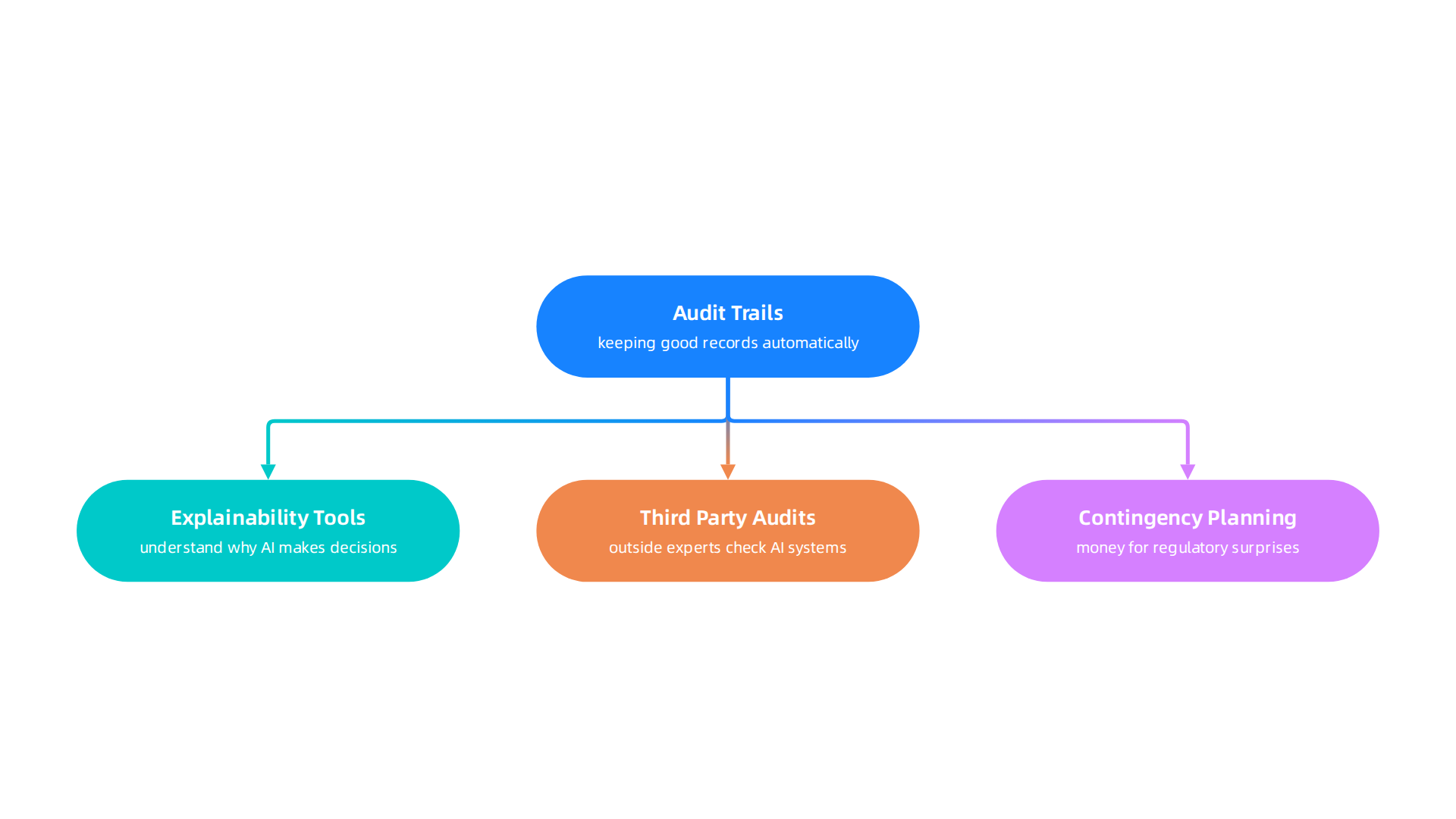
Logging and Audit Trails
One of the most important parts of AI regulation is being able to show how your AI works and what it does. This means keeping good records, also known as audit trails or logs. Many laws require this. For example:
- The EU AI Act says that high-risk AI systems must automatically record events for at least six months, and sometimes longer, up to ten years for technical documents, to let people check them later on EU AI Act compliance audit log: what regulators expect and….
- For financial services, logs need to capture details like when the system was used and what data it looked at AI Audit Trail in Financial Services: What to Log, How Long….
- Other rules, like SOX, HIPAA, and PCI DSS, also have their own strict timelines for keeping logs, from 12 months up to 7 years AI Audit Trail Requirements: A 2026 Compliance Checklist.
Keeping these logs means paying for storage and specialized tech solutions that can collect and manage all this information. This directly impacts your artificial intelligence cost estimation.
Explainability Tools and Data Retention
Sometimes, you don’t just need to know what your AI did, but why it did it. This is called "explainability." Tools that help explain AI decisions are becoming very important for compliance. Budgeting for these tools can help ensure your AI systems are understandable and can be checked by human oversight. You can learn more about this by understanding explainable AI for 2026 compliance and executive trust.
Data retention is another key area. Regulations often tell you how long you must keep the data used by your AI, both for training and during operation. This means you might need to budget for:
- More data storage.
- Secure systems to protect that data.
- Ways to easily get that data when an audit happens.
Third-Party Audits
Many businesses choose, or are required, to have outside experts check their AI systems. These "third-party audits" make sure your AI is fair, safe, and compliant. The costs for these audits can be significant, ranging from $25,000 to $150,000 per check, depending on how complex your AI systems are AI Compliance Cost Statistics 2026: How to Cut…. For a high-risk AI system under the EU AI Act, the yearly cost just for following the rules can be about €29,277 per model Enterprise AI Governance Cost 2026: Expert CFO Benchmark. Overall, the compliance costs for the EU AI Act alone can be between EUR 320,000 and EUR 600,000 for high-risk systems Compliance costs of the AI Act | E-001210/2026.
Contingency Planning and Insurance
What if a new rule comes out that changes everything? Or what if your AI accidentally breaks a rule? It is smart to set aside money for "contingency." This is like a rainy-day fund for regulatory surprises. It can cover things like unexpected legal advice, fines for non-compliance, or the cost to quickly update your AI. You might even consider insurance that helps with regulatory risks. These steps are part of future-proofing your artificial intelligence cost estimation. Knowing how to AI regulation 2026 navigate compliance and avoid risks is very important.
Staying on top of these fast-changing rules and their financial impacts can be tough.
Get clear daily AI updates from The AI Newsletter Worth Reading.
Staying on top of these fast-changing rules and their financial impacts can be tough. So, let’s look at how these costs and risks play out in real situations for different types of businesses. This helps investors and technology leaders truly understand artificial intelligence cost estimation.
Practical Scenarios and Case Studies for Investors and Technology Leaders
Understanding AI costs changes based on how far along your AI project is. What might seem like a small cost for a test project can become a huge problem for a company-wide system.
Early-Stage Proof of Concept (PoC)
At the very beginning, when a company is just trying out an AI idea, the costs seem low. This is like building a small model car to see if the engine works. For a proof of concept (PoC), you might spend money on:
- Small-scale data: Getting just enough data to train a basic AI.
- Simple tools: Using easy-to-access AI development tools.
- Basic computing power: Not needing a lot of expensive hardware.
The biggest risk here isn’t the direct cost, but ignoring future compliance. If this PoC turns into a real product, those small choices can lead to big problems later. Investors looking at these early projects will want to see that the team has at least thought about future rules. They want to know the team understands that artificial intelligence cost estimation will grow significantly as the project scales.
Scale-Up Pilot Project
When a company decides the PoC works and wants to test it on a larger scale, it becomes a "pilot project." This is like building a bigger, working prototype. Now, the costs for AI grow much faster.
- More data and storage: You need larger, cleaner datasets and secure places to keep them.
- Better tech solutions: You’ll invest in more robust AI platforms and tools, perhaps from an AI foundry, to manage complex AI models.
- Initial compliance checks: You might start doing basic checks to make sure your AI isn’t unfair or causing harm.
For investors, this stage is critical. They’ll look closely at how the company plans to meet regulations. If a pilot project gets it wrong, fixing it can be very costly. In fact, if an AI system is found to be out of line with rules, fixing it can cost three to five times more than if it was built correctly from the start, as highlighted in "What AI Governance Inaction Actually Costs" What AI Governance Inaction Actually Costs. This is where companies must plan for responsible AI.
Full Enterprise Deployment
When an AI system is rolled out across a whole company, the artificial intelligence cost estimation changes completely. This is the big league, where millions can be at stake.
- Deep compliance costs: This includes continuous monitoring, regular audits, and possibly using advanced tools like those from deepbrain ai to ensure the AI behaves correctly and transparently.
- Legal and insurance: Companies need specialized legal advice and even insurance against AI risks, as discussed in "Balancing the promise and peril of AI in insurance" Balancing the promise and peril of AI in insurance.
- Huge potential fines: Breaking AI rules at this stage can lead to very large fines. Some EU AI Act violations can result in penalties up to €35 million or 7% of a company’s total yearly earnings, whichever is higher The Cost of Inaction: AI Risk Assessment vs. Fines – Elevate Consult. For example, compliance failures in financial services can lead to an average cost of $14.8 million, covering direct penalties, legal costs, and reputational damage The $14.8M Problem: What Compliance Breaches Actually Cost ….
Investors doing their homework will make sure companies have strong AI governance plans and enough money set aside for potential risks. They know that ignoring these issues can lead to "AI washing" where companies pretend to be compliant but aren’t, which can result in significant penalties, even up to $250,000 for civil penalties AI Washing 2026: SEC Marketing Rule and Enforcement …. To learn more about navigating these complex rules, explore our guide on how to make an AI compliant with global regulations in 2026.
It’s clear that careful planning and budgeting for compliance from the start are key to success with AI, no matter the project size.
Summary
This article explains how to produce a realistic artificial intelligence cost estimation by breaking down the full set of expenses businesses face in 2026. It walks through the main cost drivers — data collection and labeling, training and inference compute, specialized talent, and software/licensing — then shows how to separate upfront investments from ongoing operational costs. You’ll learn practical estimation approaches (top-down for quick ballparks and bottom-up for detailed budgets), common techniques like per-epoch and per-inference costing, and concrete examples of training price ranges. The piece highlights frequently overlooked compliance costs — audits, legal review, logging, explainability tools, and jurisdictional variance — and explains how architecture choices (cloud, on-prem, hybrid, edge) change cost profiles. Finally, it gives governance advice: who should be involved, what templates to use, and how to budget for future regulatory shifts so investors and leaders can make informed, risk-aware decisions about AI projects.