
Introduction: Understanding the Regulatory Crossroads
The US tech sector is standing at a major turning point. In 2026, new rules around data privacy, artificial intelligence, antitrust enforcement, and industry-specific regulations are reshaping how companies operate. Whether you lead a startup or manage compliance for a global enterprise, keeping up with these changes can feel overwhelming.
Here is the real challenge. Information comes from dozens of sources, and it is scattered across government websites, legal journals, news outlets, and industry reports. Most decision makers simply do not have the time to track every update across every jurisdiction. And the cost of missing something? That can mean steep fines, legal trouble, or lost market access.
This is especially true for companies exploring new US tech solutions and emerging technologies. Firms like Pax Technology, Zev Technologies, Poet Technologies, and West Tech all face growing compliance demands that vary from state to state and country to country. The regulatory landscape is no longer something you check once a quarter. It changes weekly.
That is why this guide exists. We have pulled together a structured, multi-jurisdictional overview of the key regulatory areas you need to watch in 2026. Think of it as your map through the maze.

According to recent analysis of 2026 technology industry trends, compliance, AI governance, and data security are top priorities for the year ahead.

This guide covers all of them.
We will walk through the major rule changes, highlight what they mean for your business, and offer practical steps you can take right now. No fluff. No jargon. Just clear, actionable help.
If you want to stay ahead of the daily shifts, consider getting The Deep View Newsletter for clear daily AI updates that cut through the noise.
And for a deeper look at specific compliance strategies, check out our guide on AI compliance strategies to avoid fines. It breaks down exactly what the new rules require and how to meet them without slowing down your business.
Let us start with the biggest regulatory shift of 2026, the one affecting nearly every company using data or algorithms.
The Shifting Regulatory Terrain for US Tech Companies in 2026
For any US tech solutions provider, from startups to established enterprises, the regulatory terrain has changed dramatically in 2026. Federal agencies are stepping up oversight, and states are passing their own laws faster than ever. The result? A compliance map that changes by the week.
Federal Agencies Are Expanding Their Reach
The Federal Trade Commission (FTC) is going after AI and data practices more aggressively. The Federal Communications Commission (FCC) is looking at how telecom and tech companies handle network security and consumer data. And the Consumer Financial Protection Bureau (CFPB) is now watching how algorithms affect lending and credit decisions.
What does this mean for your business? More reporting, more audits, and more scrutiny. If you use any automated system that makes decisions about people, you need to pay attention. Every new mandate adds layers of cost and complexity.
State Laws Create a Compliance Patchwork
States are not waiting for the federal government. California and New York are leading the charge with new AI safety laws. California’s SB‑53 and New York’s RAISE Act both require companies to follow strict rules when developing or using advanced AI models. These are not small changes. They require transparency reports, risk assessments, and safety frameworks.
According to a detailed analysis of State AI Safety Laws: California and New York from KPMG, companies that operate across state lines now face different requirements in each jurisdiction.
What works in California may not satisfy New York, and vice versa.
The impact goes beyond AI. Starting January 1, 2026, a whole new set of California laws took effect covering tech, health care, and workplaces. New York is also examining data center impacts with a bill that could affect companies like Pax Technology and Poet Technologies that rely on large computing infrastructure.
The Federal vs. State Divide
Here is the tricky part. The federal government and states are not always on the same page. Some federal agencies want lighter rules, while states push for stricter ones. This creates real confusion for businesses.
Companies like Zev Technologies, West Tech, and Poet Technologies each face different rules depending on where they operate. A law in New York might not apply in Texas, but your systems need to handle both. As state AI legislation continues to diverge, staying on top of every change has become a full-time job.
Practical Steps to Stay Ahead
So what can you do? First, map out every state where you have customers or operations. Then check what AI and data laws are already in place or coming soon. For a deeper dive, read our guide on AI compliance strategies across states. It covers exactly how to handle the patchwork.
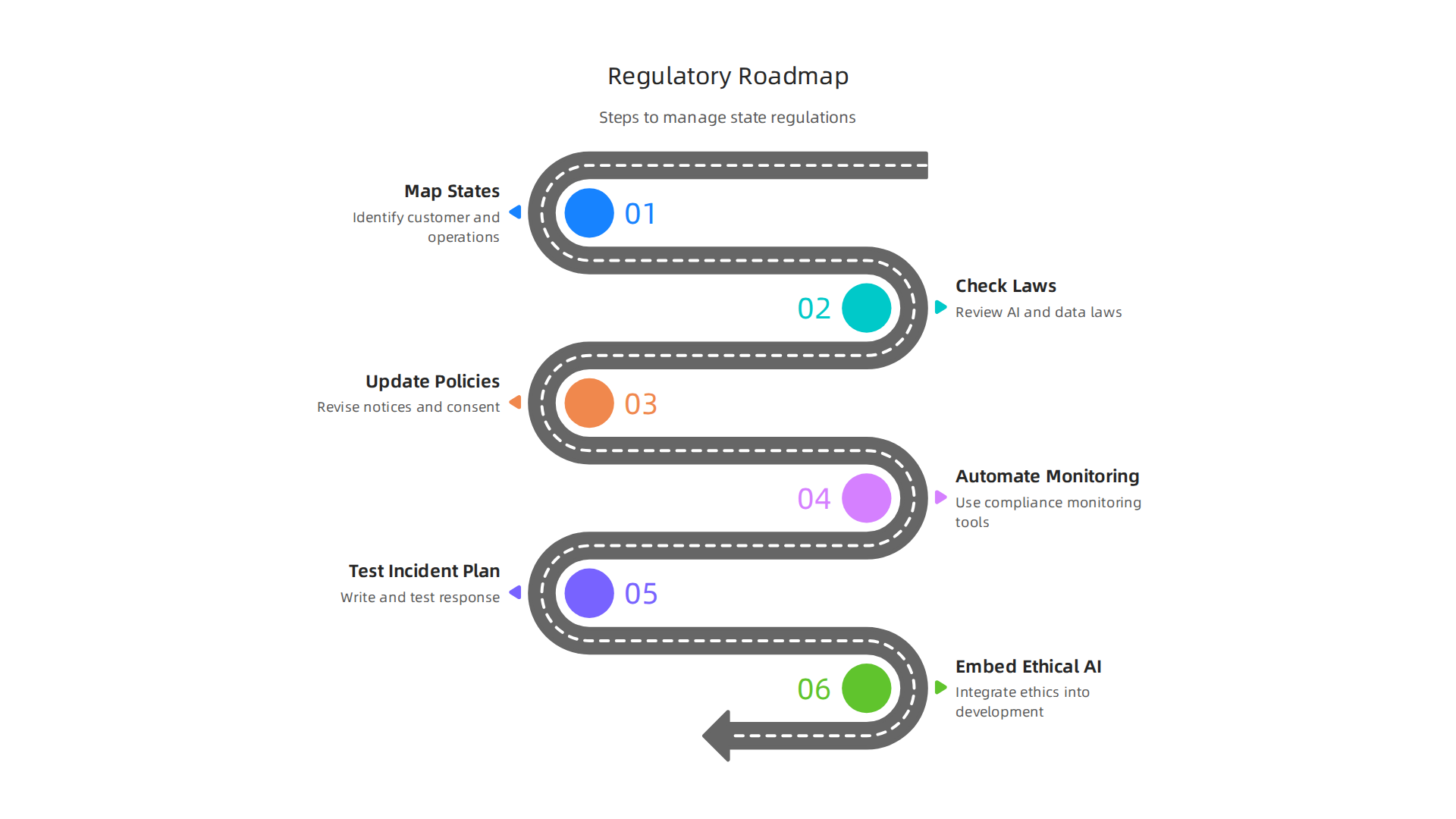
Second, build a team or process that watches these changes weekly. Regulation moves fast. A law that passed in June might be in effect by January. You cannot check once a quarter and stay safe.
Finally, look for tools that automate compliance monitoring. If your company deals with biometric data or identity tech, the id tech privacy regulations in 2026 article explains what new strategies you need.
The terrain is shifting. But with the right map, you can navigate it.

Data Privacy and Security: Navigating New Obligations
Now let’s talk about data privacy and security. Because even if your AI systems are perfect, your data practices can still get you into trouble.
The regulatory picture for data privacy in 2026 is clear: states are taking the lead, and they are not slowing down. While the US still does not have a national comprehensive privacy law, the state-level patchwork keeps growing. By early 2026, 20 states have comprehensive privacy laws in effect, according to a detailed breakdown of the 20 State Privacy Laws in Effect in 2026. That number keeps climbing.
Three new state laws took effect on January 1, 2026: Indiana, Kentucky, and Rhode Island. Each brings its own twist. Texas and Florida passed laws earlier. Oregon’s law is active too. So if your company operates in any of these states, you have new compliance work to do.
What These Laws Require
Most state privacy laws give consumers rights to know what data you collect, to delete it, and to opt out of sale or sharing. Some go further. For example, some states require data protection assessments for high-risk processing. Others impose specific consent rules for sensitive data.
The big challenge? Each state has different definitions, exemptions, and deadlines. What counts as "sensitive data" in California may not match Texas. And the penalties vary too. State attorneys general are getting more aggressive with enforcement. A recent update on Data Privacy in 2026: State Enforcement Takes Center Stage shows that regulators are not just writing rules — they are actively fining companies that slip up.
Federal Privacy Legislation: Still Stalled
You might wonder why Congress has not passed a single national privacy law. The answer is complicated. Different industries, different political priorities, and different views on how strong the law should be. In 2026, there is still no comprehensive federal data privacy law in place. The sector-specific rules (like HIPAA for health data and GLBA for financial data) still apply, but they leave huge gaps.
This means companies have to follow multiple state laws instead of one national standard. If you are a us tech solutions provider serving customers across the country, you need to comply with every state where your users live. That is a lot of legal homework.
Cybersecurity Rules Add More Pressure
Data privacy is only half the picture. Security obligations are also tightening.

The SEC’s cybersecurity rules for public companies now require rapid disclosure of material incidents. Public companies must report breaches within four business days after determining they are material.
State breach notification laws are updating too. Many states now require faster notifications and broader definitions of what counts as personal information. Some states demand that you notify the attorney general if a certain number of residents are affected.
For companies like Pax Technology, Zev Technologies, West Tech, and Poet Technologies, this means you need to have incident response plans ready before something happens. Waiting until after a breach is too late.
Practical Steps for Your Data Privacy Program
So what can you do right now? First, map all the states where you have customers or collect data. Then check which state privacy laws apply to you. Use a tracker like the IAPP US State Privacy Legislation Tracker to stay current.
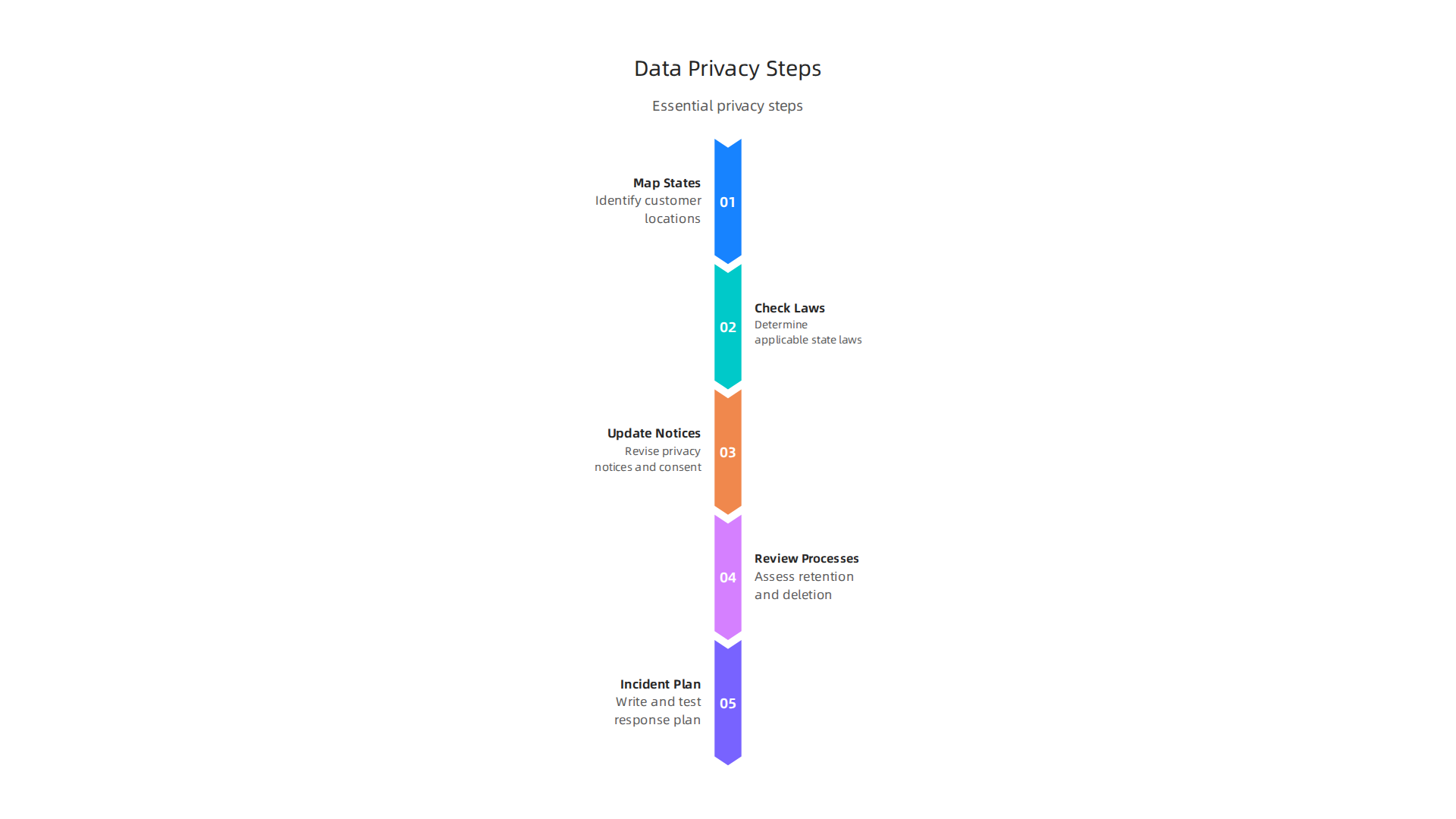
Second, update your privacy notices to cover every applicable state law. Make sure your consent mechanisms work for different jurisdictions. Review your data retention and deletion processes.
Third, get your security incident response plan in writing. Test it with drills. Make sure your team knows how to report a breach to regulators and affected users within the required timeline.
For a deeper look at how other companies handle these overlapping demands, read about Palantir’s data privacy compliance approach. It shows how even large enterprises have to build systems that satisfy multiple privacy frameworks at once.
One Way to Stay Ahead
The regulatory landscape changes fast. New state laws pass, enforcement actions happen, and breach notification rules shift. You need a reliable source of daily updates.
That is why many compliance leaders subscribe to The AI Newsletter Worth Reading. It delivers clear, timely updates on AI rules, privacy changes, and tech regulation so you do not miss critical deadlines. Staying informed is the first step to staying compliant.
AI Governance and Ethical AI Standards
Data privacy was one thing. Now let’s talk about the rules for the technology itself. AI governance is the next big wave of regulation hitting your desk.
The year 2026 is shaping up to be a turning point for AI rules in the US. There is still no single federal AI law. But that does not mean the rules are absent. Far from it. A mix of federal guidance, state laws, and industry frameworks is building a complicated compliance landscape for every us tech solutions company.
The NIST AI Risk Management Framework Is the Baseline
The National Institute of Standards and Technology released its AI Risk Management Framework (AI RMF) a couple of years ago. In 2026, it has become the de facto standard for how federal agencies and many large companies approach AI risk.
Think of the NIST AI RMF as a playbook. It helps you identify risks, measure them, and manage them throughout the lifecycle of an AI system. It covers things like bias, transparency, accountability, and security. Many state laws and federal guidance documents now point directly to the NIST framework as the recommended approach.
If your company uses AI for anything important, you should study the NIST AI RMF. It gives you a structured way to prove you are being careful. And regulators are starting to expect it.
States Write Their Own AI Rules
While Washington debates, states are acting. California, Colorado, Texas, and Illinois now have active AI laws on the books. According to a detailed overview of the US AI regulations 2026 landscape, these state rules cover everything from algorithmic bias audits to disclosure requirements when AI interacts with consumers.
Colorado’s AI law is one of the most notable. It requires companies that deploy high-risk AI systems to conduct impact assessments and tell consumers when they are interacting with AI. California’s proposed rules go even further, focusing on transparency and accountability for automated decision-making tools.
The pace is staggering. As of March 2026, state lawmakers in 45 states had already introduced over 1,500 AI-related bills, according to the State AI Legislation Tracker 2026.
That means almost every state in the country is thinking about AI rules. For companies like Pax Technology, Zev Technologies, West Tech, and Poet Technologies, this means tracking legislation in every state where you operate or sell.
Federal AI Legislation: Still Uncertain
What about a national AI law? The Federal Algorithmic Accountability Act has been proposed multiple times in Congress. So far, it has not passed. The main sticking points are how strong the requirements should be and which agencies should enforce them.
The White House did release a National AI Legislative Framework in March 2026. This document outlines policy recommendations but does not carry the force of law. It signals what the administration wants, but Congress still has to act.
For now, the federal approach relies on executive orders and existing agency powers. The Federal Trade Commission uses its authority to go after deceptive AI practices. The Equal Employment Opportunity Commission focuses on AI bias in hiring. The Consumer Financial Protection Bureau watches AI in lending decisions. Each agency is building its own rules piece by piece.
If you want a deeper understanding of how these overlapping rules affect daily operations, check out this guide on how to make an AI compliant with global regulations in 2026. It walks through the practical steps for aligning with both state and federal expectations.
What Ethical AI Standards Look Like in Practice
Ethical AI is not just a buzzword anymore. It is becoming a compliance requirement. Most state laws and the NIST framework agree on a few core principles:
- Transparency: Tell people when they are interacting with AI
- Fairness: Test for bias in outcomes across different groups
- Accountability: Have a human responsible for AI decisions
- Safety: Ensure AI systems do not cause harm
- Privacy: Protect the data used to train and run AI models
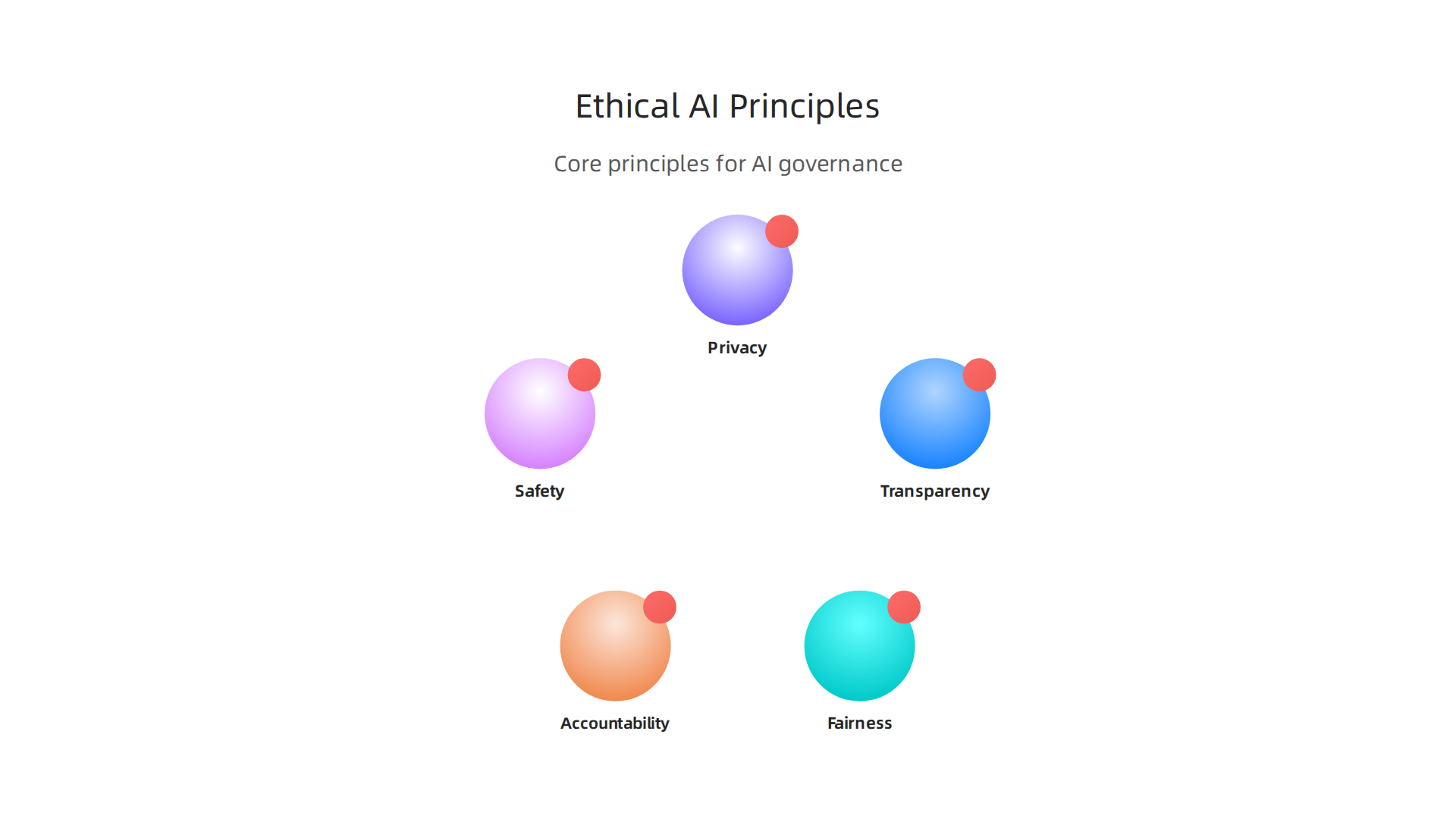
Building these principles into your product development process is the smartest move you can make.

It is much cheaper to design for compliance from the start than to fix problems after a regulator comes knocking.
The regulatory picture for AI in 2026 is complex but navigable. Start with the NIST framework. Watch the states where you operate. And keep one eye on Washington, even if progress is slow. The companies that take AI governance seriously now will be the ones that thrive when the rules tighten further.
Antitrust and Competition Policy for Tech Giants
From AI rules to market rules. While you work on AI governance, the government is also taking a hard look at who controls the digital marketplace. The year 2026 is a critical moment for antitrust enforcement against the biggest names in tech.
The Department of Justice and the Federal Trade Commission have major cases moving through the courts right now. The outcomes could change how every us tech solutions company does business.
The Google Antitrust Case Is the Biggest
The most watched battle is the DOJ’s case against Google. In August 2024, a federal court ruled that Google is a monopolist in online search. That was a landmark decision. Judge Amit Mehta found that Google broke antitrust law by paying billions to phone makers and browsers to make its search engine the default choice. You can read the full background on the United States v. Google LLC antitrust case to understand how we got here.
The remedies trial finished in late 2025. The DOJ has proposed some serious fixes. One idea forces Google to sell off parts of its ad tech business. Another requires Google to share its search data with competitors. Both sides filed final briefs in early 2026, and a decision is expected soon.
Google is not giving up. In May 2026, the company filed an appeal. According to recent reporting, Google appeals its search monopoly ruling in a case that could take years to fully resolve. But the message from the court is already clear. Monopoly behavior in tech will not go unchecked.
What This Means for Other Tech Companies
The Google case is not the only one. The FTC has an active lawsuit against Meta over its past acquisitions of Instagram and WhatsApp. Amazon is also facing antitrust scrutiny from both the FTC and several states.
These cases all target the same idea. Big platforms used their market power to squash competitors. And they all could lead to forced breakups or new rules about how platforms operate.
For smaller us tech solutions companies, this creates both risk and opportunity. The risk is that your business could get caught up in broader regulatory changes. The opportunity is that a more level playing field could open doors that were previously blocked.
Proposed Legislation Could Change Everything
Beyond court cases, Congress is still talking about the American Innovation and Choice Online Act. This bill would stop dominant platforms from favoring their own products over competitors. Think of Apple promoting its own apps in the App Store or Amazon ranking its own products above third-party sellers.
The bill has bipartisan support but has not passed yet. If it does, it would reshape how app stores work, how platforms rank products, and how big tech runs its marketplaces. Companies like Pax Technology, Zev Technologies, West Tech, and Poet Technologies need to watch this closely.
Practical Steps for Your Business
Antitrust enforcement also affects mergers and acquisitions. The FTC and DOJ have been much tougher on tech deals in recent years. If you are planning an acquisition or investment, expect more scrutiny than ever.
Staying on top of all these overlapping regulatory changes is a challenge. One smart way to stay informed is to attend top tech events in NYC 2026 where experts break down the latest antitrust developments and what they mean for your business.
The antitrust landscape in 2026 is reshaping the entire tech industry. Whether you are a startup or an established player, understanding these cases and laws is essential for planning your next move.
To stay on top of these fast-moving developments, consider subscribing to The AI Newsletter Worth Reading. Get clear daily AI updates from The Deep View Newsletter delivered straight to your inbox.
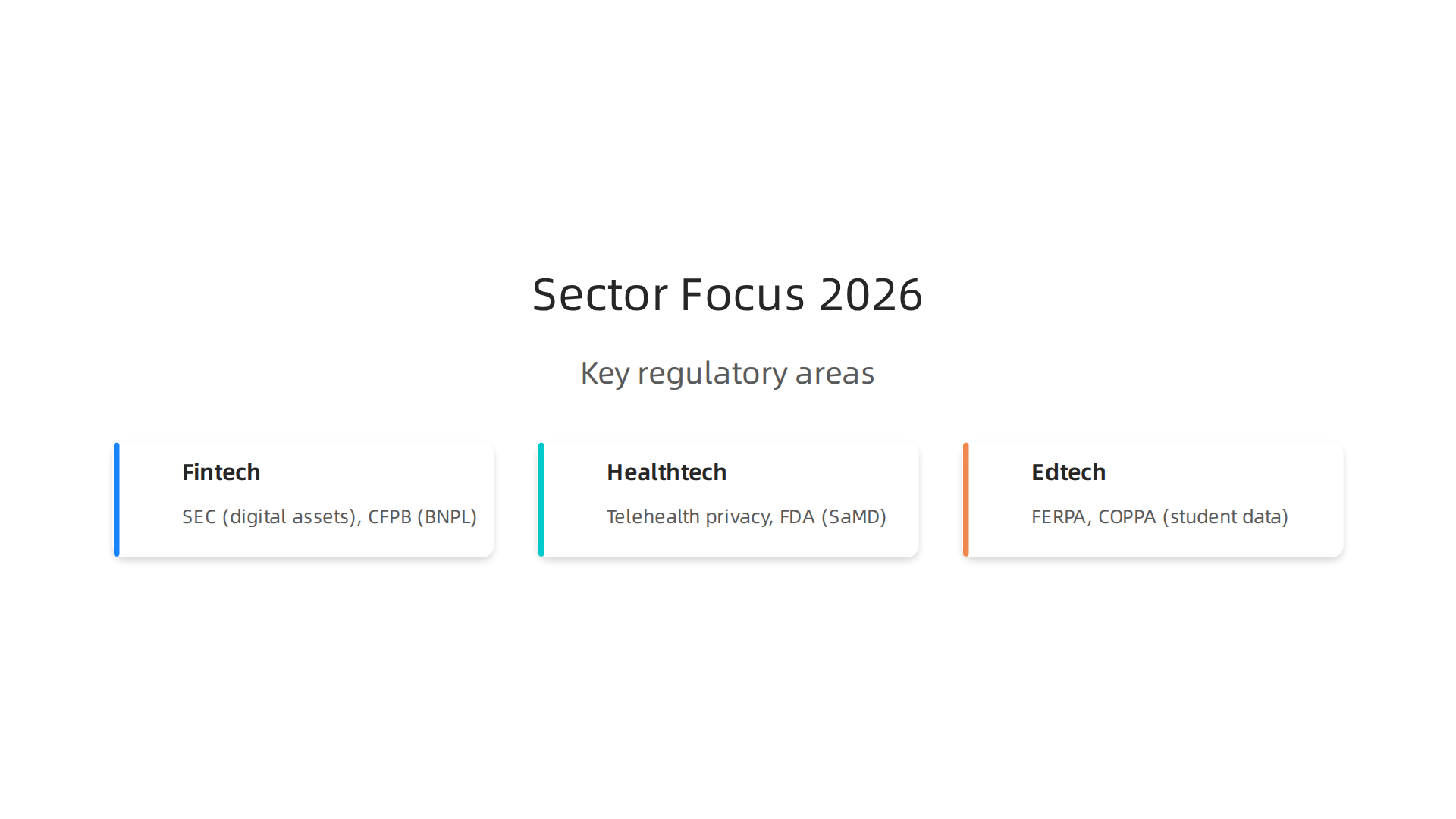
Sector-Specific Regulations: Fintech, Healthtech, and Edtech
The antitrust battles from the last section show us that big tech is in the spotlight. But the rules do not stop there. Every tech sector has its own watchdogs, and 2026 is a busy year for them all.
Let us look at three specific industries where the regulatory pressure is rising fast.
Fintech: SEC and CFPB Turn Up the Heat
If you work in financial technology, you are dealing with two powerful agencies right now. The Securities and Exchange Commission (SEC) is going after digital assets and crypto platforms. The Consumer Financial Protection Bureau (CFPB) is focused on buy now, pay later (BNPL) services and open banking rules.
The SEC has argued that many crypto tokens are securities. That means exchanges that list them must register or face penalties. Meanwhile, the CFPB wants BNPL lenders to follow the same rules as credit card companies. That includes giving consumers the right to dispute charges.
Companies like Pax Technology must track these changes closely. A single rule change can affect how you handle payments, store customer data, or report transactions. The fines for getting it wrong can run into millions.
Healthtech: Telehealth Privacy and Software as a Medical Device
Healthtech companies face a double challenge. First, telehealth privacy rules are getting stricter. States like California and New York have passed laws that go beyond federal HIPAA standards. These new laws require stronger consent from patients before sharing health data. You can read about the state privacy laws taking effect in 2026, including Indiana, Kentucky, and Rhode Island, that affect health data in this state privacy law overview.
Second, the FDA keeps updating its rules for software as a medical device (SaMD). AI tools that help doctors diagnose diseases or recommend treatments now need FDA clearance before hitting the market. That creates a longer and more expensive path to launch. Companies like Zev Technologies that work in defense health systems and West Tech that builds medical devices must build compliance into their product design from day one.
Edtech: FERPA and COPPA Enforcement Is Real
Education technology companies collect massive amounts of data on students. That data includes grades, behavior, and even biometric information. Two federal laws control this space: FERPA (Family Educational Rights and Privacy Act) and COPPA (Children’s Online Privacy Protection Act).
In 2026, enforcement is stronger than ever. The Federal Trade Commission has fined edtech companies for selling student data without proper consent. States are also passing their own rules. California’s new laws for 2026 bring more limits on how schools and edtech providers can use student information, as covered in the California laws taking effect in 2026.
Any us tech solutions company operating in the edtech space needs a clear data privacy policy and a plan for how to delete student data when asked.
The Cross-Sector Reality
Here is the thing. These sector-specific rules are not happening in a vacuum. They all sit on top of the broader state privacy laws we discussed earlier. By 2026, twenty states have comprehensive privacy laws in effect. That means every tech company, whether fintech, healthtech, or edtech, must comply with multiple sets of rules at once.
To make sense of all these overlapping regulations, compliance teams need a clear strategy. A good place to start is this guide on AI regulations and compliance strategies for 2026 that breaks down the steps you can take today.
The bottom line: ignoring sector-specific rules is not an option. The agencies are watching, the fines are real, and the best defense is a proactive compliance plan.
Summary
This article maps the fast-changing regulatory landscape facing US tech companies in 2026, covering federal agency action, an expanding patchwork of state AI and privacy laws, antitrust enforcement, and sector-specific rules for fintech, healthtech, and edtech. It explains why the mix of FTC, FCC, CFPB and state regulators matters, how the absence of a comprehensive federal privacy law shifts the burden to state rules, and why the NIST AI Risk Management Framework is now a practical baseline for AI governance. The guide walks through concrete steps: map jurisdictions where you operate, adopt standardized risk assessments, update privacy notices, run incident-response drills, and consider tools that automate monitoring. It also outlines how antitrust cases and agency enforcement change merger review and platform behavior, and why designing for compliance from product inception is cheaper than retrofits. Readers will finish able to prioritize immediate compliance tasks, plan resources and drills, and choose next-readings and tools to stay current as rules evolve weekly.