

Introduction: Why Understanding AI Foundations Matters
You ask your phone for the weather. You let an app suggest your next movie. You trust a tool to write a draft email. Artificial intelligence powers all of these things. But here is the strange part. Most people have no idea how any of it actually works.
That is becoming a real problem. AI is no longer just a cool feature in a product. It is reshaping entire industries. Business leaders make decisions about AI every day.

Regulators write rules that affect millions. Investors bet billions on AI companies. Yet the foundational concepts behind this technology remain a mystery to many of the people making those calls.
Understanding artificial intelligence a modern approach prerequisites is not just for computer science students anymore. It matters for executives, compliance teams, and policy watchers too. The history of artificial intelligence from IBM shows how far the field has come since the Dartmouth workshop in 1956. Today’s AI systems build on decades of research in mathematics, statistics, and computer science. You do not need to be a mathematician to grasp the basics. But you do need a working knowledge of how machines learn, make decisions, and sometimes fail.
A modern approach to AI asks you to pull together several areas. You need some math to understand probability and optimization. You need statistics to make sense of data and uncertainty. You need computer science to know how algorithms work. And you need domain knowledge to apply AI wisely in your own field. This mix of skills is what the phrase "artificial intelligence a modern approach prerequisites" really points to. It means building a complete picture, not just learning one piece. For a deeper look at how these concepts connect to real business and regulatory decisions, check out this AI modern approach compliance roadmap.
This understanding is not optional anymore. Terms like agentic ai definition are entering boardroom conversations. Concepts like superhuman ai spark both excitement and fear. Technologies such as the google quantum computer promise to change what AI can do. And new regulations in 2026 demand that leaders understand AI systems well enough to govern them responsibly.
If these topics feel new or overwhelming, you are not alone. The field moves fast. But the rewards for getting the basics right are huge. You make smarter decisions. You reduce compliance risk. You spot opportunities others miss. For clear daily updates on AI developments and regulatory changes that affect your work, check out the AI Newsletter Worth Reading.
The Evolution of AI: From Symbolic Reasoning to Deep Learning
To understand where AI is today, it helps to see how it got here. The journey from symbolic reasoning to deep learning tells the story.
And it is a story every leader needs to know if they want to grasp the artificial intelligence a modern approach prerequisites for 2026.
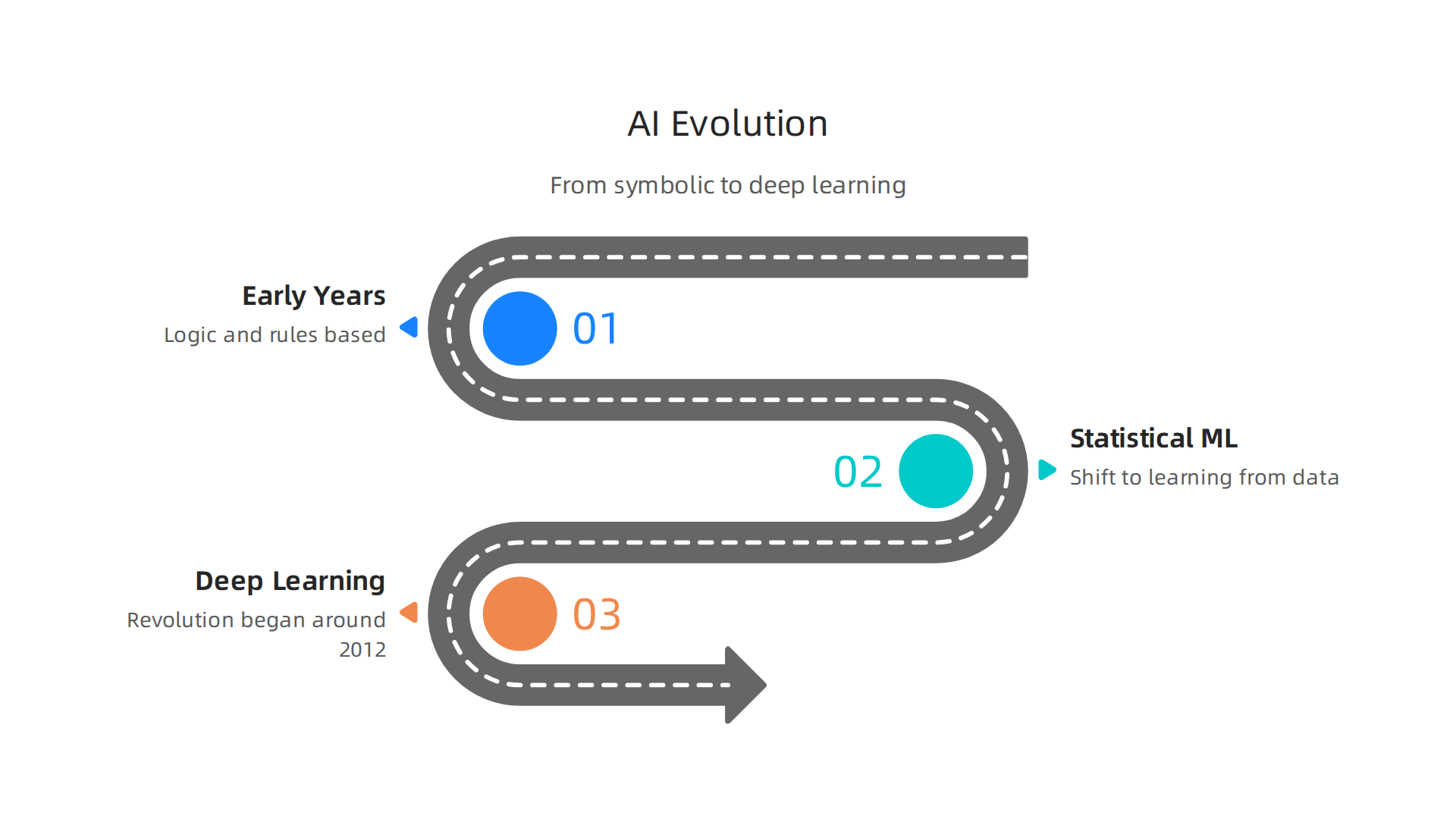
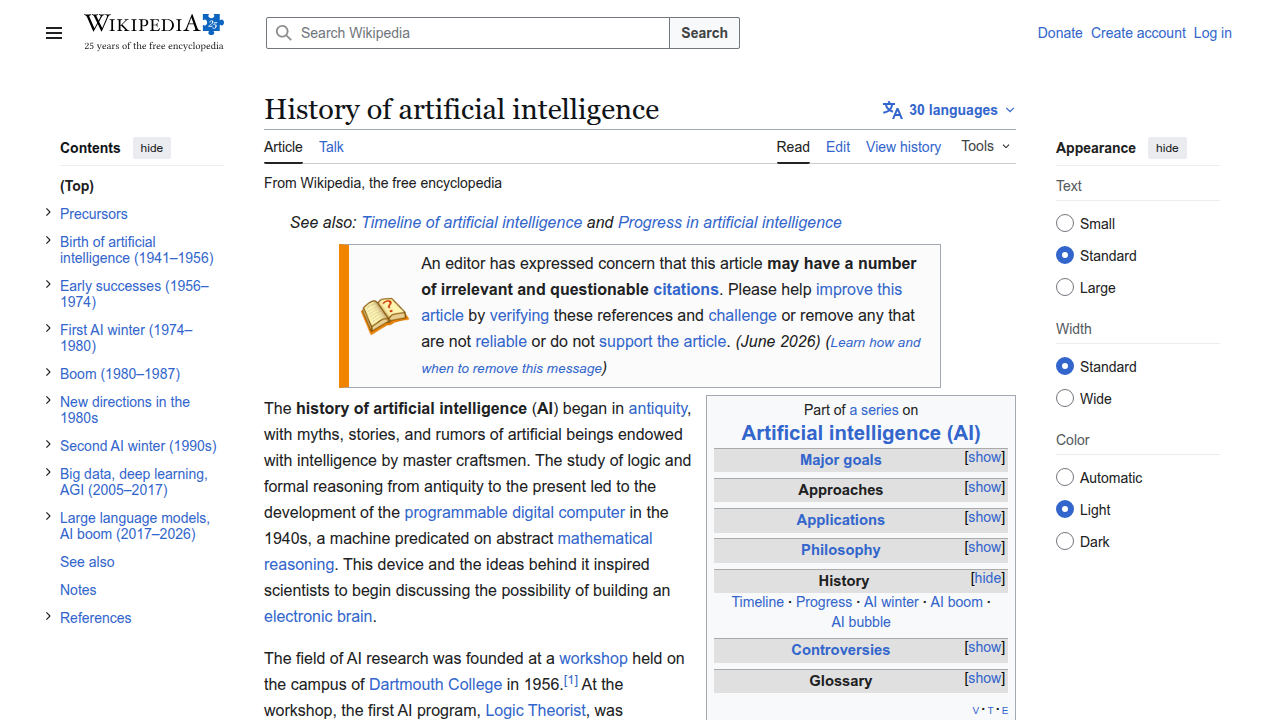
The early years were all about logic and rules. In 1956, a group of researchers met at Dartmouth College to launch "artificial intelligence" as a field. They believed intelligence could be programmed using clear symbols and logical steps. Programs like the Logic Theorist could prove math theorems. Later, in 1966, MIT created ELIZA, a chatbot that used simple pattern matching to pretend it understood you. These systems were impressive for their time, but they had a major limit. They could only handle problems someone had manually coded as rules. Real-world situations were just too messy for that approach. For a more detailed look at those foundational years, the History of artificial intelligence on Wikipedia covers the key early moments.
Then came the shift to learning from data. By the 1980s and 1990s, researchers realized that giving machines rigid rules would never be enough. They needed to let machines learn from examples instead. This was the rise of statistical machine learning. One big breakthrough came when Judea Pearl introduced Bayesian networks, which let AI handle uncertainty by calculating probabilities. At the same time, Yann LeCun and his team at AT&T Bell Labs showed that backpropagation could train neural networks to recognize handwritten ZIP codes. That was one of the first practical uses of deep learning, years before the term became popular. IBM’s Deep Blue beat world chess champion Garry Kasparov in 1997, proving that specialized systems could master complex games. But these systems still needed huge amounts of carefully labeled data and a lot of human guidance. The IBM history of artificial intelligence gives a solid overview of this era.
The deep learning revolution began around 2012. That was the year AlexNet won the ImageNet competition by a huge margin. It used a deep neural network with many layers to recognize images better than anything before. From that point, deep learning took over. Researchers scaled up their models, added more data, and built faster hardware like the google quantum computer to train them. By 2016, DeepMind’s AlphaGo beat the world’s top Go player, a feat many experts thought was years away. Then OpenAI released GPT-3 in 2020 with 175 billion parameters, and suddenly AI could write essays, code, and poetry almost like a human. Today, deep learning powers everything from your phone’s face unlock to the agentic ai definition tools businesses use to automate decisions.
Understanding this evolution is crucial for anyone who needs artificial intelligence a modern approach prerequisites. The old rule-based systems taught us that logic alone is not enough. The statistical era showed us that data and probability matter more. And the deep learning era proves that scale can create surprising capabilities. Each shift changed what AI could do and how you should think about it.
For a practical breakdown of how neural networks actually work and why they matter for compliance today, check out this guide on artificial neural network basics for business leaders.
Core Prerequisites: Mathematics, Statistics, and Programming
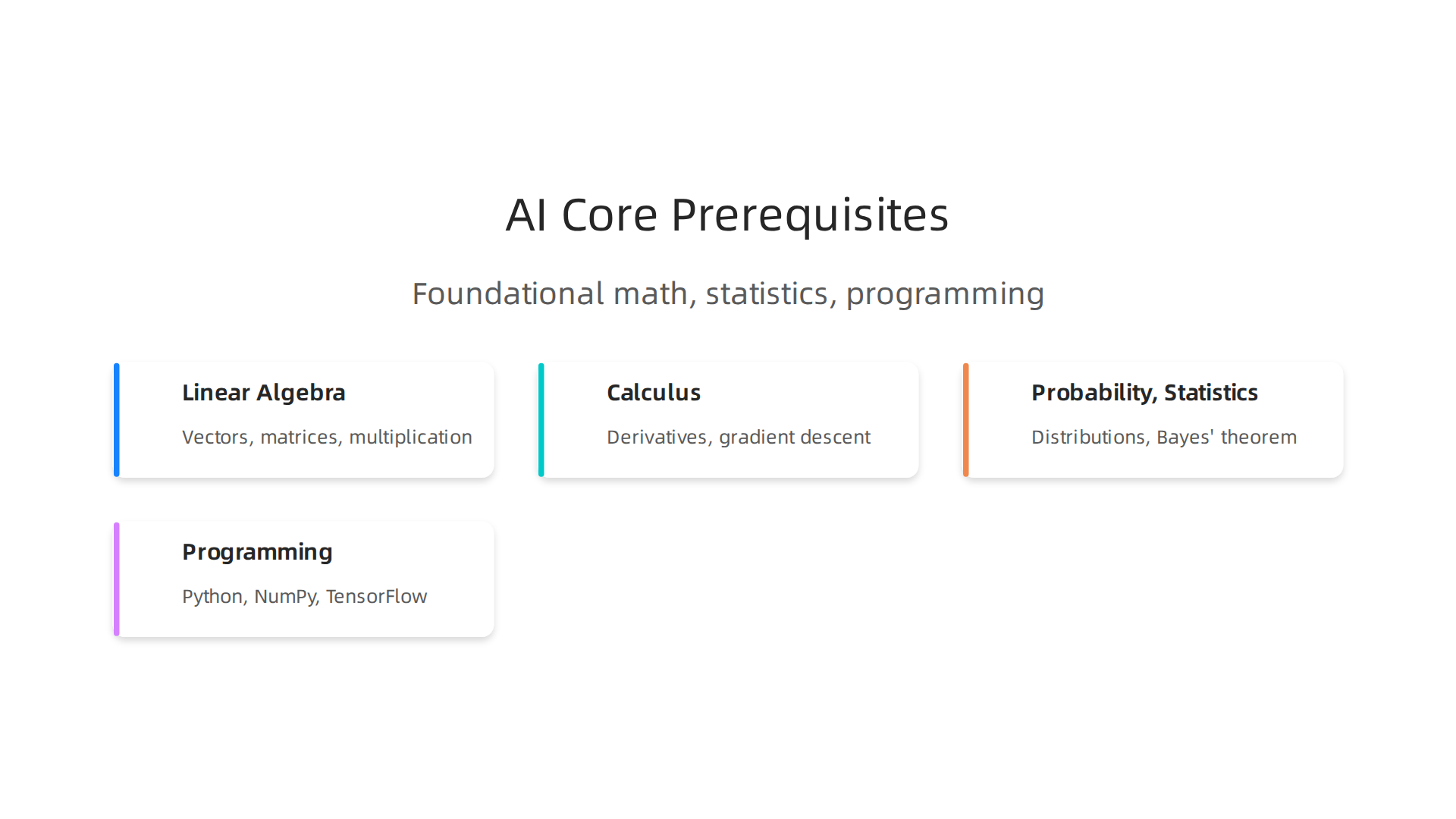
Here is the honest truth. You do not need a PhD in math to work with AI in 2026. But you do need a solid grasp of three core areas.
These are the building blocks that make everything else click. If you want to master the artificial intelligence a modern approach prerequisites, start here.

Linear Algebra: The Language of Data
Every AI model represents data as numbers arranged in rows and columns. That is linear algebra. Vectors and matrices are the basic containers. When you multiply a matrix by a vector, you are transforming data. When you train a neural network, you are doing thousands of these multiplications per second.
Key concepts include:
- Vectors and matrices
- Matrix multiplication
- Dot products and Euclidean distance
- Eigenvalues and eigenvectors
- Singular value decomposition (SVD)
You do not need to memorize every formula. But you need to understand what these operations do. The Maths for machine learning guide from GeeksforGeeks breaks down exactly which linear algebra topics matter most.
Calculus: How Models Learn
Training an AI model is basically a giant optimization problem. The model makes a guess, measures how wrong it is using a loss function, and then adjusts itself to make a better guess next time. That adjustment relies on calculus.
The most important idea is the gradient. Think of it as the slope of a hill. The model wants to roll downhill to find the lowest point, where the error is smallest. That process is called gradient descent. And it is the heart of how every deep learning model learns.
You also need to know:
- Derivatives and partial derivatives
- The chain rule (essential for backpropagation)
- Multivariable calculus
- Jacobians and Hessians
If this sounds heavy, do not panic. Many online courses teach these ideas without heavy theory. The Google ML Crash Course prerequisites explain what level of calculus is needed for practical work.
Probability and Statistics: Handling Uncertainty
Real world data is noisy. No two data points are exactly alike. Probability and statistics give you the tools to deal with that uncertainty.
For example, when a model predicts the chance of rain tomorrow, it is outputting a probability. When you measure how accurate that prediction is, you use statistics. Key topics include:
- Probability distributions
- Bayes’ theorem
- Mean, median, variance, standard deviation
- Confidence intervals
- Hypothesis testing
- Maximum likelihood estimation (MLE)
The Probability and statistics for machine learning course on Coursera covers these ideas in a hands‑on way. You apply the math using Python code, which brings us to the third prerequisite.
Programming Proficiency in Python
Theory is useless if you cannot build anything. Python is the language of AI in 2026. You need to be comfortable with:
- Variables, loops, functions, and data structures
- Libraries like NumPy for math operations and pandas for data handling
- TensorFlow or PyTorch for building models
- Jupyter notebooks for experimentation
You do not need to be a software engineer. But you do need to write code confidently. A good programmer can pick up AI faster than someone who only knows theory. The Reddit discussion on ML prerequisites highlights that hands‑on programming matters more than deep math for most roles.
Putting It All Together
These three areas form the foundation. Once you understand them, concepts like gradient descent, overfitting, and regularization become clear. And you will be ready to dive into the practical side of AI.
For a complete overview of how all these pieces connect in a business context, check out the artificial intelligence a modern approach guide. It maps the technical prerequisites to real‑world compliance and strategy.
And if you want to stay current on how AI is evolving every day, subscribe to The AI Newsletter Worth Reading. It delivers clear daily updates straight to your inbox, helping you keep your skills sharp.
Understanding Machine Learning: Supervised, Unsupervised, and Reinforcement
Now that you have the math and programming tools ready, it is time to look at the actual learning methods. Machine learning is not one single thing. It splits into three main approaches.
Each one solves a different kind of problem. And each one uses data in a different way.
Supervised Learning: Learning with a Teacher
Supervised learning is the most common type. Think of it like a student with a teacher who gives the right answers. The algorithm trains on labeled data. That means every input has a known output.
For example, you give it thousands of emails. Each email is labeled "spam" or "not spam." The model learns which patterns lead to each label. After training, it can predict the label for new emails.
Common tasks include:
- Classification: Sorting things into categories (spam or not, cat or dog)
- Regression: Predicting a number (house price, temperature)
The math you learned earlier, like linear algebra and calculus, powers the training process. Each time the model guesses, it uses the loss function to measure its mistake. Then it uses gradient descent to adjust and get better. To really understand how these algorithms work, you need the math skills we discussed. The mlcourse.ai course lists essential math concepts for machine learning as a key starting point.
Unsupervised Learning: Finding Hidden Patterns
Unsupervised learning works without any labels. There is no teacher. The algorithm looks at the raw data and finds patterns on its own.
Imagine you have customer purchase history but no labels. The algorithm might group customers into clusters. One cluster might be people who buy baby products. Another cluster might be students who buy cheap snacks. You did not tell the model about these groups. It found them naturally.
Common tasks include:
- Clustering: Grouping similar items together
- Dimensionality reduction: Simplifying data while keeping important information
Unsupervised learning is great for exploring new data and spotting trends you did not expect. Businesses use it for customer segmentation, fraud detection, and recommendation systems.
Reinforcement Learning: Learning Through Trial and Error
Reinforcement learning is different. Here, an agent learns by doing. It takes actions in an environment and gets rewards or penalties. The goal is to learn a strategy that earns the most reward over time.
Think of a robot learning to walk. It tries moving its leg forward. If it falls, it gets a negative reward. If it stays upright, it gets a positive reward. Over thousands of tries, it figures out the best way to walk.
Reinforcement learning is a key part of agentic AI, where an AI system acts on its own to achieve goals. It also led to superhuman AI results. For example, AlphaGo used reinforcement learning to beat the world champion in Go. The agent played millions of games against itself and got better every time.
Common applications include:
- Game playing (chess, Go, video games)
- Robotics (walking, grasping objects)
- Self-driving cars (deciding when to brake or turn)
Putting It All Together
These three approaches form the core of modern machine learning. Supervised learning is best when you have labeled data. Unsupervised learning shines when you need to explore without labels. Reinforcement learning works when an agent must learn through interaction.
Understanding these types is part of the artificial intelligence a modern approach prerequisites for anyone serious about applying AI. To dive deeper into how these methods connect to real business problems, check out the artificial intelligence and machine learning explained guide. It breaks down the concepts in plain language and shows how to apply them in 2026.
Deep Learning and Neural Networks: The Engine of Modern AI
You now understand the three main types of machine learning. But the models that power today’s biggest breakthroughs all share one thing in common. They use deep learning. Neural networks are the engine behind modern AI. From the chatbot that answers your questions to the system that spots cancer in medical scans, deep learning is the reason these tools work so well.
What Is a Neural Network?
A neural network is a math model inspired by the human brain. But do not let that scare you. It is not a real brain. It is just layers of numbers that learn patterns.
Think of it like this. You have an input layer. That is your raw data. Then you have hidden layers. Each layer takes the numbers from the previous layer, does some math, and passes the result forward. The final layer gives you the output.
Every connection between layers has a weight. Training means adjusting those weights so the output gets closer to the right answer. The magic happens through two key ideas.
Activation functions decide whether a neuron should "fire." A common one is ReLU. If the input is positive, pass it through. If not, send zero. This lets the network learn complex patterns, not just straight lines.
Backpropagation is how the network learns from its mistakes. After it makes a guess, it calculates how wrong it was using a loss function. Then it sends that error backward through the layers. Each weight gets a small adjustment. Over thousands of examples, the adjustments add up and the network gets better.
Without these two tools, neural networks would be useless. They turn random guessing into real learning.
Deep Architectures That Changed Everything
A deep neural network has many hidden layers. The more layers, the more patterns it can learn. But not all deep networks are built the same. Different architectures work best for different types of data.
-
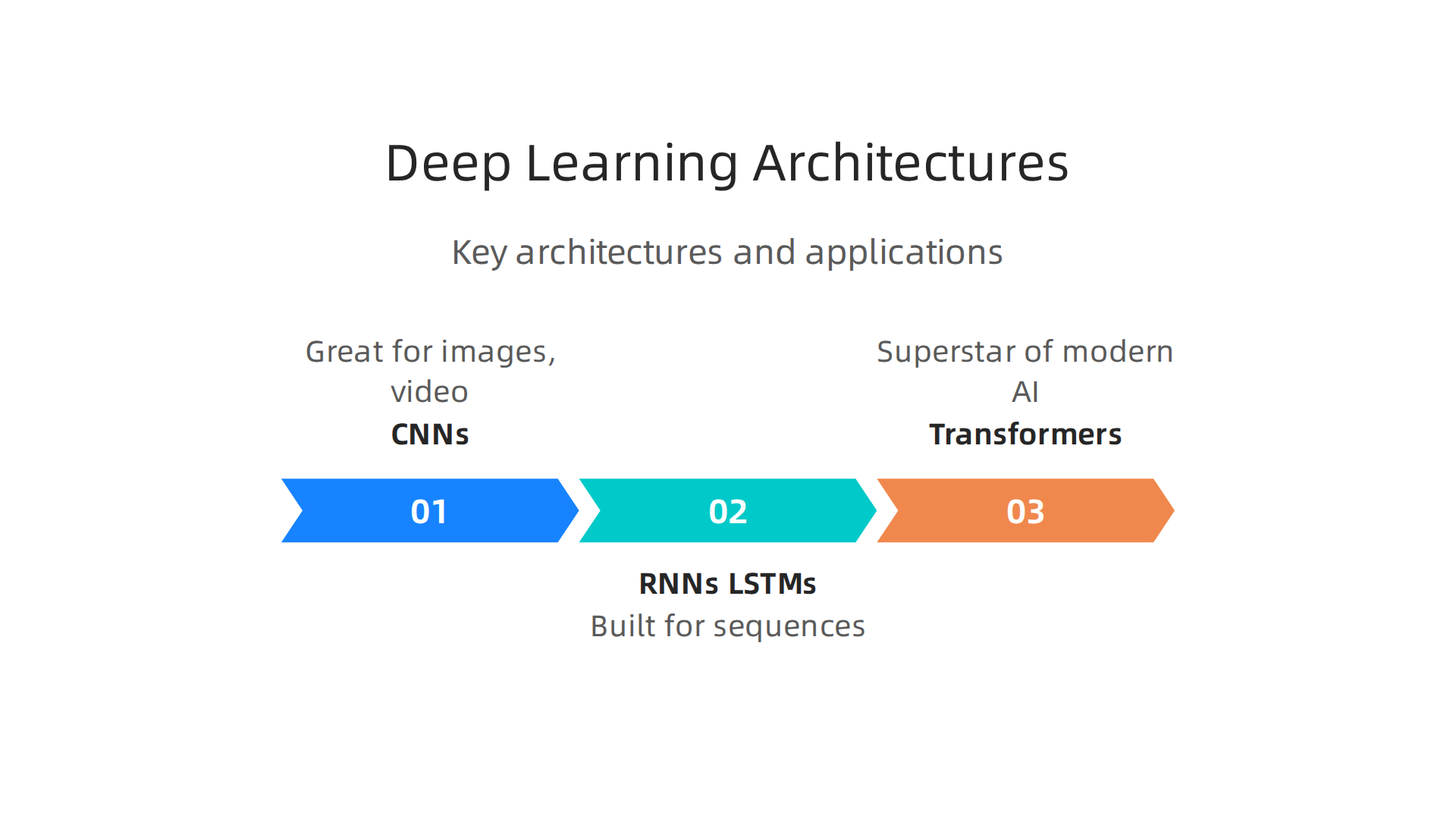
Convolutional Neural Networks (CNNs): Great for images and video. They scan small pieces of the image using filters. This lets them detect edges, shapes, and even faces. CNN models are still the best choice for medical imaging and edge devices in 2026, according to a guide on choosing deep learning architectures.
-
Recurrent Neural Networks (RNNs) and LSTMs: Built for sequences like sentences, audio, or stock prices. They have a memory that keeps information from earlier steps. Long Short-Term Memory (LSTM) networks solve the problem of forgetting after a few steps. They are still strong in time-series work where compute matters.
-
Transformers: The superstar of modern AI. Transformers do not process data step by step. They look at the whole sequence at once using something called self-attention. This makes them faster and better at handling long stretches of text. Every major large language model in 2026, including GPT-5 and Gemini 2.5 Pro, is built on Transformer architecture.
Each of these architectures needs huge amounts of data and specialized hardware like GPUs or TPUs. If you want to understand how they all fit together, the artificial neural network basics guide explains it in plain terms.
Why This Matters for the Modern AI Approach
Knowing about neural networks is part of the artificial intelligence a modern approach prerequisites. You do not need to build one from scratch. But you do need to understand the trade-offs.
Deep learning models are powerful but demanding. They need data, compute, and careful tuning. Techniques like dropout and regularization help prevent them from memorizing instead of learning. Getting these details right separates a working model from a disaster.
Staying on top of these fast-moving developments is tough. That is why getting clear daily AI updates from The Deep View Newsletter helps professionals keep their knowledge current without drowning in noise.
The Role of Data: Quality, Quantity, and Ethics
You have now seen the engines that power modern AI. But here is the truth. Even the most advanced neural network is useless without good data. Data is the fuel. Without it, nothing happens. The quality and quantity of your data directly decide how well your model performs. This is one of the artificial intelligence a modern approach prerequisites that too many people skip.
Why Data Quality Matters More Than Algorithm Choice
A common mistake is thinking a better algorithm fixes bad data. It does not. If your training data is full of errors, missing values, or bias, your model will learn those same flaws. Garbage in, garbage out. That phrase is still the most important rule in AI.
Bias in data is a serious problem. If you train a hiring model on past data that favored one group, the model will keep doing the same thing. It will not fix the bias. It will only make it bigger. This is not just a technical problem. It is an ethical one.

Poor data quality can lead to unfair outcomes, legal trouble, and lost trust.
The Rising Importance of Data Governance and Privacy
In 2026, you cannot just collect data and use it however you want. Regulations like the GDPR in Europe and the CCPA in California set strict rules. You need to know where your data comes from, who owns it, and whether you have permission to use it. Getting this wrong can mean fines in the millions.
Data governance is the process of managing data access, quality, and security. It is not exciting work, but it saves you from disaster. Good governance makes sure your data is accurate, consistent, and legally safe to use. For a deeper look at how unchecked AI can go wrong, read about the real risks of bad data and AI bias.
The same rules apply whether you are building a simple model or aiming for something like superhuman AI. The data needs to be clean and compliant.
Solutions When Real Data Is Scarce
What do you do when you do not have enough real data? Two methods are saving time and money in 2026.
Data augmentation takes your existing data and creates slightly changed copies. If you have ten pictures of a cat, you can rotate, flip, or crop them to make more examples. This helps the model learn without needing thousands of new images.
Synthetic data is data generated by a computer. It mimics the patterns of real data without containing any personal information. This is especially useful for healthcare and finance, where privacy is critical. Synthetic data lets you train models on large datasets without breaking any privacy laws.
Both of these approaches help you build better models with less real-world data. They are essential tools for anyone learning the modern AI playbook, including understanding agentic AI definition and how autonomous agents need data that reflects real decision making.
From Theory to Practice: Frameworks and Tools
Once your data is clean and ready, you need the right tools to turn it into a working model. This is where deep learning frameworks come in. They handle the heavy math so you can focus on design and results. In 2026, three frameworks dominate the conversation: PyTorch, TensorFlow, and JAX. Each one has a clear job.
Which Framework Should You Start With?
The answer depends on what you are building. By 2026, the AI community has settled into a clear pattern. According to the 2026 guide on Choosing the Right AI Framework in 2026, the three main tools now specialize:
PyTorch is the default for research and new projects. It powers about 85% of deep learning papers in top venues. If you are building a language model, a computer vision system, or any generative AI tool, PyTorch is the path with the least resistance. It feels natural to use and has the biggest community.
TensorFlow still leads in production deployment, mobile and edge devices, and enterprise MLOps pipelines. If your project needs to run on a phone or inside a factory system, TensorFlow with LiteRT is a safe bet.
JAX is the specialist for high performance computing. It can deliver 23x speedups over the other two for certain workloads. If you need Google TPU performance or are doing advanced scientific computing, JAX is worth learning.
The PyTorch vs TensorFlow in 2026 comparison shows the performance gap has narrowed to single digits. Your choice now depends on deployment target and team skill, not raw speed.
MLOps: The Missing Piece
Building a model is only half the work. Running it in the real world requires MLOps. This means version control for your data and models, experiment tracking to see what worked, and automated pipelines to deploy updates without breaking things.
Without these tools, your project stays stuck in the lab. You need the same discipline that software engineers use, applied to machine learning.
Cloud Platforms Give You Power
You do not need to own expensive hardware anymore. Cloud platforms like AWS, Google Cloud, and Azure let you rent GPUs and TPUs by the hour. Google’s quantum computer work and TPU infrastructure are accessible through cloud services. This makes scaling affordable for teams of any size.
If you want to understand how all these pieces fit together in a regulated environment, reading up on how to build a technology strategy board for EU AI Act compliance can help you plan responsibly.
Your Next Step
Frameworks and tools change fast. Keeping up with daily developments matters. The AI Newsletter Worth Reading delivers clear updates so you never miss a shift in the landscape. It is a simple way to stay informed while you build.
The Future of AI Learning: Trends and Unresolved Challenges
You have the frameworks and tools. Now it is time to look ahead. The field of artificial intelligence is changing fast, and keeping up means understanding the trends and challenges that shape what you should learn next.
Three Big Shifts in How AI Learns
First, self-supervised learning is becoming the standard. Instead of needing humans to label every data point, models teach themselves from raw text, images, and video. This makes training much faster and cheaper.
Second, foundation models are everywhere. These are giant pre-trained models that you can adapt to many tasks. Think of them as a starting point you can customize instead of building from scratch.
Third, neuromorphic computing is moving from labs into real hardware. These chips mimic how the brain works, using much less power than traditional GPUs. Early results show big efficiency gains for certain workloads, even as separate efforts like Google’s quantum computer push into a different direction entirely.
The Hard Problems Nobody Has Solved Yet
Even with all this progress, big questions remain.

Interpretability is one. When a model makes a decision, can you explain why? In regulated industries, you need that answer.
Robustness is another. Models can fail in surprising ways when faced with data they haven’t seen before. And alignment — making sure AI does what humans actually want — is an open challenge that researchers are actively working on. The idea of superhuman AI raises even bigger questions about control and safety.
How to Keep Up Without Burning Out
The pace of change is relentless. New papers and tools appear daily. The best way to stay current is to build a habit of continuous learning. Follow trusted sources, set aside time each week to read, and focus on understanding the fundamentals.
According to the 2026 AI trends from Microsoft, AI is evolving from a tool into a true collaborator, especially in areas like reasoning, agent workflows, and multimodal understanding. Keeping an eye on these shifts helps you plan your learning path wisely.
But the most important thing you can do is master the prerequisites. That foundation makes everything else possible. Our guide to artificial intelligence a modern approach by Russell and Norvig breaks down the core concepts you need to stay ahead, even as the landscape shifts around you.
Summary
This article lays out the practical prerequisites anyone needs to understand modern AI—from its history and evolution to the concrete skills required in 2026. It explains why linear algebra, calculus, probability, and hands‑on Python matter, and shows how those foundations power supervised, unsupervised, and reinforcement learning as well as deep neural networks. The guide stresses that data quality, governance, and ethics are as important as model architecture, and it compares dominant frameworks (PyTorch, TensorFlow, JAX) and the operational practices (MLOps) needed to move models into production. It also connects technical learning to real business needs and regulatory requirements, highlighting agentic AI, compliance with evolving rules, and practical steps for scaling AI responsibly. After reading, leaders and practitioners will know what to study, which tools to try first, how to reduce data and compliance risk, and where to focus next to apply AI effectively in their organizations.