

Introduction
The road to self driving trucks and robotaxis is getting bumpier by the month. As artificial intelligence powers more autonomous vehicles, regulators are scrambling to keep up. For companies like Aurora Innovation, that means navigating a messy, fast changing set of rules.

Autonomous vehicles today operate under a patchwork of state laws. Seventeen states and the District of Columbia have passed their own AV legislation, and several more have executive orders in place. That creates real headaches. A truck that is legal in Texas might not be allowed to run in California. This kind of uncertainty makes it hard for any company to plan long term investments.
That is why aurora innovation news matters beyond just the company itself. Aurora is a bellwether for the entire self driving industry. When regulators tighten rules around safety testing or data sharing, it affects not only Aurora but also its partners, suppliers, and competitors. Technology executives, investors, and compliance teams need to understand these shifts to manage risk and make smart bets.
At the same time, new federal proposals are trying to change the game. The America Drives Act, introduced in 2025, would override many state level restrictions on autonomous commercial vehicles. Groups like the Autonomous Vehicle Industry Association are pushing for a single national framework. But safety advocates have pushed back, arguing that federal bills could weaken protections.
So where does that leave companies like Aurora in 2026? The answer is complicated. And that is exactly why we wrote this article.
We will walk through the key regulatory developments shaping the autonomous vehicle space right now. You will see how AI rules, data privacy laws, and safety standards all intersect. We will use Aurora Innovation as a real world case study to show what works and what does not.
If you are responsible for compliance or strategy at a tech company, staying ahead of these changes is critical. That is why many leaders turn to resources like the Palantir regulatory compliance 2026 guide to understand how AI and data privacy rules connect.
The landscape shifts fast, and a missed update can cost millions.
At the end of this article, you will have actionable insights to help your team navigate the regulatory maze. But first, let us look at where the rules stand today and what that means for Aurora Innovation.
Want to stay informed as these rules evolve? Get clear daily AI and tech regulation updates straight to your inbox from The Deep View Newsletter.
The Autonomous Vehicle AI Regulatory Landscape
If you think keeping up with AI rules is messy, try adding wheels to the equation. Self driving cars and trucks are not just fighting traffic. They are fighting a tangled web of regulators.
Right now, the U.S. has no single federal law for AI in autonomous vehicles. Instead, multiple agencies each want a piece of the action. The National Highway Traffic Safety Administration, or NHTSA, oversees vehicle safety standards. The Department of Transportation handles broader transportation policy. The National Institute of Standards and Technology, known as NIST, creates AI risk management frameworks. And the Federal Trade Commission watches for unfair or deceptive practices around what companies claim their self driving tech can do.
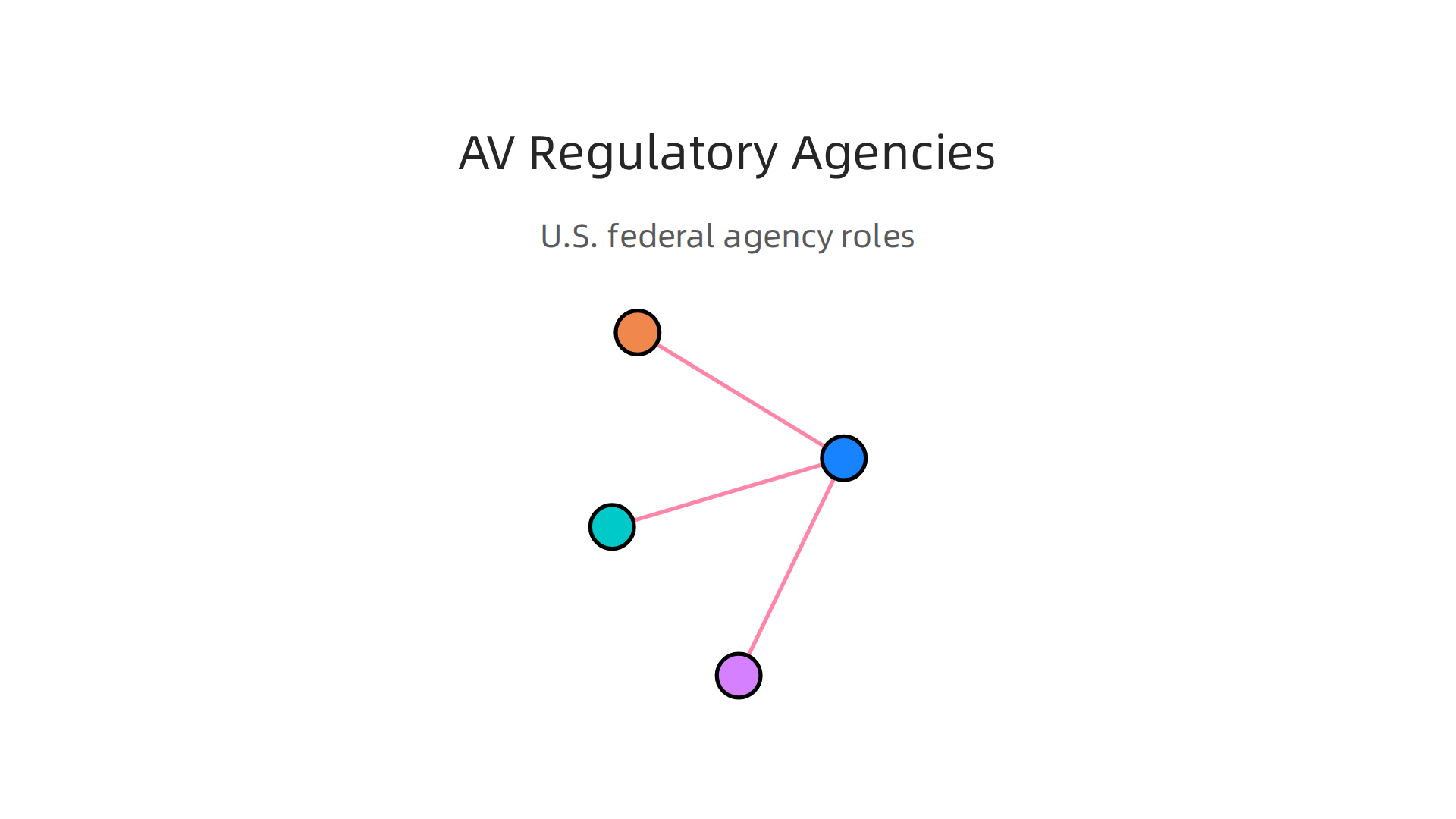
That is a lot of cooks in the kitchen. And each agency has its own timeline, its own priorities, and its own set of rules.
The result? A fragmented regulatory framework that varies wildly depending on where the vehicle is operating. According to the Governors Highway Safety Association, seventeen states and the District of Columbia have already passed AV laws, and six more have executive orders in place. That means a truck that runs fine in Arizona might get stopped at the California border.
Here is what changed in 2025 and 2026 that matters most for anyone following aurora innovation news.
NHTSA Updated Its Safety Framework
In 2025, NHTSA released an updated Voluntary Safety Self-Assessment framework. This is the main way companies tell the public and regulators how they test and validate their self driving systems. The update added new expectations around how AI makes decisions in real time. Companies like Aurora now need to show more transparency around their algorithms, especially in edge cases like construction zones or bad weather.
California Pushed AI Liability Rules
California regulators proposed new AI liability rules specifically for autonomous vehicles. Under these proposed rules, if an AI system causes a crash, the company behind the software could be held directly responsible. That is a big deal. It shifts accountability from the vehicle operator to the AI developer. For Aurora, this means their software stack needs even stronger safety documentation and testing records.
Federal Legislation Still Moving Slowly
The America Drives Act, introduced in July 2025, would override many state level restrictions on autonomous commercial vehicles. The Autonomous Vehicle Industry Association is backing this kind of federal framework, arguing that the current patchwork is hurting American competitiveness. But safety groups, like the Advocates for Highway and Auto Safety, have pushed back hard. They say federal bills could weaken protections that states have worked hard to build.
Meanwhile, the EU has its own approach. The EU AI Act, fully applicable as of August 2026, sets strict requirements for high risk AI systems, including those used in autonomous vehicles. That means companies like Aurora operating in Europe face a different set of compliance demands than in the U.S.
For compliance teams trying to make sense of all this, a single source of truth is hard to find.

That is why many technology leaders turn to resources like the Beta Technologies compliance 2026 guide to understand how overlapping rules apply across jurisdictions.
The bottom line? The regulatory landscape for AI in autonomous vehicles is still being built. No single playbook exists yet. But companies that track developments closely, document their AI systems thoroughly, and prepare for both state and federal rules will have a real advantage.
Staying on top of these fast changing rules is not easy, but you do not have to do it alone. Get clear daily AI and tech regulation updates straight to your inbox from The Deep View Newsletter.
Aurora Innovation: A Case Study in Autonomous Vehicle Compliance
So after all that talk about messy rules, you might be wondering: how does an actual self driving company stay ahead? It is a fair question. Let us look at Aurora Innovation as a real world example.
Aurora does not just sit back and wait for regulators to tell them what to do. They take a proactive approach. In their latest annual report, they explain that their whole strategy is built on a "first-principles approach" to technology development. That means they start from scratch with safety in mind, not just bolt it on later.
Here is what sets Aurora apart in the compliance game.
Voluntary Safety Programs First
Aurora participates in NHTSA’s Voluntary Safety Self-Assessment program. This is not required by law, but it shows regulators they are serious. They publish detailed safety cases that explain how their AI system, called the Aurora Driver, makes decisions on the road. This level of transparency builds trust.
Aligning with UL 4600
There is a safety standard called UL 4600 that is becoming the gold standard for autonomous vehicle safety. Aurora designs its safety case to meet this standard. That means they document every edge case, from construction zones to sudden weather changes. This documentation is exactly what regulators in California and the EU want to see.
Scaling While Staying Compliant
In February 2026, Aurora tripled its driverless network to 10 routes across the Sun Belt. They also validated a 1,000-mile lane from Fort Worth to El Paso. And they plan to deploy hundreds of driverless trucks with next-generation hardware by the end of 2026. Every new route means new state regulations to follow. But because Aurora built compliance into their system from day one, they can scale faster than competitors.
Meeting Both US and International Rules
Aurora operates in both the United States and Europe. That means they have to follow NHTSA guidelines and the EU AI Act at the same time. Their approach is to build one system that satisfies both sets of rules, rather than having separate versions. This saves money and reduces legal risk.
Other AI companies face similar pressure. For example, Harvey AI in legal tech and Rackspace Technology in cloud services both need to show their systems are fair, safe, and transparent. The same compliance lessons apply.
For anyone tracking aurora innovation news, 2026 is the year theory meets reality. The company is moving from testing to real revenue, with guidance of $14 to $16 million for the year.
Want to stay on top of how companies like Aurora navigate fast changing rules? Get clear daily AI and tech regulation updates from The Deep View Newsletter.
Key AI Regulatory Challenges for Self-Driving Technologies
So we have seen how Aurora Innovation stays ahead of the game. But not every company makes it look that easy. The truth is self driving technology runs into some serious regulatory roadblocks. And in 2026, these challenges are only getting more complex.
Let’s break down the three biggest ones.
1. Safety Assurance and Liability Allocation
Here is the big question: when an autonomous vehicle crashes, who is at fault? The manufacturer? The software developer? The owner? This is still a gray area in most places.

Regulators want rock-solid proof that the AI can make safe decisions before it hits public roads.
Aurora’s approach is to build a detailed safety case that documents every possible edge case. They follow standards like UL 4600 to prove their system is safe. But many companies struggle with this because AI decision making is hard to explain, even for the engineers who build it.
Some legal experts argue that a strict liability regime makes the most sense for autonomous vehicle accidents. That means the company behind the technology takes full responsibility, no matter what. Others push for liability shields if companies follow recognized risk management standards like the NIST AI Risk Management Framework.
Until lawmakers agree, this uncertainty keeps a lot of self driving projects stuck in testing mode.
2. Data Privacy and Cybersecurity
Self driving cars are basically data collection machines. They gather sensor data, video footage, location info, and sometimes even passenger behavior. All that data needs to be protected.
On top of that, vehicles rely on over the air software updates, which opens the door for cyberattacks. Regulators in both the US and Europe are tightening rules around how this data is stored, shared, and secured.
Companies like Rackspace Technology that provide cloud infrastructure for autonomous systems have to meet these same privacy standards. The more data you collect, the more risk you carry.
3. Algorithmic Transparency and Explainability
Europe’s AI Act is setting strict rules about how AI systems explain their decisions. For self driving cars, that means the neural network has to be able to tell regulators why it braked here or turned there.
This is hard because many AI models are like black boxes. Even top systems like Samsung’s Galaxy AI features can be tough to explain at the code level. For autonomous vehicles, regulators want full transparency. That forces companies to build explainability right into the system, not as an afterthought.
Other AI firms like Harvey AI in legal tech face similar pressure to show how their models reach conclusions. It is a cross industry challenge.
These three challenges safety, privacy, and transparency are why compliance teams have their hands full in 2026. And they are exactly why staying informed matters so much.
If you want to keep up with how these rules change from week to week, get clear daily AI and tech regulation updates from The Deep View Newsletter.
Comparing Autonomous Vehicle Regulations: EU vs US vs China
We have seen the key challenges around safety, privacy, and transparency. But in 2026, the rulebook you follow depends entirely on where your self driving cars operate. The European Union, the United States, and China each take a very different approach. If you are a company like Aurora Innovation, you must understand all three to stay compliant.
Let’s break down how each region handles autonomous vehicle regulation.
The European Union: Centralized and Risk Based
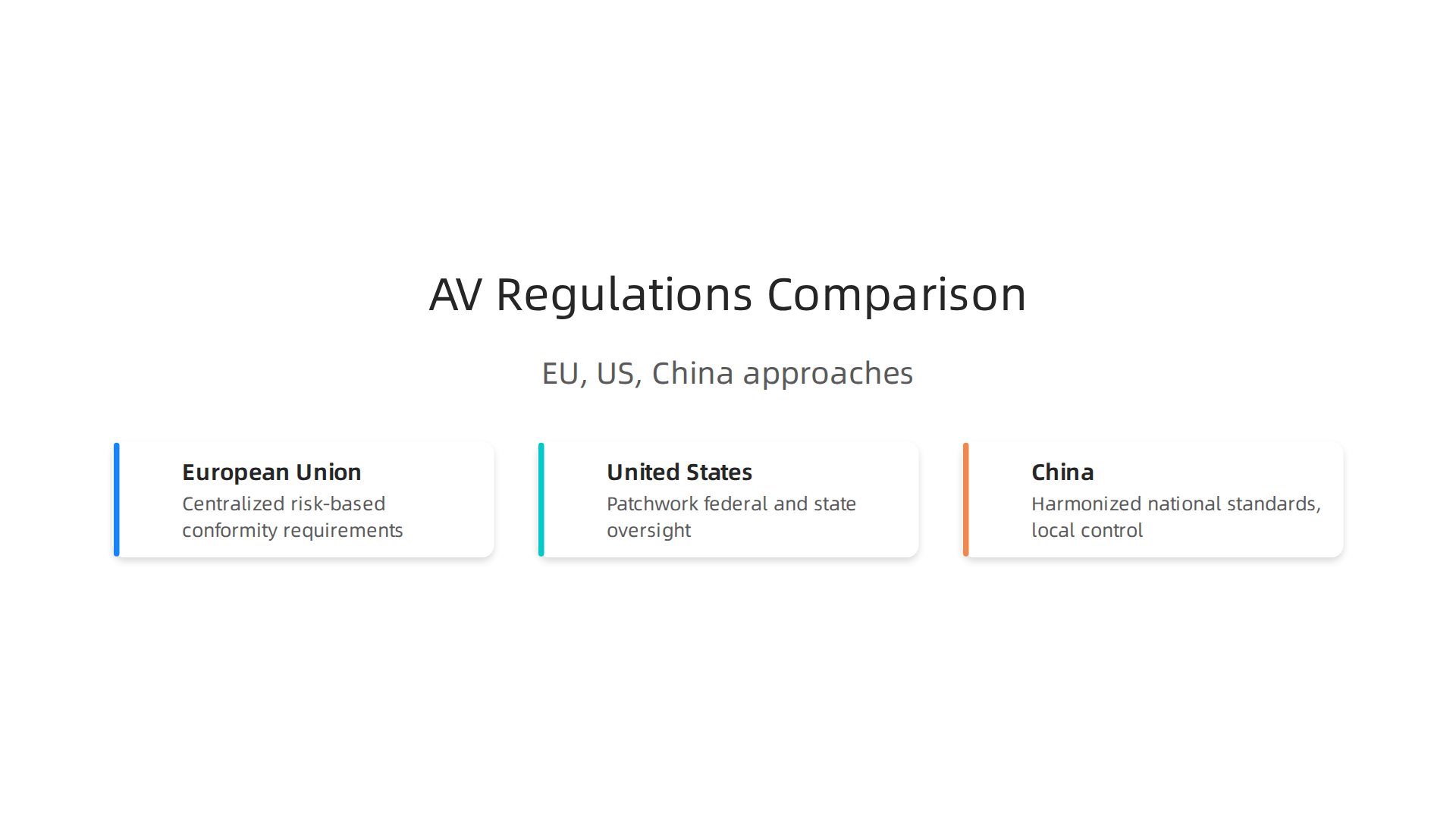
The EU relies on its AI Act, which entered into force in August 2024 and becomes fully applicable in August 2026. Under this law, autonomous vehicles are classified as high risk AI systems. That means companies must pass strict conformity assessments before deploying their technology on public roads. The EU AI Act requires detailed documentation, human oversight plans, and ongoing monitoring.
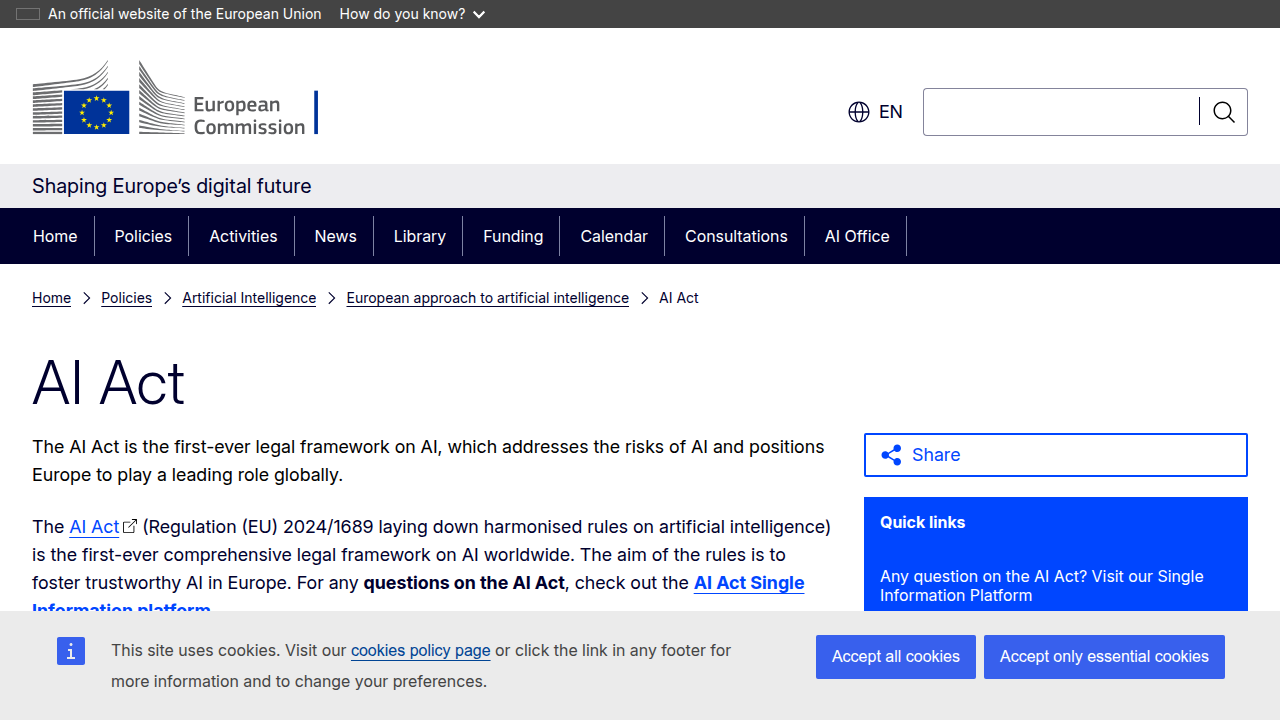
This centralized framework makes compliance clear but demanding. Every developer, from car makers to AI software firms like Harvey AI, must prove their system is safe and explainable. The EU’s approach leaves little room for shortcuts.
The United States: A Patchwork of Federal and State Rules
The US does not have a single federal law like the EU AI Act. Instead, as of May 2026, federal AI governance is shaped by guidelines from agencies like the National Highway Traffic Safety Administration (NHTSA). NHTSA takes a performance based approach, meaning it focuses on what the vehicle does, not how it was built. But states also pass their own laws. California, for example, has strict testing and data rules. This mix creates a complex landscape for companies trying to launch nationwide.
For cloud providers like Rackspace Technology that host AV data, the rules vary by state. And without a unified federal law, companies must track multiple regulatory bodies. This adds cost and risk.
China: Harmonized Standards with Local Control
China is moving fast to create harmonized national standards for autonomous vehicles. But it also enforces strict local requirements. All driving data, including video and sensor logs, must be stored inside China. The government also requires algorithm approval for AI systems used in vehicles. This means companies must submit their neural networks for review before deployment.

Even consumer AI features like Samsung’s Galaxy AI face similar scrutiny in China. For autonomous vehicle developers, the data localization rule is one of the toughest hurdles. It forces foreign companies to build separate data infrastructure within the country.
What This Means for Companies Like Aurora
A company like Aurora Innovation that wants to operate globally must comply with all three approaches. That means passing the EU’s high risk assessment, meeting NHTSA standards while tracking state laws, and satisfying China’s algorithm and data rules. It is a heavy lift, but staying informed is the first step.
If you are managing compliance for self driving or any AI system, you cannot afford to miss regulatory changes. Get clear daily updates on tech regulation with the The Deep View Newsletter.
And for more on building a solid compliance strategy, check out these compliance strategies to avoid million dollar fines.
Building a Proactive Compliance Strategy for Autonomous AI

We have seen how different the rules are in the EU, US, and China. Waiting until your autonomous vehicle is ready to launch is a recipe for disaster. The smartest companies in 2026 are the ones that build compliance into their workflows from day one. This is not a legal checkbox anymore. It is a strategic advantage.
So what does a proactive compliance strategy actually look like? Let’s break it down into three practical steps.
Start with a Risk Based Approach
Do not wait for a regulator to knock on your door. Start by mapping out every risk your AI system could create. The NIST AI Risk Management Framework gives you a solid starting point. It helps you identify and manage risks to people, organizations, and society. You should integrate this kind of monitoring into your product development cycle from the very first prototype.
For example, companies working on autonomous driving must consider risks like misdetecting pedestrians or incorrect vehicle localization. That is not a theoretical problem. It is a real safety hazard documented by the US Department of Transportation. Build your testing regimes around those known failure modes from the start.
Engage with the People Writing the Rules
Here is something many teams miss. You can actually help shape the regulations that affect you. Standard setting bodies like SAE, IEEE, and ISO are always looking for industry input. Participating in their working groups gives you a seat at the table. You can advocate for rules that are both safe and practical.
On top of that, look for pilot programs in your target markets. Many states and countries invite companies to test their autonomous systems under real conditions. These pilots let you gather data and prove your safety case. And they help regulators understand your technology before they write final rules.
This is exactly the kind of proactive engagement that leaders in aurora innovation news are closely following. If you want to see how a major player handles this, keep an eye on what Aurora Innovation does next.
Invest in Transparency and Documentation
The EU AI Act requires you to explain how your AI works. That means you need an auditable safety case, not just a bunch of black box algorithms. Invest in explainable AI tools and record every test result, every decision, and every safety argument.
You also need to think about data. In China, driving data must stay inside the country. That forces cloud providers like Rackspace Technology to build local infrastructure. And even consumer AI features like Galaxy AI face scrutiny over how they handle personal data. So make sure your documentation covers where data lives, how it moves, and who can access it.
At the end of the day, compliance is not just about avoiding fines. It is about building trust with the public and your partners. The International AI Safety Report 2026 makes it clear that we still have gaps in our understanding of AI risks. The companies that close those gaps will lead the way.
Staying on top of all this takes effort. But you do not have to do it alone. Get clear, daily updates on AI regulation with The Deep View Newsletter. It will help you spot changes before they become problems.
And if you want a deeper look at building your compliance playbook, check out this guide on moving from pilot to scale with AI for business in 2026.
Summary
This article examines how fast-changing AI and transportation rules are reshaping the self-driving industry, using Aurora Innovation as a practical case study. It explains the current fragmented U.S. landscape of state laws and federal agency guidance, recent NHTSA updates, California’s proposed AI liability rules, and how the EU and China take different regulatory approaches. The piece breaks down the three biggest compliance challenges—safety assurance and liability, data privacy and cybersecurity, and algorithmic transparency—and shows how Aurora addresses them through voluntary safety programs, alignment with UL 4600, and unified systems for global markets. Readers will get a clear, actionable framework: start with risk mapping, engage regulators and standards bodies, and invest in documentation and explainability so teams can scale with less legal risk. The article highlights concrete steps compliance and strategy leaders can take now to minimize operational disruption and position their companies to deploy driverless vehicles responsibly.