

Why a plain-language guide to AI matters for non-technical leaders
In 2026, artificial intelligence, or AI, is changing how businesses work every single day. You might hear lots of big words and technical talk about AI that can make it hard to really understand what it means for your company. As a leader, you need to make smart choices, but it’s tough when the information is confusing. Many decision-makers feel lost trying to get a clear picture of AI without all the complicated jargon.

Actually, AI is just about making machines and computer programs that can do tasks usually done by people. This includes things like understanding speech, figuring out what pictures show, and making choices, as explained in a primer on the topic AI, THE GULF, AND THE US: A PRIMER.
This guide is for you. We want to give you the "artificial intelligence basics: a non-technical introduction" you need. We will explain the main ideas of AI in a simple way. You’ll learn about different kinds of AI, such as how some are like expert systems artificial intelligence that help with complex decisions. We’ll also look at practical ways AI can help your business right now. You’ll discover what are AI agents and how they can perform tasks for you.
Our goal is to give you clear information, so you can see how AI really works and how it can help you. This will include how to think about next steps for leaders in your role. When you understand these important ideas, you can make better choices for your business and feel more confident about using new tools. To learn more about using AI for your business goals, check out this how to use AI strategically: a decision-makers’ guide for 2026.
Want to stay informed on AI every day?
The AI Newsletter Worth Reading offers clear daily updates.
What is AI? Core concepts and simple definitions
So, what exactly is AI? It is a big field in computer science that focuses on making machines and computer programs that can do tasks that usually need human smarts. This includes things like understanding what you say, looking at pictures and knowing what they show, and even making good choices. You can think of it as teaching computers to think and learn a bit like people do Artificial Intelligence (AI) 101: What You Need to Know.
When we talk about artificial intelligence, it’s a very broad term. Under this big umbrella, there are two important ideas you’ll often hear: Machine Learning and Deep Learning.
Machine Learning: Computers that learn from examples
Imagine you want to teach a computer to spot cats in pictures. You wouldn’t write down a long list of rules like "a cat has pointy ears and whiskers and fur." That would be too hard! Instead, with Machine Learning (ML), you show the computer many, many pictures. Some pictures have cats, and some do not. You tell the computer "this is a cat," or "this is not a cat."
Over time, the computer learns to find patterns in the pictures on its own. It figures out what cats look like by itself. So, when you show it a new picture, it can tell you if there’s a cat in it. That’s Machine Learning. It’s about letting computers learn from data without being told every single step to take. This is a core part of understanding artificial intelligence and machine learning explained for 2026 business leaders.
Deep Learning: A more powerful way for computers to learn
Deep Learning (DL) is a special kind of Machine Learning. It’s like an even smarter way for computers to learn. It uses something called neural networks, which are inspired by how the human brain works. These networks have many layers, like different steps in thinking. Each layer helps the computer understand more complex things.
Think back to our cat example. With Deep Learning, the computer doesn’t just learn about pointy ears and whiskers. One layer might learn about lines and shapes. The next layer might combine those shapes to see eyes and noses. A layer after that might put them together to see a whole cat face. This multi-layered approach lets Deep Learning tackle really big and complicated tasks, like understanding human speech or driving cars.
Key Building Blocks of AI
To make AI work, we need a few main parts:
- Models: An AI model is like the "brain" or the "set of rules" that the computer learns. It’s what the computer builds after it looks at all the data. Our cat-spotting brain would be a model.
- Data: This is the information we feed the AI. For our cat example, the data would be all the pictures of cats and non-cats. The more good data an AI has, the better it can learn.
- Training: This is the learning part. It’s when the AI looks at the data and adjusts its model to find patterns and make predictions. It’s like a student studying for a test.
- Inference: After the AI is trained, it’s ready to work. Inference is when the AI uses its learned model to make predictions or decisions on new information. When you show the trained cat-spotting AI a new picture, and it says "cat!" that’s inference.
Understanding these basic ideas gives you a strong start on your "artificial intelligence basics: a non-technical introduction." Knowing the difference between AI, Machine Learning, and Deep Learning, along with how models learn from data, helps you see how these powerful tools are built.
Now that we know AI learns from data, let’s talk about the main ways it actually does this. Think of it like how a student learns.

Sometimes a teacher gives them all the answers, sometimes they have to figure things out on their own, and sometimes they learn by trying things and seeing what happens. AI learns in similar ways through what we call learning types. These learning types are key to understanding the artificial intelligence basics: a non-technical introduction.
There are three main ways AI systems learn:
1. Supervised Learning: Learning with a Teacher
This is the most common way AI learns. Imagine you have a teacher who shows you a math problem and then gives you the correct answer. You look at many problems and answers, and slowly, you learn how to solve new problems by yourself.
In supervised learning, we give the AI lots of "labeled data." This means each piece of information (like a picture or a piece of text) comes with its correct answer or label. For example, if you are teaching an AI to spot spam emails, you give it thousands of emails. For each email, you tell the AI: "this is spam" or "this is not spam." The AI then learns to find patterns that link emails to their labels. When you give it a new email, it can guess if it is spam or not based on what it learned. This method is often used for making predictions from data Supervised, unsupervised, reinforcement learning explained.
2. Unsupervised Learning: Learning on Its Own
Sometimes, there is no teacher to give answers. In unsupervised learning, we give the AI a bunch of data that is not labeled. The AI has to look at the data and find its own patterns or groupings.
Think of giving a child a big box of mixed toys. You do not tell them "these are cars" or "these are blocks." The child might naturally put all the cars together and all the blocks together because they see similarities. That is what unsupervised learning does. It finds hidden structures or groups within data all by itself. This is helpful for things like finding customer groups in marketing or spotting strange patterns that might mean fraud.
3. Reinforcement Learning: Learning by Trial and Error
This type of learning is like training a pet or playing a video game. The AI agent (the learning program) tries to do something in a specific environment. If it does something good, it gets a "reward." If it does something bad, it might get a "penalty." Over many tries, the AI learns which actions lead to the biggest rewards.
A great example is teaching an AI to play chess. The AI tries many moves. If it wins the game, it gets a big reward. If it loses, it gets a penalty. It does not get told the "right" move for every situation, but it learns through playing again and again to make better choices over time. This is how many expert systems artificial intelligence get better at complex tasks.
The Power of Good Data
No matter which way an AI learns, the quality of the data is super important. If you feed an AI bad data, it will learn bad habits. Imagine trying to learn math from a textbook full of mistakes; you would get the wrong answers!
For AI, this means using data that is:
- Accurate: The information is correct.
- Complete: Nothing important is missing.
- Relevant: The data actually helps the AI learn about the task it needs to do.
If the data has errors or is biased, the AI model will also have those problems. For example, mislabeled data during training can hurt an AI model’s ability to work well AQuA: A Benchmarking Tool for Label Quality Assessment. High-quality data helps the AI learn correctly and make fair decisions. This focus on data quality is essential for understanding how to make an AI compliant with global regulations in 2026.
Understanding these different learning methods and the importance of good data helps you grasp the foundational principles behind many AI systems we see today. It is all part of understanding the artificial intelligence basics: a non-technical introduction.
Get clear daily AI updates from The Deep View Newsletter. The AI Newsletter Worth Reading
We have learned how AI systems learn, whether it is with a teacher, on their own, or by trying things out. Now, let’s see where we actually use these smart systems in our daily lives and in different businesses.

In 2026, artificial intelligence is everywhere, helping us in many ways. Understanding these common uses is a big part of knowing the artificial intelligence basics: a non-technical introduction.
Here are some main things AI does across different jobs and industries:
1. Automation: Making Tasks Easier and Faster
AI helps machines do tasks that people used to do. This is called automation.
- Customer Service: Chatbots are a common example. They answer questions on websites or over the phone, helping customers quickly without needing a human every time. This frees up human agents for more complex issues.
- Manufacturing: In factories, robots powered by AI can put things together, check for problems, and move items. This makes production faster and more exact.
- Data Entry: AI can read documents and pull out important information, like names and dates. This speeds up tasks that usually take a lot of time.
Companies across the board are looking at how AI can help them automate tasks, from customer service to document processing, to make their work smoother and faster in 2026 AI Implementation Case Interview Guide (2026).
2. Prediction: Guessing What Happens Next
AI is very good at looking at past information and guessing what might happen in the future.
- Sales Forecasting: Businesses use AI to guess how much of a product they will sell. This helps them stock the right amount and not run out or have too much.
- Maintenance: AI can look at how machines are working and predict when they might break down. This allows for fixes before a big problem happens.
- Healthcare: AI can help doctors guess if a patient might get sick with certain diseases based on their health information.
Many industries, from finance to healthcare, are finding powerful AI use cases that help them make better predictions and decisions Top 10 AI Use Cases Across Major Industries in 2026.
3. Personalization: Tailoring to You
AI can learn about what you like and then offer things that fit you best.
- Shopping: When you visit an online store, AI suggests other products you might like based on what you have looked at or bought before.
- Entertainment: Streaming services use AI to suggest movies, shows, or music you would enjoy.
- News Feeds: Social media and news apps use AI to show you articles and posts that are most interesting to you.
This type of AI can create a much better experience for users and customers.
4. Decision Support: Helping Make Smart Choices
AI can look at huge amounts of information and help people make better decisions. It acts like a very smart helper.
- Financial Services: AI can spot strange patterns in money dealings that might mean fraud. It also helps banks decide if someone should get a loan.
- Agriculture: AI can tell farmers the best time to plant or water their crops based on weather and soil data.
- Law: AI tools can review many legal documents to find key information faster for lawyers. These are sometimes called expert systems artificial intelligence.
These applications are changing nearly every industry by helping businesses automate, make better decisions, and find new ways to grow The most valuable AI use cases for business.
What to Expect from AI: Vendor Claims vs. Real Results
When you hear about AI, sometimes the claims can sound like magic. But it is important to know the difference between what a company says their AI can do and what it actually does in the real world. Many companies want to show how their network ai or smart tools can solve all your problems.
Here is what to remember:
- Start Small: Most AI projects begin with a clear, small goal. They do not try to change everything at once.
- Data is Key: As we talked about, good data is super important. If the data is not right, the AI will not perform well.
- Human Oversight: Even the best AI needs people to check its work and make sure it is doing what it should. This is especially true for complex systems that involve what are ai agents working on their own.
- Measure Results: Businesses should always check if the AI is truly saving money, making things faster, or improving customer happiness. Real-world impact is what matters.
Many companies are now moving their AI projects from small tests to full use, seeing real business value Generative AI Use Cases 2026: 50 Proven Enterprise. But it takes careful planning and work to go from an idea to a successful outcome. Thinking about how to use AI strategically: a decision makers guide for 2026 is always a good idea.
Even with all the good things AI can do, it is also important to know about its downsides. Just like anything powerful, artificial intelligence comes with its own set of risks and rules.

For leaders, understanding these risks is a big part of knowing the artificial intelligence basics: a non-technical introduction.
Let’s look at the kinds of problems AI can bring and what people are doing about them.
Operational Risks: Problems with How AI Works
When using AI, companies can face issues in how the AI systems actually run.
- Bad Data: Remember how important good data is for AI? If the data used to teach an AI is old, wrong, or incomplete, the AI will make bad choices. It is like feeding a computer bad instructions.
- Bias in AI: This is a big one. If the data used to train AI has unfair ideas built into it, the AI will also act unfairly. For example, if an AI is trained mostly on pictures of certain groups of people, it might not recognize others as well. This can lead to wrong decisions in areas like hiring or medical care.
- Misuse of Models: Sometimes, AI tools can be used in ways they were not meant for, or in ways that could harm people. This could be from mistakes, or sometimes even bad intentions.
Legal and Reputational Risks: Fines and Trust Issues
Not handling AI well can lead to big problems for companies, both with the law and with how people see them.
- Breaking Laws: Governments around the world are making new laws about AI. If a company’s AI system does not follow these rules, they could get huge fines. This is why it is so important to stay updated on AI regulation 2026: navigate compliance and avoid risks.
- Losing Trust: When an AI system makes a big mistake or acts unfairly, people lose trust in the company using it. This can hurt a company’s name and make customers go elsewhere. Being open about how AI works and checking its results, a practice known as explainable AI for 2026 compliance and executive trust, can help build trust.
Ethical Considerations: Doing What Is Right
Beyond laws, there are also ethical questions about AI. These are about what is right and fair, even if there is no law yet.
- Fairness: Ensuring AI treats everyone fairly and does not discriminate is a core ethical concern. This links back to the problem of bias.
- Privacy: AI systems often use a lot of personal information. Protecting this information and using it responsibly is very important.
- Impact on Jobs: As AI gets better, it can take over more tasks. This brings up questions about how to help people whose jobs might change because of AI. You can learn more about these broader concerns in our article on why is AI bad: the real risks of unrestricted artificial intelligence in 2026.
Emerging Regulatory and Ethical Frameworks
Because of these risks, many groups and governments are working on rules for AI. In 2026, we see many new guides and frameworks. For example, the European Commission has put out guidelines for the responsible use of generative AI in research, and many countries are creating their own national policies to guide AI use safely and ethically AI Governance Frameworks. These frameworks help leaders make smart decisions by giving them a clear path to follow when developing and using AI.
Staying informed about these fast-moving changes is critical for anyone working with AI. For regular updates, consider subscribing to The AI Newsletter Worth Reading.
Even with many new rules and guidelines for AI popping up in 2026, simply knowing about the risks is not enough. Companies need to be truly ready to handle AI safely and fairly. This means checking how well an organization can use and manage artificial intelligence. It involves looking at internal rules, how data is handled, and how different teams work together.
How to Get Ready for AI: A Checklist
To make sure your company is ready for AI, leaders need a clear plan. Here’s a checklist for strong AI governance,
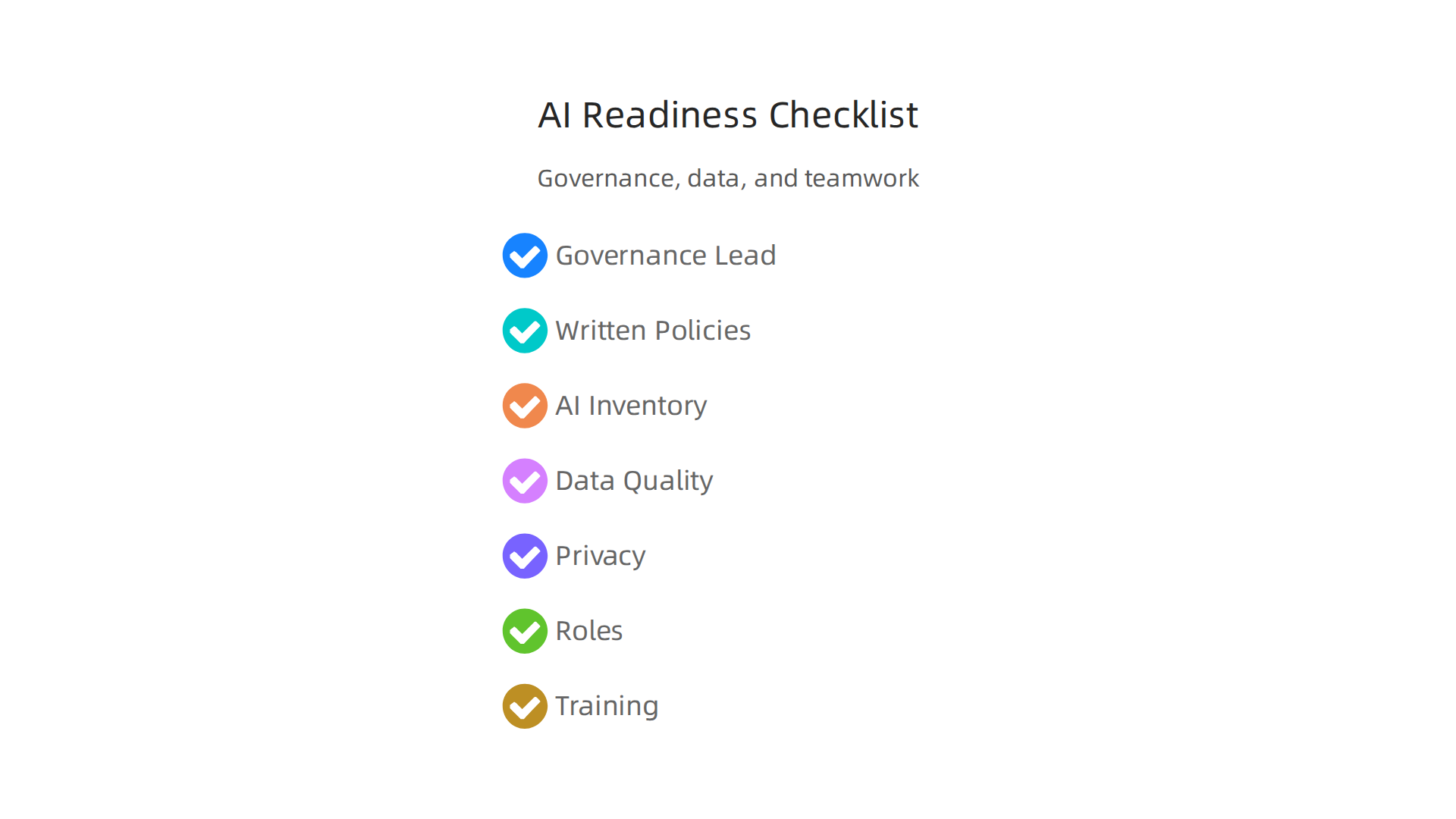
helping you understand the artificial intelligence basics: a non-technical introduction to being prepared. Many organizations use such checklists to meet compliance needs and build trust, as seen in an AI Governance Checklist for Enterprises (2026).
1. Setting Up Clear Rules (Governance)
- Who is in charge? You need specific people or a team to oversee all AI activities. This team decides what AI tools can be used and how. They act like a guide for all things AI.
- Written Policies: Create clear rules that everyone understands. These policies should cover how to use AI responsibly, how to protect data, and what to do if something goes wrong. An AI Governance Checklist (2026) points out the need for written policies about approved tools and data usage.
- Knowing Your AI: Keep a full list of all AI systems your company uses, whether they are built in-house or bought from others. This helps you track their purpose and potential risks.
2. Using Data Wisely
- Good Data In, Good Decisions Out: Ensure the data used to train AI is correct, fair, and up-to-date. If your data has errors or unfair patterns, your AI will learn those bad habits. Remember, bad data leads to bad AI.
- Protecting Privacy: AI often uses lots of information. It is vital to protect people’s private data and follow all privacy laws. You can learn more about this by reading about US Tech Regulations 2026 Navigating Data Privacy AI Governance and Antitrust Rules.
- Checking Data Quality: Regularly check the quality of your data. This helps prevent bias and ensures your AI systems work well.
3. Working Together Across Teams
AI is not just for tech people. It needs everyone’s input.
- Different Roles: Make sure different teams, like legal, product development, and customer service, all have a say in how AI is used. This helps catch problems from all angles.
- Training for Everyone: Teach employees about AI policies and how to use AI tools correctly. This is important because everyone in the company might interact with AI.
Working Together: Legal, Compliance, and Product Teams on Risk
Having legal, compliance, and product teams work together is key to handling AI risks.
- Risk Checks: These teams should regularly check AI systems for problems before they cause harm. They should ask: What could go wrong? Who would it affect? What laws might we break?
- Legal Guidance: Legal teams help make sure all AI tools follow current laws and new rules coming out in 2026. This is especially important for expert systems artificial intelligence that make big decisions.
- Compliance Checks: Compliance teams make sure the company follows its own internal rules and industry standards. They ensure the company is ready to prove how it governs AI and privacy decisions, as highlighted in the AI Governance Checklist for 2026 Compliance.
- Product Safety: Product teams ensure that AI features are built with safety and fairness in mind from the very start. They also think about how AI agents might affect users.
By following these steps, companies can make sure they are not just using AI, but using it wisely and responsibly. This helps avoid problems and builds trust with customers and regulators. To build a stronger plan, consider reading our guide on how to build a strategic artificial intelligence series for your business.
When you understand the basic steps for using AI in a good way, the next part is to put those ideas into action. This means asking the right questions. Whether you’re working with outside companies or with your own teams, knowing what to ask helps you manage AI safely. This is a very important part of understanding the artificial intelligence basics: a non-technical introduction to smart AI use.
Practical next steps: questions to ask vendors, partners, and your team
Bringing AI into your business is a big step. You need to make sure every new AI tool fits your rules and values. This is true whether you buy a tool from a vendor, work with a partner, or develop something new with your own staff.
Asking Vendors and Partners About AI
Before you sign up for any new AI service, ask direct questions. This helps you understand what you’re getting and if it’s safe. Think of it as making sure your new AI friend plays by your rules.
- How was this AI built? Ask about the data used to train the AI. Is it fair? Does it avoid showing unfair ideas? This is key for systems like expert systems artificial intelligence that make important decisions.
- What are the risks? Does the vendor openly share any known problems or dangers with their AI? How do they fix them? This helps you see if they are actively AI in managing risk.
- How does it protect private information? Make sure their AI tools follow all privacy laws.
- Can we check its work? Will the AI explain why it made a certain decision? Being able to understand the AI’s choices is very important, especially for things like explainable AI for 2026 compliance and executive trust.
- What if something goes wrong? What support do they offer? Who is responsible if the AI makes a mistake?
- How do you keep it updated? AI systems need regular check-ups to stay fair and safe. Ask how often they update their models and what kind of checks they do. Guidelines for responsible AI often suggest clear oversight, as mentioned in AI Guidance Responsible AI in Action.
Creating Simple Rules (Governance Guardrails) Before Using More AI
Before you start using AI more widely, set up some basic safety rules. This helps prevent problems later on.
- Start small: Pick one or two simple AI tools to try first. Don’t try to change everything at once. This helps you learn the artificial intelligence basics in a safe way.
- Set clear limits: For each AI tool, decide exactly what it can and cannot do. For example, maybe an AI can help answer simple customer questions but cannot give legal advice. A good resource for this is a CFO’s Checklist for 2026 AI Governance.
- Keep people in the loop: Always have a person check the AI’s work, especially for big decisions. This is important even with smart AI systems like what are AI agents that act more on their own.
- Review regularly: Set a time to check how your AI tools are working. Are they fair? Are they helping? Are they causing any new problems? This helps you grow your network AI efforts in a controlled way.
- Document everything: Keep records of your AI choices, checks, and rules. This helps you show that you are using AI responsibly. Developing an artificial intelligence ethics governance checklist can be very helpful here.
By asking these questions and setting up simple rules, you can make sure your company uses AI in a way that builds trust and follows the law. This strategic approach will help you navigate the many AI regulations 2026 compliance strategies for businesses that are in place.
Stay informed on the fast-changing world of AI and its rules. Get clear daily AI updates from The AI Newsletter Worth Reading.
Summary
This plain-language guide explains artificial intelligence for non-technical leaders so you can make smarter decisions without the jargon. It defines AI, clarifies the difference between machine learning and deep learning, and walks through how systems learn (supervised, unsupervised, reinforcement). The article breaks down the core building blocks—models, data, training, inference—and shows why data quality and bias matter. It maps common business uses like automation, prediction, personalization, and decision support, and contrasts vendor claims with real-world outcomes. The guide also covers key operational, legal, and ethical risks and explains emerging regulatory frameworks leaders must watch. Finally, it gives a governance checklist, cross-team roles, and practical questions to ask vendors so you can start small and scale AI responsibly.