

Why regulatory trends matter when you build AI today
Building AI in 2026 is exciting, but it also means dealing with a lot of new rules. Around the world, governments are creating laws about how companies should design, train, test, and use their AI systems. This is a big change for anyone who wants to build AI.
Think about it like this: if you’re building a new car, there are safety rules you must follow. Now, similar rules are coming for AI.

For example, the European Union has a big law called the AI Act. This law fully starts being enforced in August 2026, making the EU the first place to have such wide-ranging rules for AI AI Governance and Regulation 2026: A Complete Guide to ….
Also, South Korea put its own AI Framework Act into force in January 2026 AI Regulation by Country 2026: The Complete Global Map.

Other countries like the US, UK, and China are also developing their own approaches, though they might not be exactly the same AI Regulation Compared: EU, US, UK, China (2026) – Legalithm.
These rules are super important for many people. If you are a founder creating a new AI product, an executive leading a tech company, an investor putting money into AI, or part of a legal team, you need to pay close attention. These new AI policy rules affect everything. You have to think about how to make sure your products follow the law, how to manage risks, and even how to make big business plans. Ignoring these changes can lead to serious problems, like big fines or losing trust with customers.
To stay on top of these changes and understand how to build AI responsibly, it’s helpful to have good information. You can learn more about how to navigate these updates by reading about Tech Regulations 2026: Global Changes Tech Leaders Must Understand. Staying informed about these global regulatory trends is key to succeeding in the world of AI domains today.
If you want to keep up with all the daily updates on AI and technology rules, consider getting regular insights.
The AI Newsletter Worth Reading
Global Policy Landscape: Major Jurisdictions and What They Demand from Teams That Build AI
While many countries are setting up AI rules in 2026, they don’t all do it the same way. It’s like how different cities have different traffic laws. To truly build AI responsibly, you need to know these differences. Most places take one of three main paths: risk-based, sectoral, or capability-based rules. Actually, no two major places regulate AI exactly alike Global AI Regulation Comparison 2026 – AskAjay.ai.
Here’s a simple look at how some big players make their AI policy:
- European Union (EU): The EU AI Act is a big example of a "risk-based" approach.
This means the stricter rules apply to AI systems that could cause more harm. High-risk AI, like those used in hiring or healthcare, need to follow many detailed steps before they can be used. This includes making sure the data used to train the AI is good and unbiased.
- United States (US): The US tends to use a "sectoral" approach. This means different industries might get their own AI guidelines or rules. Often, these are voluntary, relying on existing government bodies to manage AI risks within their areas.
- United Kingdom (UK): Similar to the US, the UK largely relies on its current regulators to manage AI. They also have a more flexible approach, aiming to support new ideas while keeping AI safe.
- China: China moves fast with its AI policy. It often creates "targeted" rules for specific AI domains, like deepfakes or recommendation systems. These rules are usually mandatory and come with clear demands.
So, what does this all mean for teams that build AI? A lot, actually. You can’t just create an AI product and hope it fits everywhere. Your product teams need to think about new steps from the very start.
Teams must now:
- Keep Records: You need clear technical documents for your AI systems.
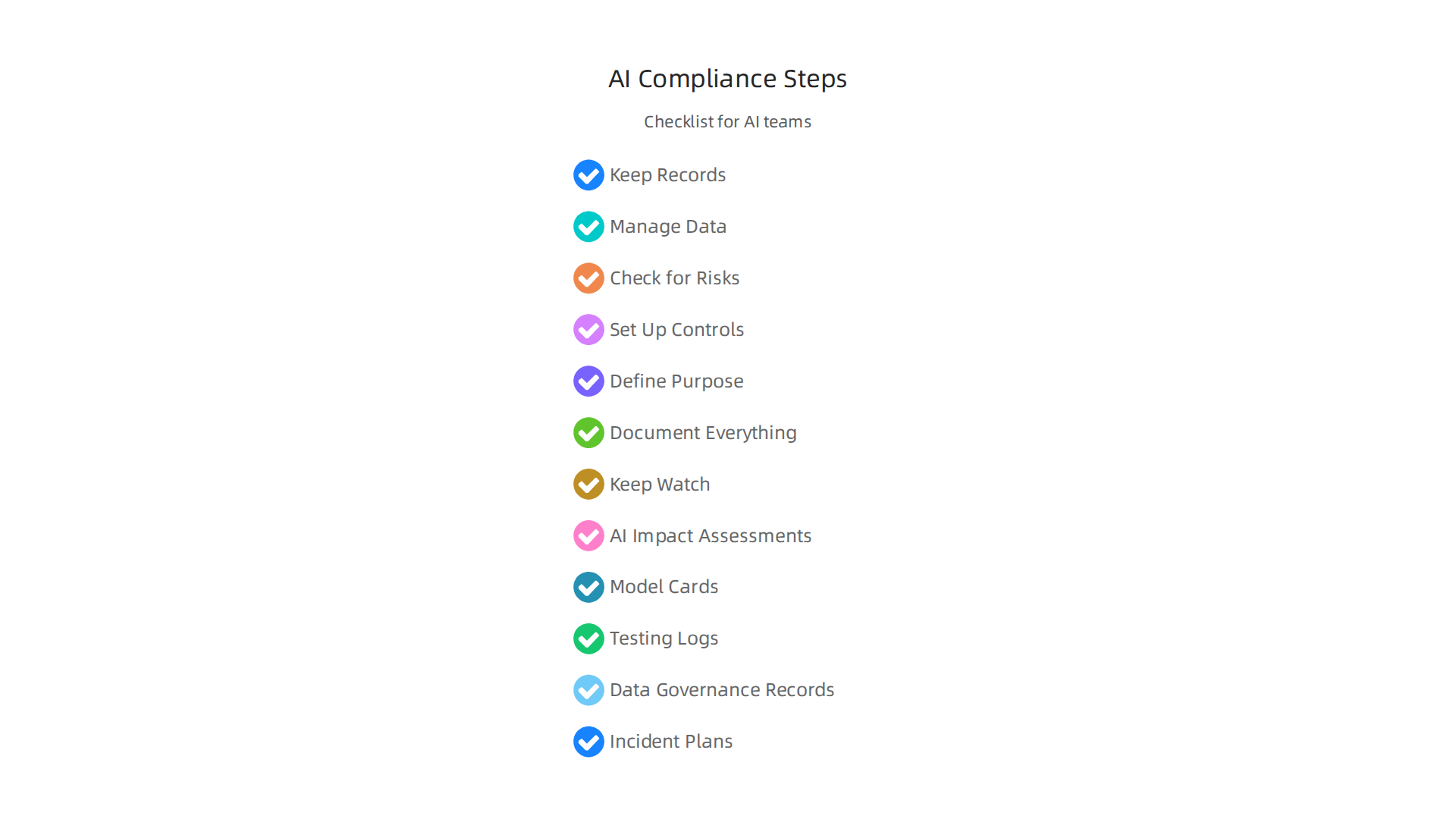
This includes having a full list of all AI tools your company uses, even those from other companies Building AI Compliance Governance Infrastructure: A Practical ….
- Manage Data Carefully: The data you use to train your AI must be relevant and free from unfairness, as much as possible. This is part of good data governance.
- Check for Risks: You’ll need to do "AI impact assessments." These are like safety checks to find out if your AI could cause harm, especially to people’s rights. The EU AI Act, for example, makes it a must to assess fundamental rights for high-risk AI systems.
- Set Up Controls: This means having systems in place to manage risks throughout the life of your AI product. It includes having human oversight and clear instructions for how your AI should be used The EU AI Act: A Compliance Checklist & AI Systems Audit ….
Learning about these different global rules helps you make smart choices when you build AI products. It helps ensure your AI is not only smart but also safe and fair. To learn more about meeting these requirements, read about AI regulations 2026 compliance strategies for businesses.
Compliance-by-design: embedding regulatory controls into the AI development lifecycle
Understanding different global AI rules is a good start. But for companies to truly build AI responsibly in 2026, they need to do more than just know the rules. They must bake these rules into how they create AI products from the very beginning. This is what we call "compliance-by-design." It means thinking about AI policy and safety at every step, not just at the end.
Imagine you’re building a house. Compliance-by-design is like making sure the house meets all building codes while you’re still drawing up the plans and pouring the foundation. You don’t wait until the house is finished to check if it’s safe.
Here’s how teams can embed regulatory controls into their AI journey:
- Before You Start (Planning & Data Collection):
- Define Purpose: Clearly write down what your AI will do, who will use it, and what good it will bring.
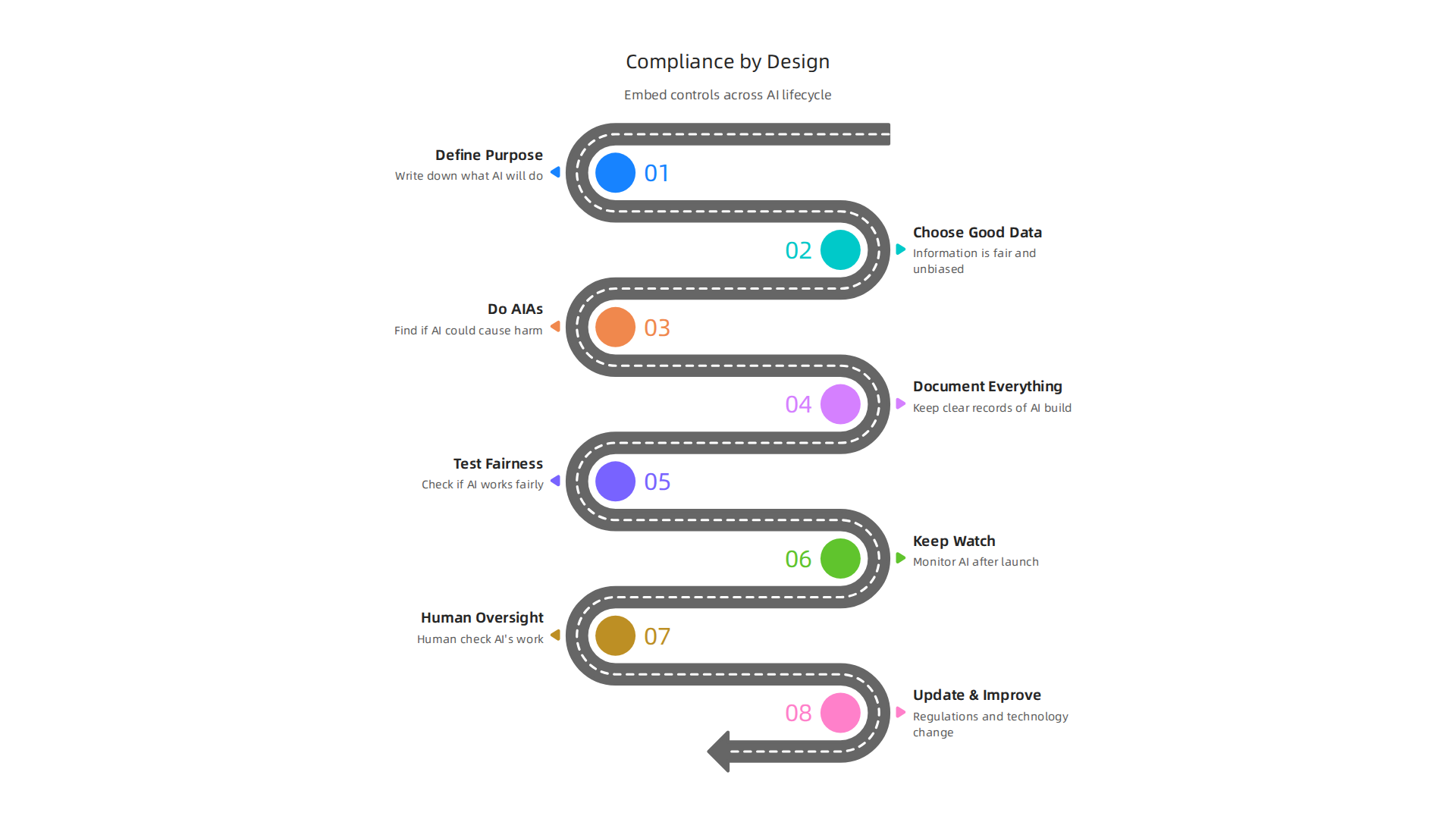
This helps you spot possible risks early on How To Conduct an AI Impact Assessment.
* Choose Good Data: Make sure the information you use to train your AI is fair and doesn’t lean one way or another. This helps avoid unfair outcomes later.
* Do AI Impact Assessments (AIA): Before you even train your AI, do a check-up. This helps you find out if your AI could cause harm, especially to people’s rights or privacy. Many templates exist to help with this, like the ISO/IEC 42001 AI Impact Assessment Template or the EU AI Act fundamental rights & AI impact assessment template.
- During Development (Training & Testing):
- Document Everything: Keep clear records of how your AI was built. This includes details about the data, how the AI was trained, and why certain choices were made. Good documentation makes it easier to show that your AI is trustworthy.
- Test for Fairness and Safety: Don’t just test if your AI works. Test if it works fairly for everyone and if it has any unexpected bad effects. Some tools and frameworks can help with these checks, offering AI Risk Assessments in Practice.
- After Launch (Deployment & Monitoring):
- Keep Watch: Even after your AI is out in the world, you need to keep an eye on it. Make sure it still works as expected and doesn’t cause new problems.
- Have Human Oversight: For important decisions, a human should always be able to step in and check the AI’s work.
- Update and Improve: Regulations and technology change. Your AI and its compliance plan should also change and get better over time.
To make all this happen, companies often set up special governance roles. These are people or teams whose job it is to oversee responsible AI use. They ensure that all the rules are followed and that the proper paperwork is kept. This way, the company can show that it’s building responsible AI, no matter the specific AI domains it’s working in.
Want to stay on top of daily AI updates and policy changes? Get clear, daily AI updates from The AI Newsletter Worth Reading.
When you build AI, it’s not enough to just follow the rules behind the scenes. You also need to show proof that you followed them. Regulators in 2026 want to see specific papers and records that prove your AI systems are safe, fair, and responsible.

This collection of papers is often called a "portfolio of artifacts."
Here are the key documents regulators will likely ask for when you deploy AI:
- AI Impact Assessments (AIAs): These are like reports that explain any bad things your AI might do before you even launch it.
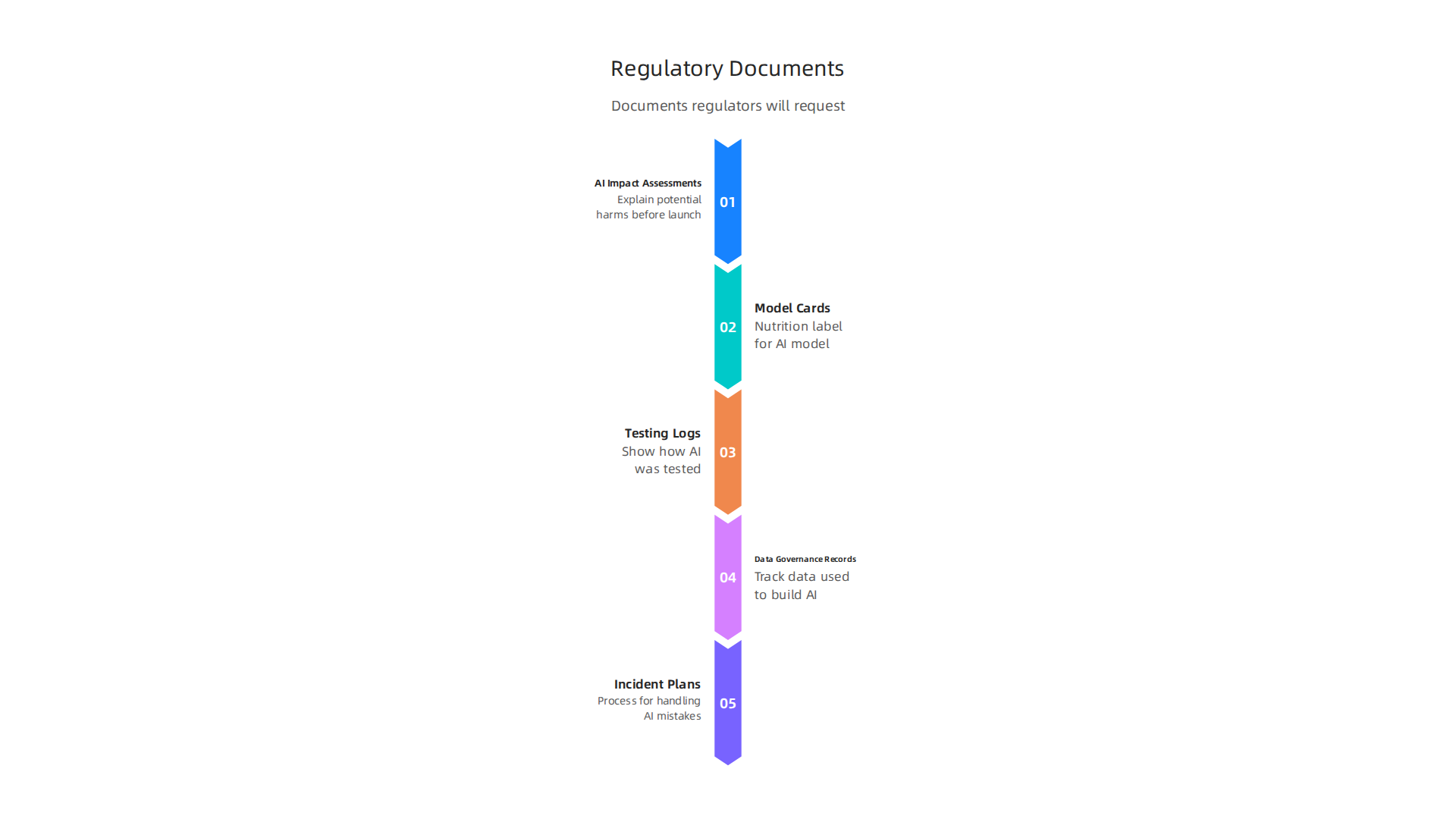
They check for harms to people’s rights or privacy. Regulators want to see that you thought about risks early on and planned how to fix them. Different groups offer templates, like the AI Impact Assessment Template from ISO/IEC 42001.
- Model Cards: Think of these as a nutrition label for your AI model. They give important details about how your AI works. This includes what kind of data was used to train it, what it’s good at, what it’s not good at, and how it should be used. This helps people understand its limits. Some frameworks, like those discussed in Regulatory Alignment, even offer specific model card templates for different types of AI.
- Testing Logs and Reports: These documents show how you tested your AI. Did you check for fairness? Did you look for biases? Were there any errors? These logs prove you properly tested your AI to make sure it works as expected and doesn’t cause harm. This is a crucial part of showing your commitment to responsible AI.
- Data Governance Records: This means keeping track of all the data you use to build AI. Regulators want to know where your data came from, how you cleaned it, and how you made sure it was fair and didn’t have hidden biases. Good data records are a must for trustworthy AI.
- Incident Response Plans: What happens if your AI makes a mistake or causes a problem? An incident response plan shows that you have a clear step-by-step process for handling such issues. It tells regulators you’re ready to act quickly and fix things if something goes wrong.
How AI Risk Levels Change What Regulators Want to See
The amount of paperwork you need to prepare also depends on how risky your AI system is. This is called "risk tiering." Not all AI is treated the same.
- Low-Risk AI: If your AI does simple tasks that don’t affect people much, like suggesting a movie, you might not need as many detailed documents. The rules are lighter for these AI domains.
- High-Risk AI: This is where things get serious. AI systems that make important decisions about people’s lives, like in hiring, loan applications, or healthcare, are considered high-risk. For these, regulators expect a lot more documentation. For example, the EU AI Act classifies systems like those used in employment decisions as high-risk, requiring detailed conformity assessments and documentation before they can be deployed. In fact, many industries are seeing stringent AI compliance needs in 2026.
- Prohibited AI: Some AI uses are so risky or harmful that they are outright banned. In these cases, no documentation will make it okay.
Regulators are actively investigating companies this year, issuing fines, and requiring fixes for AI systems that don’t meet standards. For instance, the EU AI Act’s first enforcement action was an investigation into a CV-screening vendor’s risk-management documentation in May 2026, as noted in the State of AI Compliance Q2 2026 mini-report. This shows that having the right documents isn’t just a suggestion; it’s a requirement to avoid serious problems.
To successfully build AI that meets regulatory expectations, companies must create and maintain these specific documents. It shows a clear path of responsible AI development and helps you avoid trouble. To learn more about navigating the complex rules, explore how to master global AI regulations in 2026.
When you build AI, simply having the right documents isn’t the whole story. Regulators don’t just ask for paperwork; they check to see if you’re actually following the rules. This means companies must be ready for audits, surprise investigations, and requests for information from other countries.
What Happens When Regulators Take Action?
In 2026, regulators are not shy about taking strong action. If your AI system doesn’t meet the rules, here’s what could happen:
- Fines: Companies can face big money penalties for not following AI laws.
- Orders to Fix Things: Regulators might tell you to stop using your AI or make big changes to how it works. This is called a corrective action.
- Investigations: Agencies like the Federal Trade Commission (FTC) are actively looking into companies. For example, in April 2026, the FTC focused on AI systems that made false claims, showed bias, or used fake reviews, leading to enforcement actions for deceptive AI marketing claims, biased automated decision systems, and fake AI-generated reviews. State attorneys general are also playing a bigger role in making sure AI is used fairly. This means companies need to prove their AI systems are safe and fair. You can learn more about how to prepare for tech regulations in 2026 and global changes.
These investigations can be triggered by many things. Maybe a customer complains, or an AI system has a public error. Regulators are paying close attention to AI domains that affect people’s rights, like hiring or loan approvals. They want to see proof that you developed responsible AI.
Steps to Be Ready for Regulatory Scrutiny
To avoid trouble and show you build AI responsibly, you need to prepare. Here are some key steps:
- Do Your Own Audits: Regularly check your AI systems yourself. Think of it like a self-checkup for your AI. Look for biases, unfair outcomes, or privacy problems before regulators do. This shows you’re committed to fair AI policy.
- Have a Plan for Problems: What if your AI makes a big mistake or there’s a data breach? You need an "incident response playbook." This is a step-by-step guide on what to do. It tells you who to call, how to fix the problem, and how to tell the right people, like regulators or affected users. This quick action can help lessen the impact of a problem.
- Think About Data Across Borders: Many AI systems use data from people in different countries. Each country might have its own rules about how this data can be shared and used. You need to understand these "cross-border data transfer" rules. Make sure your data practices follow all laws, no matter where the data comes from or where your AI operates. Regulators around the world are increasing their focus on ensuring that companies follow data privacy rules when using AI. As of 2026, enforcement agencies are actively investigating and issuing fines across the EU, UK, US, and Asian markets, underscoring that AI laws now have real teeth.
Staying updated on all these moving parts is a full-time job. Regulators are always adding new guidelines and taking new actions. Keeping up with global AI regulations is crucial for any business using AI.
Staying on top of these fast-changing rules is vital. To make sure you’re always in the know, get clear daily AI updates.
Get clear daily AI updates from The Deep View Newsletter.
Staying on top of these fast-changing rules is vital. To make sure you’re always in the know, companies that build AI are looking for smarter ways to show they are following the rules. This is where technical standards, special certifications, and outside experts can really help. They make it easier to deal with all the different laws.
Technical standards, certifications, and third-party assessments: reducing compliance friction
In 2026, many countries are still setting up their full AI laws. For example, while the European Union and South Korea have broad AI laws in place, other places like the US and UK rely more on existing agencies or special rules for different industries. Because of this, companies need clear ways to prove their AI is responsible AI.
One way is to follow technical standards. Think of these as common ways of doing things that show your AI works safely and fairly. When you build AI, using these standards means you’re already halfway to meeting many regulatory demands. These standards cover things like how you collect data, how you train your AI, and how you make sure it’s not biased.
Getting Certified for Trust
Another big help comes from AI certifications. These are like official stamps of approval from groups outside your company. They show that your AI systems have been checked and meet certain rules for safety, fairness, and privacy. As of 2026, many new AI certifications have popped up, making it easier for companies to prove their commitment to fair AI policy. Some certifications focus on the basic ideas of AI, while others are for more advanced roles, like AI engineers. For instance, California is even looking into special certification standards for AI vendors for state agencies.
Getting certified can also make it easier for other companies to trust your AI products, especially in sensitive AI domains like health or finance. There are many major AI certifications available in 2026, from basic knowledge to expert levels, helping professionals show their skills and companies prove their systems are reliable.
Doing It Yourself vs. Getting Outside Help
When it comes to making sure your AI is compliant, you have two main choices: build up your own team’s skills or hire outside experts.
- Doing it yourself: If you have a big team with lots of experts, you might want to handle all your AI checks in-house. This gives you full control over the process and can help you build a deep understanding of your own AI systems. You can create special rules and tools tailored exactly to what you need. However, this takes a lot of time, money, and skilled people.
- Getting outside help: For many companies, using third-party assessors or getting certifications is a simpler path. These outside groups specialize in checking AI systems against the latest rules. They can offer a fresh set of eyes and usually have the most up-to-date knowledge about what regulators expect. This can save your company time and resources. It also shows regulators that an independent expert agrees your AI is safe and works well. This can reduce the friction of compliance and help you avoid big fines down the road. It helps you quickly understand how to make an AI compliant with global regulations in 2026.
Choosing the right path depends on your company’s size, resources, and how complex your AI systems are. But no matter what, making use of these standards and assessments is a smart move for any business looking to build AI responsibly in today’s world.
No matter what, making use of these standards and assessments is a smart move for any business looking to build AI responsibly in today’s world. This smart approach also means looking at your overall business plan. You need to make sure your products, where you sell them, and how you invest all fit with the newest rules about AI.
Business strategy: aligning product roadmap, market entry, and investment decisions with regulatory trends
For any company in 2026 that wants to build AI, understanding the rules isn’t just about following the law. It’s about making smart business choices.

How you plan your products, decide which markets to enter, and even where to put your money should all be guided by what the government expects from responsible AI.
Guiding Your Products and Markets
Think of new AI rules as a map for your product team. They help you decide what features to build or avoid. If a new rule makes a certain AI function risky or expensive to use, it might be a "no-go" for that feature. For example, some US states have specific laws about AI, such as how data is collected or used. Knowing these local laws can help you decide if you should launch your product in California versus another state, especially if your AI uses special data. Staying updated on these changing state laws is key to making informed market entry decisions, according to a guide on US AI regulations 2026: the state laws you must comply with.
Also, keeping up with regulations helps set timelines. If a new AI policy is coming out next year, you might speed up or slow down a product launch to make sure you can meet the new requirements. This helps you develop a strong AI regulations 2026 compliance strategies for businesses.
How Investors Look at AI Risk
For investors and company leaders, it’s really important to know how to measure regulatory risk. This means understanding how new laws might affect how much money a company can make or how much trouble it might get into. Some groups have even created special tools, like a Responsible AI Playbook for Investors, to help people score how risky an AI investment is. These tools help leaders ask the right questions about:
- Data privacy: Is the AI handling personal data carefully?
- Fairness: Does the AI treat everyone equally, without bias?
- Transparency: Can we understand how the AI makes its decisions?
By using such frameworks, investors can better decide if an AI company is a good, safe place to put their money. This helps them balance the excitement of new technology with the need to build AI that is both smart and safe. Learning how to use AI strategically a decision makers guide for 2026 can make a big difference.
Staying informed about these shifts in AI policy and understanding how to apply them to your business decisions is a continuous process.
Get clear daily AI updates from The AI Newsletter Worth Reading.
Staying informed is key, but looking ahead to what’s coming next is just as important. For companies working with AI, it’s not enough to simply react to current rules. You need to peek into the future to see what new AI policy might be on its way, especially as we look beyond 2026. This means learning how to predict risks and set up ways for your company to change easily.
Anticipating 2027+: forecasting regulatory risk and building adaptive compliance programs
To really build AI with confidence, businesses need to become good at guessing what new rules will come up. This way, they can change quickly without slowing down new ideas. This future-gazing, often called "horizon scanning," helps teams stay ahead of the curve.
Keeping an Eye on What’s Next
Governments around the world are getting serious about AI rules. In 2026, many agencies are already actively looking into companies. For example, the FTC has been taking action against companies making false claims about AI, using biased AI systems, or having fake AI reviews, as highlighted in a report on FTC AI Enforcement Actions April 2026. This shows that there are real consequences for not following the rules.
Also, state governments in the US are getting more involved. State attorneys general are often stepping up to enforce rules even if federal agencies haven’t yet, according to The State AG Dispatch. They are using existing laws about consumer privacy to cover AI issues. This means that companies need to watch out for changes not just at the federal level, but also in each state where they operate. It’s a busy time for AI Regulation Enforcement in 2026 across many regions.
To forecast what might come next, your team can:
- Watch for new laws being talked about: Pay attention to early drafts or discussions about new regulations.
- See what other countries are doing: Often, a rule that starts in one place, like the EU AI Act, might give clues about what could happen in other tech regulations 2026 global changes.
- Look at past enforcement actions: What problems did companies get into before? Regulators might focus on similar issues again. The first enforcement action against a "high-risk" AI system under the EU AI Act happened in May 2026, showing regulators are serious about documentation and risk management, as reported in the State of AI Compliance Q2 2026.
Making Your Company Ready to Adapt
To be truly ready, companies need simple ways to handle new rules. This means having:
- Easy-to-follow plans: Create guidebooks or playbooks that show teams what to do when a new rule comes out. This helps keep everyone on the same page.
- Clear roles: Make sure everyone knows who is in charge of what part of the AI policy and compliance. This helps you build responsible AI.
- Fast updates: Your company should be able to quickly change how your AI products work, how you keep records, and what information you share with customers.
These steps help you put in place good "governance rhythms." This means that checking and updating your AI systems for new rules becomes a normal part of how you do business. It helps you build AI that is both clever and safe, allowing for new ideas to grow while still respecting the rules. This is important for all AI domains and helps your business thrive.
Summary
This article explains why the rapidly evolving regulatory landscape matters for anyone building AI in 2026 and beyond. It compares major approaches — the EU’s risk-based AI Act, sectoral U.S. and U.K. models, and China’s targeted rules — and shows how those differences change what teams must do. The piece walks through compliance-by-design practices across planning, development, and post-launch monitoring, and lists the concrete artifacts regulators expect (AI impact assessments, model cards, testing logs, data records, incident plans). It also covers real enforcement risks, steps to prepare for audits, and how standards, certifications, and third-party assessments can lower friction. Finally, it explains how to align product roadmaps and investment choices with regulatory trends and how to set up adaptive compliance programs to anticipate future rules. After reading, leaders will know which documents to produce, which lifecycle controls to embed, and how to organize teams to stay audit‑ready and market‑safe.