

In 2026, artificial intelligence (AI) is everywhere. It is changing how we work, how businesses run, and even how we live. But with all these changes, it can be hard for busy people to keep up. If you are a technology leader, an investor, or part of a compliance team, you need to understand AI. It is not just for the tech experts anymore.

You might feel like there is too much information out there, and it is all very technical. How do you know what is important and what is not?
This is a common challenge. Many people in important roles need a simple, clear guide to AI. They need to know "how to use ai" in smart ways. They need to understand what AI is, how it works, and how it impacts their business without getting lost in complex details. For example, understanding the foundational ideas is key to preparing for discussions about strategy, following rules, and talking to technical teams. Experts even say that for those who are not technical, starting with an AI literacy course is often the best first step to learn what AI can and cannot do. This helps with understanding how AI projects are planned and reviewed, and how companies decide if using AI is a good idea Best AI Courses with Certificates in 2026.
This guide will give you a clear and actionable foundation in AI. We will help you understand the core ideas, much like learning the basics from a well-known resource such as master artificial intelligence a modern approach prerequisites for business and compliance. Our goal is to prepare you for making smart choices about AI. We will focus on building trust and making sure you are ready for important talks about AI strategy, following the rules, and working with technical teams. Knowing the basics of artificial intelligence: a modern approach 4th us ed is no longer optional; it is a must for leaders and teams who want to succeed in today’s fast-moving tech world.
To keep up with the newest changes in AI and how they affect rules and business, consider signing up for daily insights. Get clear daily AI updates from The Deep View Newsletter. The AI Newsletter Worth Reading.
The previous section helped explain why understanding AI is so important right now. So, let us get to the very first step: figuring out what artificial intelligence actually is.
What is artificial intelligence? Clear definitions for non-academics
Artificial intelligence, or AI, is a big area in computer science. It is all about making machines that can do tasks we usually think only humans can do. This includes things like learning new information, solving problems, understanding what we say or write, and even recognizing faces or objects. The idea of AI is not new at all. A computer scientist named John McCarthy first used the term in 1955. He called it "the science and engineering of making intelligent machines" SETR 2026: Artificial Intelligence.
For business leaders and legal teams, it helps to think of AI as systems that take information and then use it to create something new. This could be making predictions, writing content, giving suggestions, or making decisions that can affect the real world or a digital one AI Systems as Digital Public Goods. This definition helps us understand why knowing "how to use ai" responsibly is a big deal today.
AI is a very broad field, like a big tree with many branches. Inside this big field, there are smaller, more specific areas. Two of the most important branches you will often hear about are Machine Learning and Deep Learning.
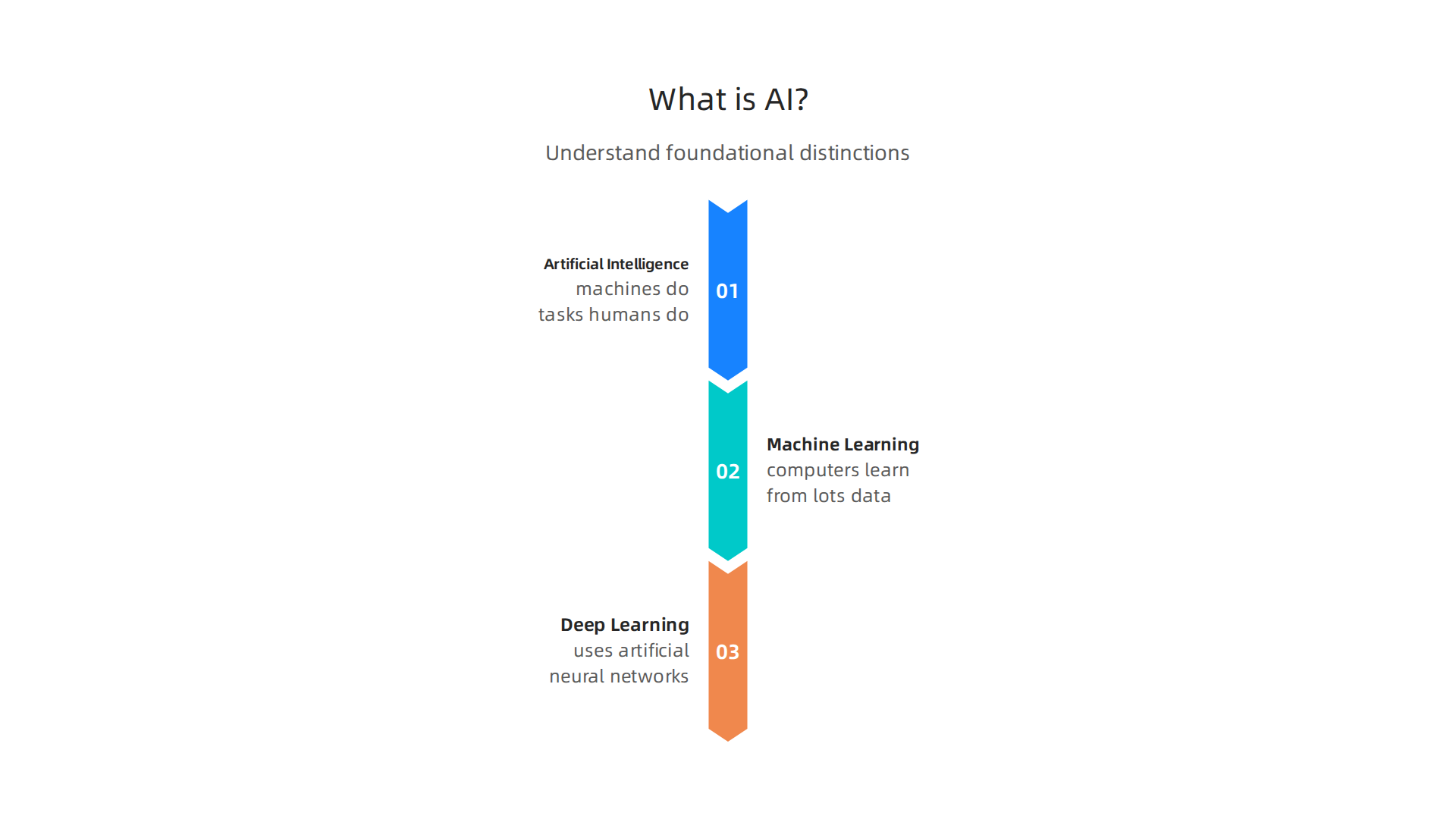
They are both part of AI, but they work in different ways:
- Machine Learning (ML) is a key part of AI where computers learn from lots of data without being directly told every single step. Think of it like teaching a child by showing them many examples, rather than giving them a rulebook. Machine learning lets computers get better at tasks over time, such as recommending a product you might like or finding unusual patterns that could mean fraud Machine learning, explained.
- Deep Learning (DL) is an even more focused kind of Machine Learning. It uses special computer programs called "artificial neural networks," which are made to act a bit like the human brain. These networks are very good at finding hidden patterns in huge amounts of information, like recognizing faces in pictures or understanding human speech. If you are curious about these building blocks, you can learn more about artificial neural network basics every business leader needs to understand.
So, when people talk about "artificial intelligence: a modern approach 4th us ed" or even an "artificial intelligence olympiad," they are talking about this whole world of smart machines and all their different learning methods. Keeping these differences clear helps everyone, from business owners to compliance officers, understand how AI tools work and what rules they need to follow. This foundational knowledge is key for anyone navigating the AI world in 2026, including specialized areas like "delana hope ai."
To truly understand the big picture of artificial intelligence, it helps to look back at how we got here. AI did not just appear overnight; it has grown through different ideas and approaches over many years. Knowing this history helps us understand why AI works the way it does in 2026 and what we can expect from it.
At first, a lot of AI research, especially in the 1970s and 1980s, focused on what we call Symbolic AI. Think of this like teaching a computer with very clear rules and logic, step by step. It was about making machines reason like humans do, using symbols and carefully programmed information JRC study for a correct taxonomy of AI. These systems were good for specific tasks where rules were easy to define.
Then, things started to shift. The focus moved more towards statistical Machine Learning. Instead of just giving computers rules, people started giving them lots of data. The computers would then find patterns in this data and learn from it, improving over time. This approach showed that AI could learn to make predictions or decisions without being told every single detail.
More recently, in the past decade, we have seen the rise of Deep Learning. As discussed before, this is a special kind of Machine Learning that uses networks like the human brain. Deep learning has been amazing at tasks like understanding speech, recognizing images, and powering the large language models we see everywhere today. These historical changes help shape how we think about "how to use ai" effectively and responsibly. If you want a deeper dive into these ideas, many people find "artificial intelligence: a modern approach 4th us ed" to be a very helpful book. You can learn more about how this knowledge applies to your business and compliance needs with an internal guide on artificial intelligence a modern approach by Russell Norvig.
Understanding these different waves of AI, from symbolic logic to today’s advanced deep learning, is important. It helps us see that AI is not one single thing but a collection of smart methods that keep getting better. This evolution also means that when we talk about things like an "artificial intelligence olympiad" or specialized AI such as "delana hope ai," we are talking about efforts built on these changing ideas. This ongoing story impacts what AI can do for businesses and highlights the need to stay informed about the latest developments and regulations in 2026.
Staying updated on the fast-changing world of AI is crucial for any professional today.
Get clear daily AI updates from The AI Newsletter Worth Reading.
Staying updated on the fast-changing world of AI is crucial for any professional today. After seeing how AI has changed over time, it helps to look at the main ideas that make up much of what we call AI today in 2026. These ideas help us understand "how to use ai" for different tasks and set the right expectations for its power.
Core Concepts: Machine Learning, Deep Learning, NLP, and Computer Vision
The world of artificial intelligence is made up of several important parts. Understanding these parts helps you see what AI can and cannot do.
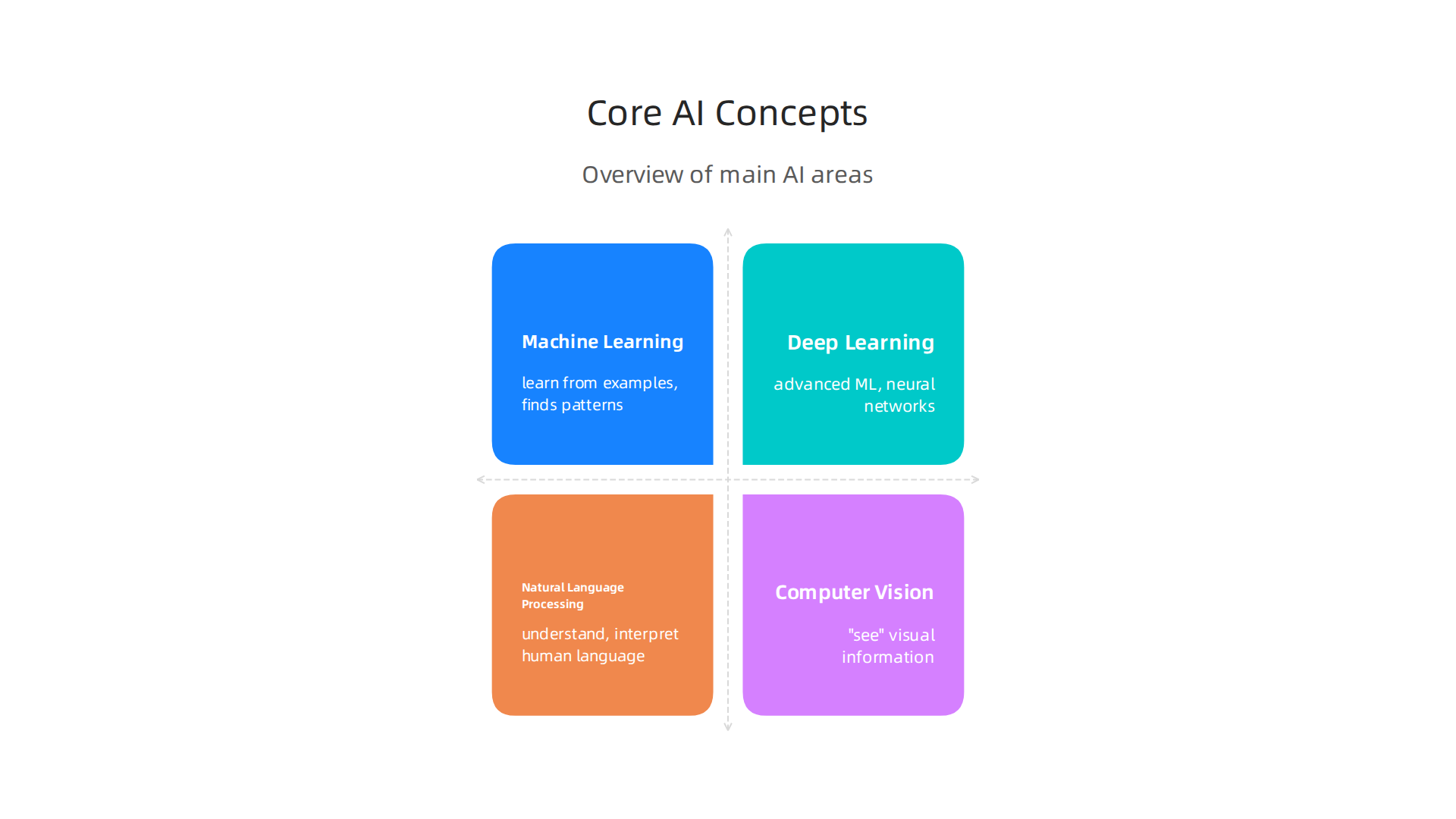
Think of them as different tools in the AI toolbox.
Machine Learning (ML)
Machine Learning is like teaching a computer to learn from examples, without giving it every single rule. You give it lots of data, and it finds patterns on its own. For example, if you give it many pictures of cats and dogs, it learns to tell them apart.
- Inputs: Large amounts of data, like numbers, words, or pictures.
- Outputs: Predictions, decisions, or ways to sort things. For example, predicting house prices, figuring out which emails are spam, or recommending products.
- When to Use: When you need to find hidden patterns in data, make forecasts, or automate decisions based on past information. It’s a key part of how many businesses use AI today Machine learning, explained.
You can learn more about how machine learning works for business leaders in 2026 by exploring artificial intelligence and machine learning explained for 2026 business leaders.
Deep Learning
Deep Learning is a special, more advanced type of Machine Learning. It uses artificial neural networks, which are inspired by how the human brain works. Deep learning needs even more data and computing power, but it can find even more complex patterns.
- Inputs: Very large datasets, often of unstructured data like images, sounds, or text.
- Outputs: Highly accurate recognition, understanding, and generation. This is what powers many advanced AI systems.
- When to Use: For tasks that require understanding complex data like recognizing faces, translating languages, or creating new content. This kind of "artificial intelligence: a modern approach 4th us ed" is very powerful. If you’re interested in the brain-like foundations, learning about artificial neural network basics every business leader needs to understand can be very helpful.
Natural Language Processing (NLP)
NLP is the part of AI that helps computers understand, interpret, and make human language. It’s how computers can talk to us, translate languages, or summarize long texts.
- Inputs: Text (written words) and speech (spoken words).
- Outputs: Language translation, chatbots, text summaries, sentiment analysis (understanding feelings in text).
- When to Use: For customer service chatbots, voice assistants, analyzing customer feedback, or translating documents.
Computer Vision
Computer Vision allows AI systems to "see" and understand visual information from the world, just like our eyes do. This includes recognizing objects, people, and actions in images and videos.
- Inputs: Images, videos, and live camera feeds.
- Outputs: Object detection, facial recognition, image classification, medical image analysis, and helping self-driving cars "see" the road.
- When to Use: For security systems, quality control in factories, medical diagnoses, and autonomous vehicles Artificial Intelligence – Stanford Emerging Technology Review.
What Executives Need to Know
For leaders, it is important to know that AI is not one magic solution but a collection of these powerful tools. Each has its strengths and best uses. When thinking about "how to use ai" in your business, remember:
- Data is Key: All these AI types rely heavily on data. Good, clean, and plentiful data makes AI work better.
- Capabilities vs. Expectations: AI can do amazing things, but it is not perfect. Understanding these core concepts helps you set realistic goals and avoid disappointments. For instance, while AI can assist in many administrative and employment contexts, it’s vital to grasp its actual abilities Artificial Intelligence (AI) in Administrative & Employment ….
- Start Simple: Often, the best way to get started with AI is to use simpler Machine Learning models for clear problems before jumping to complex Deep Learning projects.
Knowing these different types of AI and what they do can help you make smarter choices for your business in 2026, whether you’re looking into an "artificial intelligence olympiad" or specialized AI solutions like "delana hope ai."
Now that we know about the different kinds of AI tools, like Machine Learning and Deep Learning, let’s look at how these tools are actually put together. Building an AI system is like building anything else. It needs a plan, good parts, and testing to make sure it works right.

This process is often called an "AI pipeline" or "machine learning pipeline" in 2026, and it’s how we figure out how to use AI from start to finish.
How AI Systems Are Built: Data, Models, Training, and Evaluation
Building a strong AI system involves several key steps.
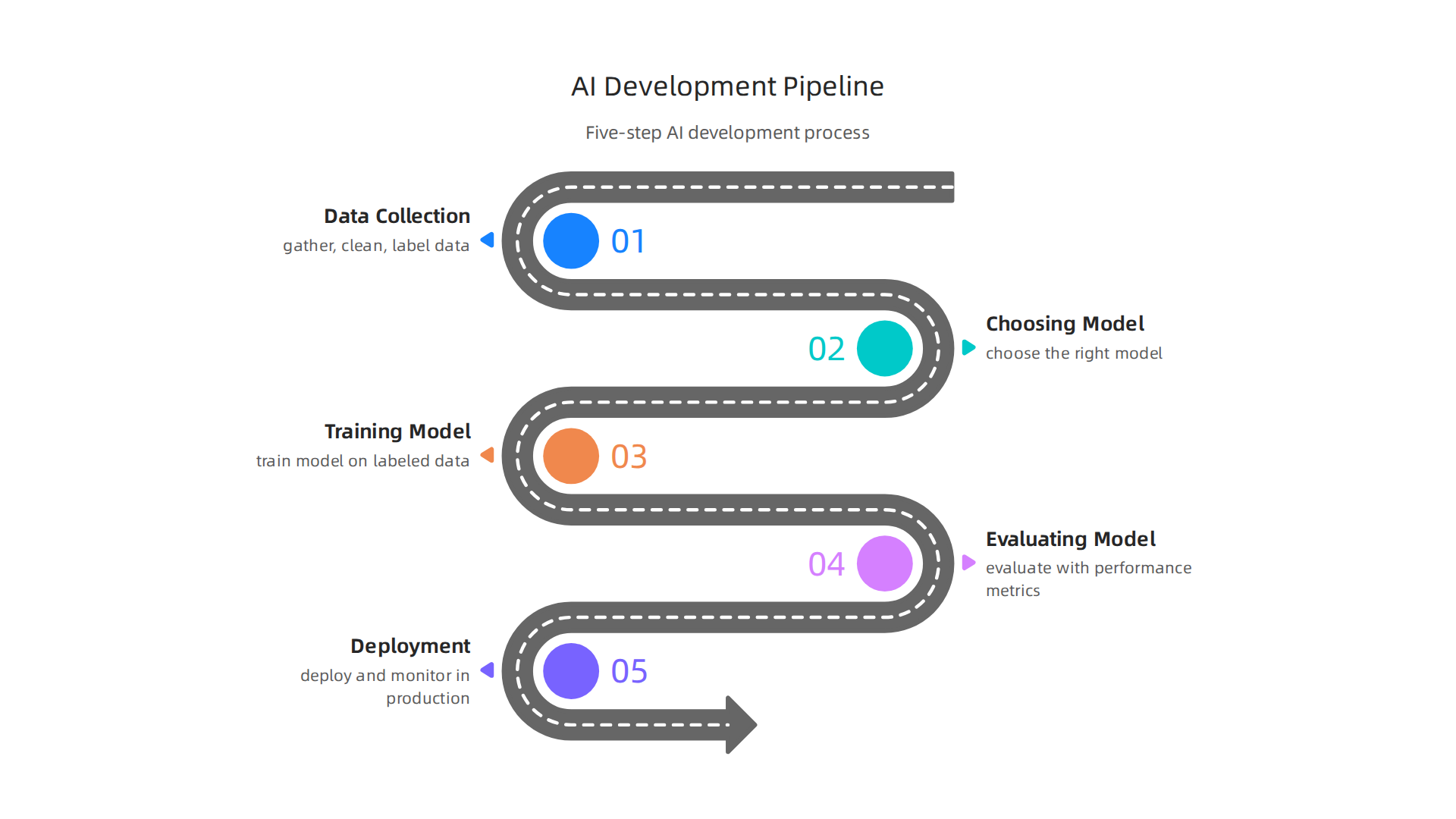
Each step is important to make sure the AI works well and gives helpful results.
1. Data Collection and Preparation
Every AI system needs data. Think of data as the food for the AI brain. Without enough good food, the AI won’t learn properly.
- Gathering Data: This is where we collect lots of information. For example, if we want an AI to recognize cats, we need thousands of pictures of cats. This data can be text, numbers, images, or sounds. A good amount of data is important for AI training Recommendation ITU-T Q.4081 (01/2026).
- Cleaning Data: Data isn’t always perfect. It might have mistakes, missing parts, or information that doesn’t make sense. Cleaning the data means fixing these issues. This step ensures the AI learns from accurate information.
- Labeling Data: For many AI tasks, especially in machine learning, we need to "label" the data. This means telling the AI what each piece of data is. In our cat example, we’d label pictures as "cat" or "not cat." This helps the AI understand what it’s looking at. Data readiness is key for AI training Data Readiness for AI: A 360-Degree Survey.
2. Choosing the Right Model
After preparing the data, the next step is to pick the right AI model. As we talked about earlier, there are different types like Machine Learning, Deep Learning, NLP, or Computer Vision. The choice depends on what you want the AI to do. If you need it to understand complex patterns in images, a Deep Learning model might be best. If it’s for simple predictions, a standard Machine Learning model could work. This step is like picking the right tool from your toolbox.
3. Training the AI Model
Training is the heart of building an AI. In this step, we feed the cleaned and labeled data to the chosen AI model. The model then learns from this data, finding patterns and rules on its own. It adjusts its internal settings again and again until it gets better at its task.
- Splitting Data: Usually, we split our data into different parts:
- Training Set: The biggest part, used to teach the model.
- Validation Set: Used to check the model’s progress during training and make small adjustments.
- Test Set: A completely new set of data that the model has never seen, used only at the very end to see how well it truly performs Automated Data Preparation for Machine Learning: A Survey.
This whole process is like studying for a big test; the AI learns from examples until it’s ready. If you want to dive deeper into the basics of AI, a resource like "artificial intelligence: a modern approach 4th us ed" can give you a strong foundation.
4. Evaluating the Model
Once the AI model is trained, we need to see how good it is. This is called evaluation. We use the test set (the data the model has never seen) to check its performance.
- Metrics: We use special measurements, called metrics, to tell us how accurate the AI is. For example, if it’s supposed to find all the cats in pictures, we’d measure how many it found correctly and how many it missed. These evaluation metrics are important for seeing how well a model works Recommendation ITU-T Q.4081 (01/2026).
- Refinement: If the AI isn’t good enough, we might go back to earlier steps. Maybe we need more data, better cleaning, or a different model. This loop of training and evaluating helps us make the AI better. Building these systems in 2026 often involves automated pipelines for better efficiency ML pipelines | Machine Learning.
5. Deployment and Monitoring
Finally, when the AI model is performing well, it’s put into action. This means it starts working in the real world, whether it’s powering a chatbot, helping a self-driving car, or something else. But the work doesn’t stop there. AI systems need to be watched carefully (monitored) to make sure they keep working correctly. Data in the real world can change, and the AI might need updates or retraining. Companies like Delana Hope AI understand this need for ongoing attention.
Understanding these steps helps business leaders know what goes into making AI work and how to make sure their AI solutions are effective and reliable. It also helps in understanding the broader picture of how to make an AI compliant with global regulations in 2026.
Staying informed about how AI systems are built and regulated is crucial in today’s fast-moving world.
Get clear daily AI updates from The AI Newsletter Worth Reading.
After an AI model is trained, it’s very important to check how well it actually works. This check uses special tools and methods to make sure the AI is reliable. Think of it like grading a student’s test. We want to know not just if they passed, but also if they really understand the subject.
Common evaluation metrics and validation techniques
When we evaluate an AI, especially for tasks like classifying things (telling cats from dogs), we look at several key measurements.
- Precision: This tells us how many of the things the AI said were correct, actually were correct. For example, if an AI finds 10 pictures it calls "cat," and 8 of those are truly cats, its precision is 80%.
- Recall: This tells us how many of the real correct things the AI managed to find. If there are 10 actual cat pictures, and the AI only found 7 of them, its recall is 70%.
- F1-score: This is a helpful score that combines both precision and recall. It gives us a single number that shows a good balance between finding most of the right things and not making too many mistakes. Many different metrics, like these, are used to see how good a model is at its job, as explored in papers like Exploring One Million Machine Learning Pipelines.
- ROC-AUC: This is another way to see how well an AI can tell two different things apart, like spotting a medical problem in a scan. It looks at how good the AI is at finding true positives versus false positives.
- Metrics for numbers: If an AI predicts numbers, like the future price of a house, we use different metrics. These might measure how far off its predictions usually are from the real answer.
- Metrics for creative AI: For AI that creates new things, like images or text, judging performance can be tricky. We might use human judges or special scores that compare the AI’s creations to real-world examples. Understanding these different ways to measure helps us make sure the AI is fit for its purpose, as detailed in guides like EVALUATION METRICS OF MACHINE LEARNING.
Beyond just looking at scores, how we test the AI also matters a lot.
- Holdout Sets: As mentioned before, we always keep a separate "test set" of data that the AI has never seen during training. This is like giving the student a completely new test to see what they really know.
- Cross-validation: Sometimes, to get an even better idea of how well the AI will do, we split the data into many different test sets, not just one. We train and test the AI multiple times with different splits and then average the results. This gives a more reliable score.
- Data Leakage: This is a big pitfall to watch out for. It’s when information from the test data accidentally "leaks" into the training data. This makes the AI look better than it is because it’s already seen parts of the "test" before. It’s like a student getting a peek at the exam questions beforehand.
For anyone serious about building AI, learning these evaluation methods is as important as understanding the basics found in texts like Artificial intelligence: a modern approach by Russell Norvig your 2026 AI business and compliance roadmap. Without proper evaluation, it’s impossible to truly know if an AI system, like those used by Delana Hope AI, is performing as expected or is ready for a real-world task, perhaps even for an artificial intelligence olympiad.
But even before we evaluate an AI, we must first pick the right kind of AI brain, or "architecture," for the job. Just like you wouldn’t use a hammer to drive a screw, you need the right tool for different artificial intelligence tasks. Understanding these popular model architectures is a key part of learning Artificial intelligence: a modern approach prerequisites for business and compliance.
Popular model architectures and when to use them
Let’s look at some common ways to build AI models and when you might choose each one.
-
CNNs (Convolutional Neural Networks): Think of CNNs like a super smart pair of eyes for computers. They are great at looking at pictures and finding patterns. This makes them perfect for tasks like telling a cat from a dog, recognizing faces, or finding objects in images. They work by looking at small parts of an image first, then putting those findings together. CNNs are very efficient for these types of tasks because of how they process visual information, as explained in comparisons of deep learning architectures like this one.
-
RNNs (Recurrent Neural Networks): RNNs are good for things that come in order, like words in a sentence, music, or a list of numbers over time. They have a "memory" that helps them understand how past information connects to new information. But sometimes, if the sequence is too long (like a very long book), they can forget what happened at the beginning. This can make them tricky for really long messages or sequences, as they sometimes struggle with remembering details from far back in the data.
-
Transformers: These are the new stars, especially for understanding language. Transformers are like an upgraded version of RNNs. They can look at all the words in a sentence at once, not just one after another. This helps them understand the bigger picture and remember things over very long texts. Because they can process information in parallel, they are faster and better for many complex language tasks. In 2026, Transformers are often the first choice for the best results in natural language processing (NLP) and even in advanced vision tasks, especially when you have lots of data and computing power to use AI effectively. They are known for achieving state-of-the-art accuracy, as noted in studies on real-world applications of these models in a 2026 publication.
-
Ensemble Methods: Imagine a team of different experts working together. That’s what ensemble methods do. They combine several AI models (which could be CNNs, RNNs, or others) to make a final decision. This often leads to better and more stable results than using just one model alone. It’s like having multiple opinions before making an important choice.
How to pick the right model:
Choosing the right architecture depends on what you want your AI to do:
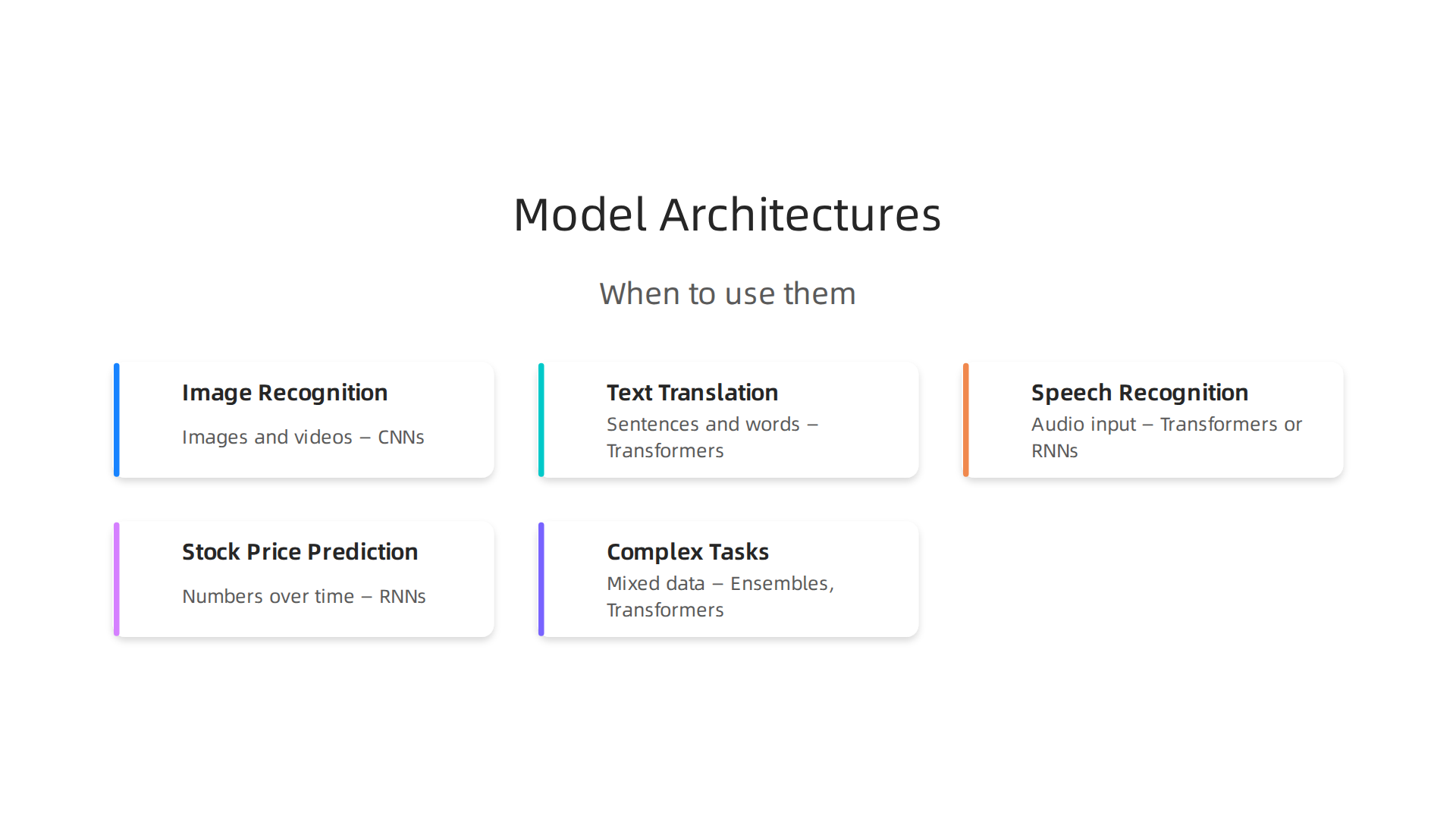
| Task Type | Data Type | Best Architecture Choice (in 2026) |
|---|---|---|
| Image Recognition | Pictures, videos | CNNs |
| Text Translation | Sentences, words | Transformers |
| Speech Recognition | Sound | Transformers, sometimes RNNs |
| Stock Price Prediction | Numbers over time | RNNs or Transformers |
| Complex Tasks | Mixed data | Ensemble methods, Transformers |
For cutting-edge applications, especially those that might be used in an artificial intelligence olympiad or by companies like Delana Hope AI, Transformers often lead the way due to their power and accuracy. However, simpler tasks with smaller datasets might still find CNNs or RNNs a more suitable and efficient choice, as a detailed comparison of deep learning architectures shows.
Staying updated on these powerful tools and the way they are used is key for any business in 2026.
Ready to dive deeper into the world of AI and its fast-changing rules?
The AI Newsletter Worth Reading
Transformer architecture: a practical overview
We touched on Transformers as the new stars for understanding language in the last section. Let’s look closer at why they are so powerful. The main trick up a Transformer’s sleeve is something called an "attention mechanism." Imagine you are reading a long book. You don’t just read word by word and forget the beginning by the time you reach the end. Your brain pays attention to the most important words and how they connect to each other, no matter where they are in the story. This is similar to how the attention mechanism works. Transformers can look at all the words in a sentence or even a whole document at once. They then decide which words are most important to understand the meaning of other words. This helps them connect ideas across very long pieces of text. This ability means they can remember details over long sequences, which was a big problem for older models like RNNs, as a Deep Learning Architectures Comparative Analysis points out.
This "paying attention" to the whole picture at once, instead of just going step-by-step, is why Transformers have become so dominant in 2026. They are especially good at tasks where context matters a lot. Think about translating languages, writing summaries, or answering questions from long articles. They achieve very high accuracy in these areas. Many breakthroughs in artificial intelligence, like those needed for an artificial intelligence olympiad, now rely on this architecture. They are truly state-of-the-art for natural language processing and are even taking over in advanced vision tasks, showing why a comprehensive comparison of deep learning architectures often places them at the top.
However, using Transformers comes with some trade-offs. To work their magic, they usually need a lot of data to learn from and a lot of computing power. This means bigger computer servers or specialized hardware. While they are great at processing information in parallel, meaning they can do many things at once, they can sometimes be slow if they have to deal with extremely long documents due to how they scale up. Despite these needs, for businesses looking to truly understand how to use AI for complex problems in 2026, especially those related to language or advanced data understanding, Transformers are often the go-to choice. Understanding these models is a core part of learning about the "artificial intelligence: a modern approach 4th us ed" and what it means for today’s technology landscape.
Capabilities and limitations: generalization, bias, and robustness
While artificial intelligence (AI) models like the Transformers we just talked about are very smart, they are not perfect. It’s important to know what they can and cannot do well, especially as we learn more about "artificial intelligence: a modern approach 4th us ed." These models learn from huge amounts of data. This means they are only as good as the data they are given.
One big challenge for AI is generalization. This means how well an AI can handle new situations it hasn’t seen before. Imagine a child who learns about cats by only seeing pictures of house cats. If that child suddenly sees a tiger, they might get confused. AI models can be like that. They might do great on tasks they’ve been trained for, but struggle when faced with something a little different. They don’t always have common sense like humans do.
Another important issue is bias. AI models learn from the data we feed them. If this data holds unfair patterns or is missing information about certain groups of people, the AI will learn those unfair patterns. For example, if a face recognition system is trained mostly on pictures of one type of person, it might not work as well for other people. This can lead to unfair results or decisions. Many governments are now setting up rules for how AI is used to fight against these biases. For instance, the UK government has a Data and AI Ethics Framework to guide responsible AI use.
Then there is robustness. This is how strong and stable an AI model is when things change a little. Sometimes, a tiny change that a human would barely notice can completely confuse an AI. Think of a picture of a stop sign that has a few small stickers on it. A human would still see it as a stop sign, but an AI might suddenly think it’s a speed limit sign. This shows that AI models can be fragile and sometimes fail in unexpected ways, which is a risk to think about when you consider why is AI bad in certain uses.
Because of these limits, it’s very important to think about the risks when using AI, especially for big tasks.

Governments and experts around the world are working to create rules and guides to make sure AI is used safely and fairly. In 2026, many countries, including the US, have proposed national plans for AI, like the White House National AI Policy Framework for governance and compliance. Understanding these frameworks is key to mastering global AI regulations for compliance.
To stay on top of all the latest changes and important discussions in AI, including how to make sure models are fair and robust, keeping informed is a must.
Get clear daily AI updates from The AI Newsletter Worth Reading.
To stay on top of all the latest changes and important discussions in AI, including how to make sure models are fair and robust, keeping informed is a must. This brings us to the core ideas of AI safety, ethics, and governance, which are crucial for anyone making decisions in 2026.
AI safety, ethics, and governance basics for decision-makers
Making sure AI is used safely and fairly means setting up clear rules and guidelines. This is what we call AI governance. It’s about creating a roadmap for how to develop, use, and oversee artificial intelligence. Many countries are now rolling out their own plans for this. For example, the US government has shared legislative ideas for a White House National Policy Framework for AI, focusing on areas like children’s safety and intellectual property.

India has also adopted its own India AI Governance Guidelines to help ensure AI innovation is safe and inclusive.
These rules often come with ethical principles. These are like a moral compass for AI, guiding people to build AI that is fair, transparent, and accountable. They ask questions like: Is the AI going to treat everyone equally? Can we understand how the AI makes its decisions? Who is responsible if the AI makes a mistake? Organizations like the Digital Cooperation Organization (DCO) have even published an Ethical AI Guidebook for Policymakers to help governments put these ideas into action.
For businesses and anyone trying to figure out how to use AI responsibly, it’s vital to watch these regulatory touchpoints. Compliance teams need to keep track of new laws and guidelines, both at home and abroad. They should look for updates from governments about how AI should be designed, tested, and used. For example, Australia has a National framework for the assurance of artificial intelligence in government that sets practices for safe government AI use.
It’s not enough to just know the rules; you also need to show that you are following them. This means documenting everything. Compliance teams should monitor:
- How AI systems are built and trained.
- The data used to train the AI, making sure it’s fair and unbiased.
- How decisions are made by the AI, and if these decisions can be explained.
- Any potential risks or harms the AI might cause, and how those risks are being managed.
Staying updated on "artificial intelligence: a modern approach 4th us ed" thinking and emerging rules is crucial. Knowing how to use AI in a way that aligns with ethical standards and legal frameworks is a big challenge, but it’s one that every organization must face. Understanding these systems can help you navigate the future, whether you’re interested in policy or even something like an artificial intelligence olympiad. If you want to learn more about keeping your AI systems compliant, check out our guide on how to make an AI compliant with global regulations. This continuous effort will help ensure AI benefits everyone safely and responsibly.
To truly make sure AI helps everyone safely and fairly, organizations need a clear plan for learning and growth.

This isn’t just for tech experts; everyone, from company leaders to compliance teams, needs to understand how to use AI responsibly. It’s about building strong skills inside your company to handle the newest AI tools and rules.
Practical learning roadmap: resources, tools, and next steps for teams
Different roles in a company need different kinds of AI knowledge. Here’s a simple roadmap for how each team can learn more and prepare for the future of AI in 2026.
For Company Leaders and Executives:
Leaders need to grasp the big picture. They should learn about what AI can do, what risks it brings, and how it can help the business grow. It’s important for them to know how to use AI to make smart choices without breaking any rules. They should focus on courses that explain the basics of AI and its effects on business and society. Many places offer general AI courses for everyone. For example, some universities provide introductory training modules that require no technical background and focus on practical skills and real-world applications of AI tools. You can find excellent general courses on platforms like Coursera and through resources like MIT Open Learning.
For Compliance Teams:
These teams are like the rule-keepers. They need to dive deep into all the new AI laws and guidelines. Their learning should focus on how to check if AI systems are fair, open, and accountable. They need to know how to track new regulations and how to prove that the company is following them. This means understanding how to audit AI systems, keep good records, and manage risks. Resources like government frameworks, such as the Data and AI Ethics Framework from the UK, can be very helpful. Knowing how to follow these rules is key to avoiding problems and making sure your AI is trustworthy.
For Engineers and Developers:
These are the people who build AI. They need to learn how to create AI systems that are ethical and secure from the start. This means using fair data, making sure decisions can be explained, and building in safety checks. For a solid foundation, many engineers study key texts like "artificial intelligence: a modern approach 4th us ed" to understand core AI concepts. There are also many technical courses and roadmaps available to guide developers. For instance, Syracuse University offers a detailed roadmap on how to learn AI in 2026. If you’re looking to deepen your technical understanding of AI’s core principles and how they connect to compliance, you might want to read our guide on master artificial intelligence: a modern approach prerequisites for business and compliance.
Tools and Next Steps for Your Team:
To build strong AI skills across your company, consider these practical steps:
- Start with AI Literacy: Provide basic AI training for everyone. Look for courses that explain what AI is and isn’t, and how to spot potential issues. USC suggests that for non-technical professionals, an AI literacy course is usually the best first step.
- Create Internal Guidelines: Work with your compliance team to write clear rules for how your company will use AI. This should cover everything from how AI is built to how it’s used with customers.
- Use AI Governance Platforms: In 2026, many tools are available to help manage AI risks and ensure compliance. These tools can help track AI models, monitor their performance, and keep records for audits.
- Continuous Learning: The world of AI changes fast. Make it a habit for teams to regularly update their knowledge. This might involve taking new courses or attending workshops. For those wanting a deeper dive into foundational AI texts, check out our insights on artificial intelligence: a modern approach by Russell Norvig, your 2026 AI business and compliance roadmap.
By following these steps, your organization can become more confident in how to use AI wisely and stay on the right side of the rules. Keeping up with the latest in AI and its regulations can feel like a big job, but having a clear plan helps. To stay informed about the daily shifts and key discussions in AI and its regulatory landscape, make sure you don’t miss out.
Get clear daily AI updates from The AI Newsletter Worth Reading.
Summary
This article gives a concise, practical introduction to artificial intelligence aimed at busy leaders, compliance teams, and investors who need to make informed decisions without getting lost in technical detail. It explains what AI is, how major approaches like machine learning and deep learning differ, and how core technologies such as NLP and computer vision are used in business. The guide walks through the full AI pipeline — from data collection and model choice to training, evaluation, deployment, and monitoring — and highlights common evaluation metrics and validation techniques. It also covers popular model architectures (CNNs, RNNs, Transformers), their trade‑offs, and real limits such as bias, generalization, and fragility. Finally, the article outlines governance, ethics, and practical learning steps for executives, compliance teams, and developers so organizations can adopt AI responsibly and stay compliant with evolving 2026 regulations.