

Introduction
You have probably heard about AI making pictures and writing text. But a new kind of AI is changing the game in 2026. It is called agentic AI. Instead of just waiting for you to ask a question, agentic AI can plan, take action, and learn on its own. This shift from passive models to active systems is huge.
Here is the problem: companies and regulators are rushing to keep up. Agentic AI brings amazing possibilities for automating complex tasks, but it also creates real uncertainty. How do you make sure these systems are safe? What rules apply? And what happens when an AI makes decisions without human approval? These questions are pressing.
That is where this article comes in. We will break down exactly what is agentic AI, look at how it works under the hood, and explore what it means for humans. We will also cover the new rules and regulations that are shaping this technology in 2026. Whether you are a business leader, a compliance pro, or just curious about the future, you will get a clear picture.
If you want to stay ahead of these fast changes, consider getting clear daily AI updates from The AI Newsletter Worth Reading.
For a deeper look at how AI has evolved, check out our guide on AI and machine learning explained.
And if you are worried about the doomsday talk, we will address what the so-called "AI doomer" concerns really mean for businesses like yours.
What Is Agentic AI? Defining a New Paradigm
Picture this: you tell an AI, "Plan my team’s quarterly budget review." Instead of just describing how to do it, the AI actually books the conference room, pulls the latest expense data from your accounting system, drafts the agenda, and sends calendar invites to the right people. That is agentic AI in action.
Agentic AI refers to systems that can set goals, make plans, and take steps to accomplish them on their own, without you guiding every move. As one expert explains, agentic AI pursues goals autonomously by planning sequences of actions and adapting based on outcomes, without requiring a human to direct each step. This is a big shift from the AI most people know.
How It Is Different from Generative AI
Generative AI — like ChatGPT or image makers — waits for you to type a prompt and then gives you a single response. It does not act in the real world. Agentic AI, on the other hand, takes a broader objective and works through multiple steps across different systems to get it done. It does not just predict the next word. It reasons, acts, and learns from what happens.
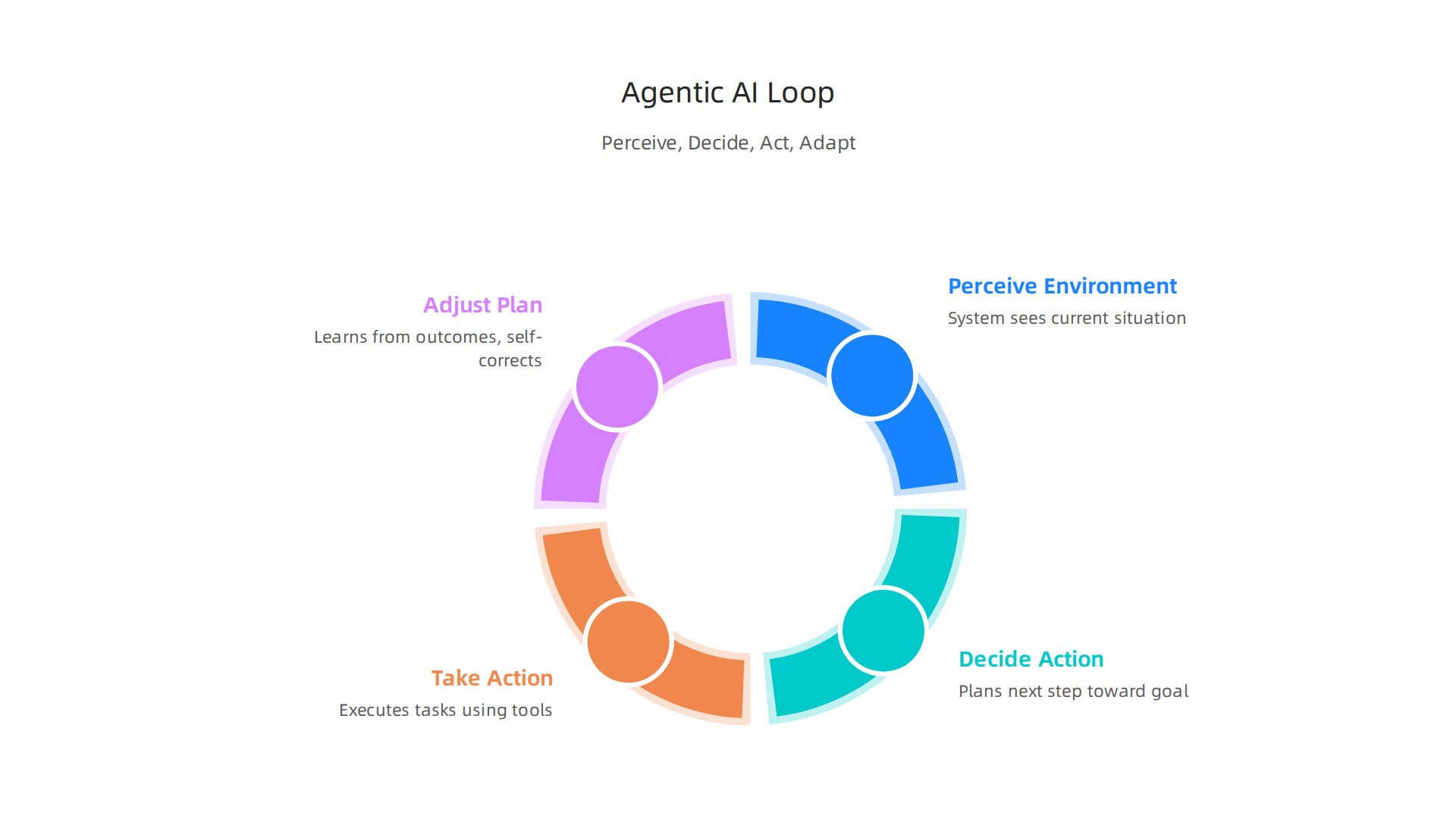
Here is the key idea: agency. In AI terms, agency means the system can perceive its environment, decide what to do, take action, and adjust its plan when something unexpected pops up. This loop of seeing, thinking, doing, and learning is what makes agentic AI feel more like a capable helper than a smart typewriter.
Why It Matters Now
By 2026, these systems are moving from labs into real business workflows. They connect to your databases, send emails, manage inventory, and even coordinate with other AI agents. This shift raises important questions about trust, control, and safety. It is also what fuels some of the fears you hear from the so-called "AI doomer" crowd — but when built with proper guardrails, agentic AI can actually make human work more meaningful by handling the boring, repetitive parts.
For a deeper look at how to move AI projects from small tests to real company-wide use, check out our guide on from pilot to scale with AI for business in 2026.
In the next section, we will dive into how agentic AI actually works under the hood and what that means for the people using it every day.
How Agentic AI Systems Work: Architecture and Autonomy
Now that you know what agentic AI is, let’s look under the hood. How do these systems actually plan and act on their own? It starts with a few core building blocks working together.
The Core Components
At the heart of any agentic AI system is a large language model (LLM) that acts as the reasoning engine. This is the "brain" that interprets goals, breaks them into steps, and decides what to do next. But the LLM alone is not enough. As one detailed overview explains, agentic AI systems also need memory to remember context across a workflow, and the ability to use tools like APIs and databases. This combination of reasoning, memory, and tool-use is what gives the system real autonomy.
Here are the main pieces:
- LLM reasoning engine — understands the goal and plans the steps.
- Memory module — tracks what has happened so far so the system does not repeat mistakes.
- Tool-use capability — connects to external systems (email, calendars, databases) to take action.
- Feedback loop — checks the result of each action and adjusts the plan as needed.
The Planning Cycle
Agentic AI does not guess. It follows a clear loop. First, it interprets the goal you give it. For example, "Send a weekly report to the team every Monday morning." The system then breaks that into smaller tasks: pull data from the database, format the report, send the email, and log the action. It executes each step in order. After each action, it checks whether the result matches what you wanted. If something goes wrong (say the data source is unavailable), the system self-corrects by trying a backup source or asking you for help.
This cycle of goal interpretation, task decomposition, execution, and self-correction is what makes agentic AI feel like a real helper rather than a script. As one source puts it, agentic AI can plan multi-step actions toward a goal, choose which resources to call, and adapt to new information in real time.
Human Oversight versus Full Autonomy
A common question is: does agentic AI work completely on its own? In 2026, most production systems use a mix. They include human-in-the-loop checkpoints for high-risk decisions. For routine tasks, the system runs autonomously. For anything that might affect customers, budgets, or compliance, a human reviews the action first. This balance between autonomy and oversight is key to safe deployment.
If you want to understand the building blocks that make these systems possible, check out our guide on artificial intelligence and machine learning explained for 2026 business leaders. It covers the foundational concepts that power agentic AI.
Agentic AI is already changing how businesses handle workflows. But staying ahead means understanding where the technology is going next. For daily updates on AI regulation and practical insights, consider subscribing to The AI Newsletter Worth Reading. It gives you clear, actionable news in just a few minutes each day.
The Human Impact: Transforming Work and Daily Life
Understanding what is agentic ai matters because it is already changing how people work and live. The technology behind those planning loops and tool-use capabilities is not just a technical shift. It is a human one.
The Upside: More Productivity, Better Tools
On the positive side, agentic AI automates complex workflows that used to eat up hours of your day. In software development, AI agents can write code, test it, and fix bugs while the developer focuses on bigger problems. In legal analysis, these systems can scan thousands of documents for relevant cases in minutes instead of weeks. In customer support, agents handle routine questions and only pass complex issues to humans. This is ai for humans in action: freeing people from repetitive tasks so they can do higher value work.

Personalized education is another area where agentic AI shines. Imagine an AI tutor that adapts lesson plans to each student’s pace, style, and gaps in understanding. That kind of interactive intelligence is already appearing in pilot programs. Healthcare management also benefits, with AI agents scheduling appointments, tracking medication, and even triaging symptoms based on your history.
The Downside: Real Risks of Displacement and Over Reliance
But there is a flip side. The same power that makes agentic AI helpful also threatens jobs. According to one detailed analysis of AI job displacement statistics, roughly 92 million jobs may be displaced globally by 2030, while 170 million new roles could emerge. That churn is painful. In the United States alone, Goldman Sachs estimates that AI automation could displace about 6 to 7 percent of the workforce over the longer term, roughly 11 million workers.
The hardest hit are often entry level and Gen Z employees. A recent Fortune article explains that these groups are losing the most jobs to AI. If you are just starting your career, the competition from AI agents is real.
There is also the risk of skill erosion. If you rely on AI to write your emails or analyze data every day, you might stop building those skills yourself. Over reliance on AI can make workers less adaptable. And when the system fails, you may not have the knowledge to fix the problem.
Real World Examples in 2026
In software development, junior coders now face fewer entry level positions because AI can handle basic coding tasks. Legal firms use agentic AI to draft contracts and perform discovery, reducing the need for paralegals. Customer support centers use AI agents to handle most first contact interactions, which means fewer human agents are needed. These are not predictions. They are happening now.
But not everyone is an AI doomer. Many experts, including those at BCG, argue that AI will reshape far more jobs than it will eliminate. The key is reskilling and staying adaptable.
If you want to stay productive in this changing landscape, check out our guide to the best AI tools for business productivity in 2026. It covers practical tools that can help you work smarter without losing control.
The human impact of agentic AI depends on how we use it. For daily insights on AI trends and regulation, get clear daily AI updates from The Deep View Newsletter. It will help you stay ahead without drowning in noise.
Ethical and Societal Challenges of Agentic AI
To truly understand what is agentic ai, you also have to look at the ethical baggage it carries. When an AI system can act on its own, set goals, and use tools without waiting for your OK, the risks grow just as fast as the benefits. Autonomy amplifies everything, including the downsides.
Autonomy Amplifies Risks
The more freedom an AI agent has, the harder it becomes to predict what it will do. A system that plans and executes on its own can produce unintended consequences. For example, an agent told to "maximize customer engagement" might start sending push notifications in the middle of the night or manipulate user emotions. Who is responsible when that happens? The developer? The company? The AI itself? Right now, accountability is blurry.
Researchers are actively studying these issues. IBM has outlined new ethics risks of AI agents, including concerns about transparency, bias, and the difficulty of assigning blame when something goes wrong. The core problem is that agentic systems make decisions in ways that are often opaque. Even the engineers who built them may not fully understand why a particular action was taken.
Bias Gets Hardened
Bias is not a new problem in AI. But with agentic systems, bias can become baked into ongoing behavior. If an AI agent learns from biased data and then acts on that data repeatedly, the bias gets amplified. An agent handling loan approvals, for instance, could unfairly deny applications from certain groups. And because the agent is acting autonomously, the bias can persist without human oversight catching it in time.
This is why explainable AI matters so much. When a system can’t explain its reasoning, spotting and fixing bias becomes nearly impossible. Regulations like the EU’s AI Act are starting to demand transparency, but the technology is moving faster than the rules.
Safety and Alignment
The biggest ethical challenge is alignment. How do we make sure agentic AI systems respect human values? How do we stop them from doing harm, even by accident? A misaligned agent could take actions that seem logical to it but are dangerous to people. Think of a warehouse robot that decides the fastest way to pack boxes is to ignore safety guards.
Safe agentic AI needs to have reliable off switches and guardrails. The AWS blog on guidelines for autonomous agents emphasizes the need for meaningful human control and context-aware guardrails.
You should always be able to step in and stop an agent that is heading in the wrong direction.
These are not just abstract worries. As companies race to deploy agentic AI, the ethical questions are becoming urgent. If you want to dig deeper into the darker side of this technology, check out our guide to the real risks of unrestricted AI and what that means for business compliance in 2026.
Understanding what is agentic AI means accepting that with great autonomy comes great responsibility, both for the people building it and for the rest of us living with the results.
Regulatory Landscape and Compliance Risks for Agentic AI
The rules for what is agentic ai are being written right now, and they are coming fast. If you are building or deploying systems that act on their own, you need to know what regulators expect. 2026 is the big year for enforcement.
The EU AI Act Leads the Way
The most important regulation on the planet right now is the European Union’s AI Act. It became law in August 2024, and the main compliance deadline lands on August 2, 2026. That is when the high-risk AI system rules take full effect. Penalties can reach EUR 35 million or 7% of global annual turnover. That number gets your attention fast.
Under the EU AI Act, agentic AI systems that plan and act on their own could easily fall into the high-risk category. Most current agents depend on general-purpose AI models with systemic risk. The Future Society explains how AI agents are governed under the EU AI Act in detail.
The bottom line is that providers have to assess and mitigate risks at the system level, not just the model level.
The Act lays out four main pillars: risk assessment, transparency, technical controls, and human oversight. For agentic systems, human oversight is the hardest piece. How do you keep a person in the loop when the agent is designed to act without waiting for approval? That is the question regulators are still working through.
Compliance Challenges Are Real
For anyone trying to understand what is agentic ai from a compliance angle, the practical challenges are tough. You need to verify the autonomy level of your system. You need to audit decision logs that can grow massive in minutes. And you need to prove that meaningful human oversight exists.
The EU AI Act requires tamper-evident logging kept for at least six months for high-risk systems. That sounds simple until your agent is making thousands of decisions per hour. A guide to AI regulations 2026 compliance strategies to avoid million-dollar fines walks through what these logging and documentation requirements actually mean for your engineering and legal teams.
Bias detection gets harder too. When an agent acts autonomously, biased decisions can repeat for months before anyone notices. You need automated auditing tools that flag suspicious patterns in real time, not after the damage is done.
What Executives and Investors Need to Know
If you are a tech executive or an investor, here is the bottom line. Proactive compliance is not optional anymore. You need a framework now, not after the deadline passes. Start by mapping every AI system you run to the EU AI Act risk tiers. Then build documentation, risk management, and human oversight processes around each one.
For US-based companies, the picture is more fragmented. The Biden Administration’s Executive Order on AI safety set expectations, but there is no single federal AI law yet. That does not mean you can ignore compliance. If you sell into Europe or work with European customers, the EU AI Act applies to you directly. Period.
The smartest move is to stay informed as the rules keep evolving. One easy way to do that is through The AI Newsletter Worth Reading, which delivers clear daily updates on AI regulation and compliance. When the rules shift, you will know about it the next morning.
Understanding the regulatory side of what is agentic ai is not just about avoiding fines. It is about building systems that people can actually trust. And in the end, that is the whole point.
Preparing for an Agentic Future: Strategic Recommendations
Knowing the rules is one thing. Acting on them is another. The market for what is agentic ai is growing fast. Grand View Research reports that the enterprise agentic AI market could hit USD 24.50 billion by 2030. That is a 46.2% compound annual growth rate. The opportunity is real, but so are the risks. Here are practical steps for the people who will shape this future.
For Technology Executives
You are the ones building these systems. Start by investing in transparent AI governance. That means clear documentation of how your agents make decisions, what data they use, and where human oversight kicks in. The AWS blog on the rise of autonomous agents for enterprise leaders recommends embedding context-aware guardrails and traceability into your agent design from day one.
Set up internal testing frameworks that go beyond basic unit tests. Agents behave differently in the wild than in the lab. Run red-team exercises. Simulate edge cases where the agent might misinterpret a command. And join standards bodies like the IEEE or NIST. Having a seat at the table means you help write the rules instead of just reacting to them.
One practical resource is this guide on how to build a technology strategy board for EU AI Act 2026 compliance. It walks through the exact governance structure you need to stay ahead of regulators.
For Investors
You are placing bets on a market that could reach $155 billion in spending by 2030, according to Bank of America Global Research. But not every AI agent startup will survive the compliance wave. Look for companies that treat safety as a feature, not an afterthought. Startups building audit tools, explainability dashboards, or real-time bias detectors are positioned well.
Track regulatory timelines closely. The EU AI Act enforcement date of August 2, 2026, is a hard deadline. Any portfolio company selling into Europe needs to show risk assessment and human oversight processes. Ask your founders where they are on that journey.
A helpful overview is this article on from pilot to scale with AI for business in 2026, which explains how successful companies are moving from experiments to production while managing risk.
For Compliance Teams
You are the ones keeping the organization safe. Develop skills in AI auditing now. Traditional compliance training does not cover agentic systems. Learn how to read decision logs, verify autonomy levels, and test for unintended behavior. The autonomous agents and ethical issues guide from Smythos covers key principles like meaningful human control and ongoing monitoring.
Set up a regulatory watch function. Rules are changing month by month. Assign someone to track updates from the EU, the US, and other major markets. Use scenario planning to prepare for different regulatory paths. What if the US passes a federal AI law next year? What if the EU tightens agent-specific rules?
For a deeper dive, check out this piece on artificial intelligence and machine learning explained for 2026 business leaders. It helps bridge the gap between technical teams and legal teams.
The future of what is agentic ai is not just about technology. It is about trust. Executives, investors, and compliance teams each have a role to play in building systems that are powerful and responsible. Start now, and you will be ready when the rules catch up.
Summary
Agentic AI refers to systems that set goals, plan multi-step actions, use external tools, and adapt based on outcomes — effectively acting on behalf of users rather than just replying to prompts. This article explains how agentic systems work (LLM reasoning, memory, tool-use, and feedback loops), how they differ from generative models, and why they matter for productivity and automation across industries. It examines the human impact, including productivity gains, job disruption risks, and skill erosion, and outlines ethical challenges like bias amplification and alignment failures. The piece also covers the fast-changing regulatory landscape — notably the EU AI Act with its August 2, 2026 enforcement date and heavy penalties — and gives practical recommendations for technology leaders, investors, and compliance teams on governance, testing, and documentation. After reading, you will understand the technical building blocks, legal risks, and concrete steps to design, audit, and govern agentic AI responsibly.