

Introduction: Why deep tech is a strategic imperative for enterprise AI
Imagine building a tall, important building. You wouldn’t use weak, simple tools for the foundation, would you? You’d need strong materials and clever engineering. It’s the same for businesses using Artificial Intelligence, especially in 2026. This is where "deep tech" comes in.
Deep tech is not just about using the latest apps or simple machine learning tools that everyone can get. Instead, it focuses on big, tough problems that need new scientific discoveries or very smart engineering solutions. Think of it as the bedrock for really serious AI projects. These are technologies that come from deep research and development, often needing a lot of time and money to create. They are the core building blocks for advanced enterprise AI, giving businesses a stronger, more reliable base than everyday AI tools can offer.
Here’s the thing: running AI projects today isn’t as simple as it used to be. Businesses face many challenges. There’s a lot of regulatory complexity, meaning many rules and laws about how AI can be used, especially with data.

For example, government agencies like the GSA require all AI projects to register their data assets and keep track of where the data comes from and its quality [1]. Other agencies, like the FTC, also have their own Artificial Intelligence Compliance Plan to follow. Without strong technical foundations, it’s hard to meet these strict demands.
This also leads to operational risk. If an AI system isn’t built well, it can make mistakes, act unfairly, or even break the law. These problems can cost companies a lot of money, hurt their reputation, and stop their business operations. You need to know how to build AI systems compliantly to avoid these issues. Many rules now ask for clear ways to audit AI systems, check data sources, and ensure transparency [2, 3]. Building AI with deep tech methods helps create these robust technical foundations, ensuring that your AI projects perform well and meet all the necessary compliance requirements. This makes deep tech a strategic imperative for any business looking to lead with enterprise AI in 2026.
To keep up with all the rapid changes in AI and its rules, it’s helpful to have a reliable source of information. Get clear daily AI updates. You can find out more by reading The AI Newsletter Worth Reading.
1) Market context: enterprise adoption, cost drivers, and regulatory exposure
Let’s look at how businesses are actually using AI right now, in 2026. Many companies are excited about Artificial Intelligence and want to use it more. But the truth is, most are still trying things out. A big survey from 2025 showed that almost two-thirds of businesses have not yet fully rolled out AI across their whole company; they are still in the testing stages The State of AI: Global Survey 2025 – McKinsey. This means that while many people might have access to new AI tools, actually getting big AI projects to work daily in the business is a different story. In fact, another report found that worker access to AI increased by 50% in 2025, showing growth, but also that businesses are still working towards scaling their AI use The State of AI in the Enterprise – 2026 AI report | Deloitte US.
This is where deep tech becomes very important. As businesses try to move from small tests to big, important AI projects, they run into challenges.

Certain industries face very close watch from regulators. Think about banks and financial services, healthcare companies, and even retail. These sectors have strict rules about how they handle customer data and make decisions. If an AI system isn’t built to be fair, secure, and clear in how it works, it can cause big problems. Using deep tech helps companies in these fields meet those tough rules. It helps them build AI that is trustworthy and follows the law. If you want to understand more about these requirements, it is helpful to know how to make an AI compliant with global regulations in 2026.
Investing in deep tech solutions for enterprise AI might seem like it costs more money at first. This includes buying special computer equipment, creating your own private AI models, and setting up very secure places for data, called secure enclaves. Businesses spent a lot more on AI recently. For example, AI spending jumped to $13.8 billion in 2024, which was six times more than in 2023 2024: The State of Generative AI in the Enterprise. These costs are for serious investments meant to give companies a real advantage and ensure their AI systems are safe and dependable.
While the initial investment in deep tech can be higher, it actually lowers your business’s risks in the long run. By using private AI models, companies keep their important data safe and private. Secure enclaves protect against cyberattacks and data leaks. Having specialized hardware means AI can work better and more reliably. This careful planning helps businesses build a strong AI roadmap that keeps their AI projects secure and compliant with all the rules. It is a smart way to integrate regulatory compliance into your corporate AI strategy and manage the complex world of enterprise AI in 2026.
The journey from trying out AI to using it widely in a business needs strong foundations. In the last part, we saw how putting money into deep tech helps lower risks. Now, let’s look at the important pieces that make up these strong AI systems. These pieces are crucial for making sure your enterprise AI works well and follows all the rules.
Core deep tech components: hardware, accelerators, and infrastructure
To run AI tasks, businesses choose different places for their computer systems.
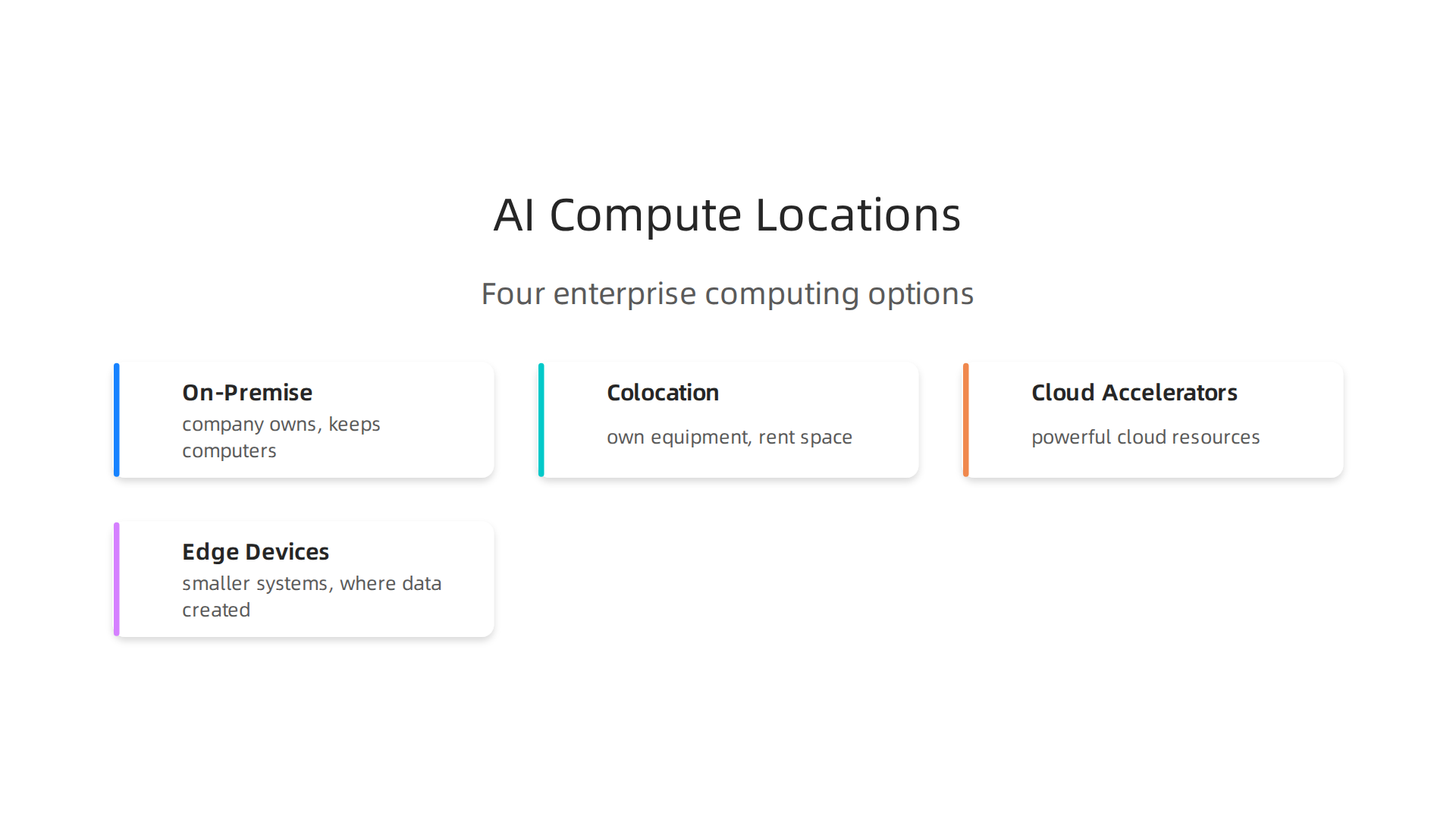
Each choice has its own good points and things to think about, especially for companies that must follow strict rules.
- On-Premise (On-Prem) Computing: This means your company owns and keeps all the computers in your own building. It gives you the most control over your data and how your AI systems work. This is often the top choice for companies in regulated fields because they can keep sensitive information completely private.
- Colocation: Here, you still own the computer equipment, but you rent space for it in a special, secure building run by another company. You keep a lot of control, but you don’t have to manage the building itself.
- Cloud Accelerators: This is when you use powerful computer resources provided by a big internet company, like a cloud service. It’s often easier and faster to set up. But, your data will travel through their systems. This can be tricky for strict rules about data privacy and where data must be kept.
- Edge Devices: These are smaller AI systems that are placed right where data is created. Think of AI tools in a factory or a hospital. Running AI on the edge makes it super fast because the data does not need to travel far. This helps with quick decisions and keeping local data private.
For regulated businesses, keeping control over data and AI systems is very important. That’s why options like on-premise and edge computing are often the best AI to use for tasks that handle sensitive information. These choices are a big part of creating a good Enterprise AI architecture for regulated industries.
Beyond where AI lives, the actual parts inside the computers are also key.
- Specialized Accelerators: These are special computer chips, like GPUs or TPUs. They are built to do the complex math that AI needs, much faster than regular computer chips. They make AI models run quicker and more accurately. This speed is vital for many AI projects today.
- Trusted Execution Environments (TEEs): Imagine a super-secure, locked box inside your computer’s brain. Even if someone gets into your main computer, they cannot easily see what is happening inside this secure box. TEEs are crucial for keeping very important data and AI models secret while they are being used. This helps a lot with mastering oversight of classified and sensitive technologies for 2026 compliance when using deep tech.
- Strong Networking: Just like good roads help cars move fast, good network connections help AI data travel quickly between computers. This is very important for AI systems that need to make decisions in real time without delays.
All these core components work together to make sure enterprise AI systems are not only fast and smart but also safe, secure, and follow all the rules. For companies in regulated fields, a solid foundation built with this kind of deep tech is not just helpful; it is a must-have for any successful AI roadmap. For more detailed insights into the complex world of AI and its rules, consider getting regular updates.
Get clear daily AI updates from The AI Newsletter Worth Reading.
Building on those strong foundations, let’s talk about making sure your AI systems are not just powerful but also super safe, private, and always follow the rules.

This is especially important for businesses that deal with sensitive information or have to meet strict legal demands in 2026.
3) Security, privacy, and compliance architectures for regulated enterprises
For any company in a regulated field, how an enterprise AI system is built is key for security, privacy, and compliance. It is like building a house: you need a good blueprint to make it strong and safe. Here are some smart ways to design AI systems using deep tech:
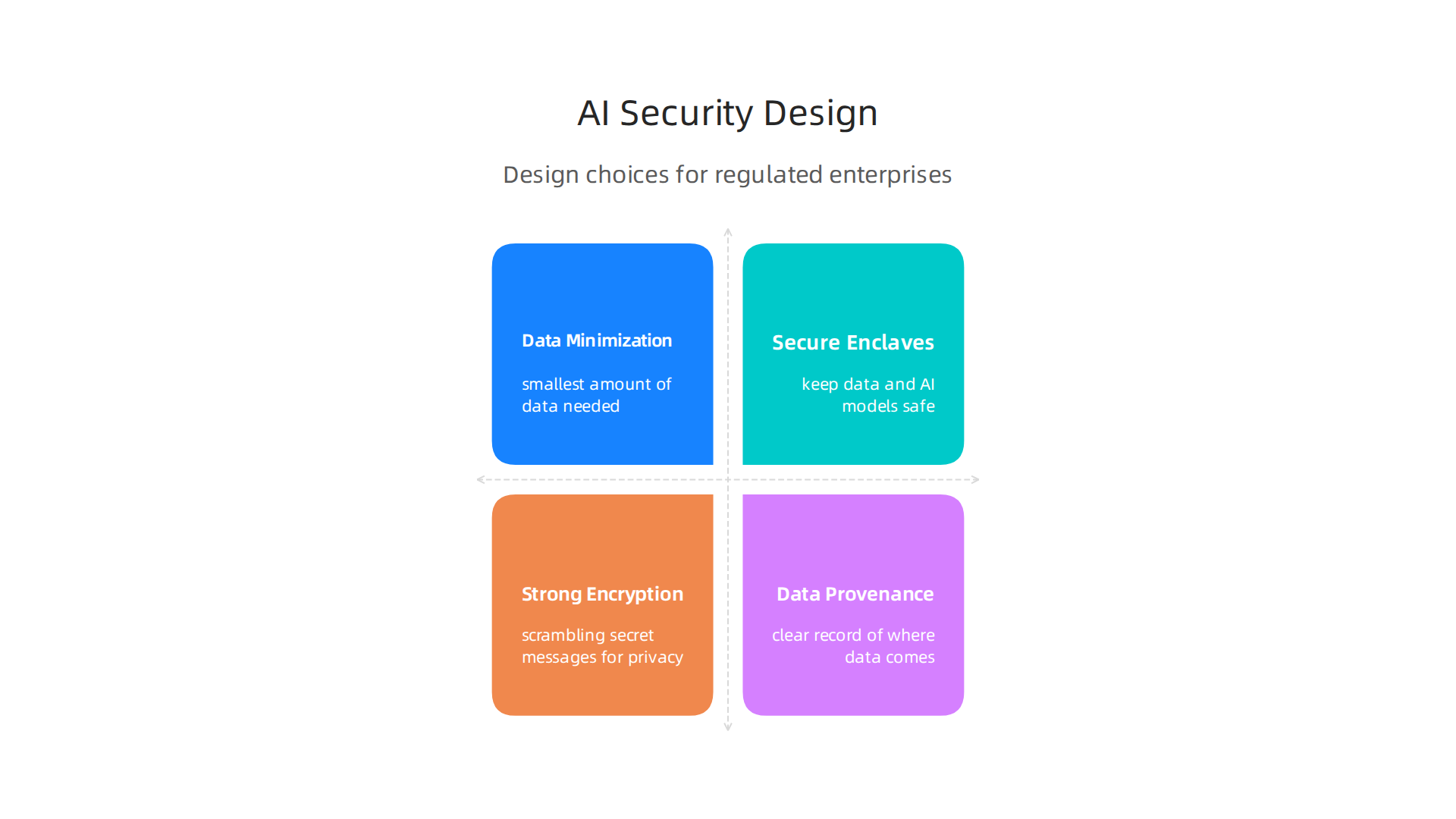
- Data Minimization: This means using only the smallest amount of data needed for an AI task. Imagine an AI that helps doctors. It should only see the specific health info it needs, not a patient’s whole history. This greatly lowers privacy risks. Some rules even require AI systems to enforce "zero-retention policies" for certain data, meaning they forget it right after use AI Technical Requirements.
- Secure Enclaves: Remember the "locked box" idea from Trusted Execution Environments (TEEs) in the last section? These secure enclaves keep data and AI models completely separate and safe, even if other parts of the computer are somehow breached. This is vital for very sensitive data.
- Strong Encryption (Cryptographic Protections): This is like scrambling secret messages so only the right people with the right key can read them. Encryption protects data when it is stored and when it is moving between different parts of the AI system, making sure private information stays private.
- Data Provenance: This means keeping a clear record of where all data comes from and how it is used by the AI. It is like a birth certificate and travel history for every piece of information. Knowing the "originator, collection methodology, and preparation process" for all data sources is often required CIO 2185.1C, Accelerating Responsible Use of Artificial …. This helps ensure data is trustworthy and not biased. For example, the GSA’s AI strategy requires all AI projects to register their data assets for review AI strategies and compliance plan.
These design choices help businesses not just follow rules, but prove they are following them. This is called "demonstrable compliance."
- Audit Trails: An audit trail is a detailed log of everything the AI system does. It records who accessed what, when, and what actions were taken. Think of it as a full diary of the AI’s life. These logs are super important for checks and can include timestamps, inputs, and outputs to show the AI’s behavior over time Principles for the Secure Integration of Artificial Intelligence …. Many governments agree that strong auditing regimes are needed for AI.
- Explainability: Sometimes, an AI gives an answer, but we need to know why it chose that answer. Explainable AI can show its work, making its decisions clearer to people. This is especially true for AI models that cannot be fully understood otherwise, requiring a detailed description of their expected outcomes Artificial Intelligence Guidelines: A USG IT Handbook …. Being able to explain AI decisions helps build trust and makes sure the AI is fair and safe. You can learn more about this by reading about explainable AI for 2026 compliance and executive trust.
- Access Controls: This means setting clear rules about who can use the AI system and who can see its data. It makes sure only authorized people can interact with sensitive information or models. This level of control is a core part of any good AI roadmap for regulated businesses.
By putting these architectural pieces in place, businesses can make sure their deep tech AI systems are secure, protect privacy, and meet all the rules, no matter how strict they are. This helps avoid big problems like penalties, which can be very high in 2026, sometimes reaching millions of Euros for serious violations in places like the EU AI Regulation Penalties by Jurisdiction: 2026 Tracker.
All those important rules and high penalties mean that businesses must be careful not just with their own deep tech AI, but also with any AI tools or services they get from other companies. This is called managing "third-party risk." It is like making sure the ingredients you buy for a special recipe are just as good and safe as the ones you grow yourself.
4) Vendor selection and procurement: evaluating deep tech providers and third-party risk
When you bring in AI from another company, you are basically trusting them with a part of your business. This is especially true for deep tech providers who offer specialized hardware, ready-to-use AI models, or managed services for your AI systems. Before you sign any papers, you need a smart way to check them out. This is called vendor due diligence.
Here is a checklist of important things to look for when choosing your enterprise AI partners:
- Security Health: Find out how secure their systems are. Do they protect data well? Have they had any security problems in the past? Ask about their regular security checks and if they encrypt data, which means scrambling it so only the right people can read it. You can review a complete AI Vendor Due Diligence Checklist for Enterprises to learn more.
- Data Handling Practices: Since AI runs on data, you need to know everything about how a vendor handles it.
- Data Source and Quality: Where does their AI training data come from? Is it fair and free of biases?
- Privacy Rules: How do they keep your data private? Do they follow rules like GDPR or other regional laws in 2026?
- Data Location and Retention: Where will your data be stored? How long will they keep it? A good AI Vendor Due Diligence Framework should cover this.
- Model Understanding (Explainability): Can they explain how their AI models make decisions? This goes back to what we talked about earlier. If their AI gives an answer, can they show you the steps it took? This is very important for fairness and trust.
- Compliance and Legal:
- Regulatory Mapping: Do they understand and follow the AI rules that apply to your business, like the EU AI Act or NIST AI RMF in 2026?
- Technical Documents: Do they have clear papers that describe how their AI works and how it meets rules? This is a key part of any AI Vendor Risk Assessment Checklist for modern businesses.
- Operational Reliability: What happens if their system goes down? How quickly can they fix it? Do they have a plan for major problems?
- Their Own Supply Chain: Ask about the other companies they use to make their AI work. You want to make sure their partners are also safe and reliable.
When you work with a deep tech vendor, the contract is super important. It is not just about price. You need to make sure the contract has strong rules to protect you.
- Audit Rights: Can you or a trusted third party check their systems to make sure they are following the rules? This gives you a way to verify their claims. A smart AI Vendor Contract Redline Template can include this.
- Liability: What happens if their AI causes a problem or a data breach? Who is responsible?
- Service Wind-down: What if you decide to stop using their service? How will you get your data back safely?
By doing your homework and having good contracts, you can greatly lower the risks that come with using outside [deep tech] AI. This helps ensure your [ai projects] stay compliant and secure. For more detailed guidance, consider checking out an AI Tech Pack Evaluation for Robust Compliance and Security.
Want to stay on top of all the fast-changing rules and best ways to work with AI providers? The AI Newsletter Worth Reading delivers clear daily updates to help you make smart choices for your business.
After you have carefully picked your AI partners, the next big step is to make sure your deep tech systems keep working well and follow all the rules, every single day. This is where "operational controls" come in. Think of it like a car factory. It is not enough to just buy good parts. You also need to manage the assembly line, check the cars as they are built, and make sure they are safe for the road.
5) Operational controls: MLOps, observability, and auditing for deep tech systems
For your AI projects, this day-to-day management often falls under something called MLOps, which means Machine Learning Operations. MLOps is like a special set of practices for building, running, and watching your AI models. For deep tech, this can be a bit more complex because these AI systems are often tied to special hardware or new ways of learning.
Here is how MLOps practices need to adapt for deep tech:
- Model Lifecycle Management: This means watching your AI model from the time you create it, through testing, putting it into action, and then updating it. For deep tech, models might be made for very specific chips or hardware. So, when you update a model, you also have to make sure it still works perfectly with that special hardware. This is a crucial part of any enterprise AI strategy.
- Versioning for Hardware-Aware Models: Imagine you have many different versions of an AI model. With deep tech, each version might be designed for a slightly different piece of equipment. You need a clear way to label and track each model version, noting which hardware it works with. This helps you know exactly what is running where and why, making sure your AI projects are always on track.
- Drift Detection: AI models can sometimes "drift" or change their behavior over time because the real-world data they see changes. For deep tech, detecting this drift is super important. If a model starts giving different answers, especially in sensitive areas, you need to know right away so you can fix it. This keeps your AI fair and working as expected.
What to Watch: Observable Signals and Evidence
To make sure your deep tech systems are always compliant, you need to set up ways to "observe" what they are doing. This means collecting special signals or evidence that can tell you how your AI is performing. Think of it like a plane’s cockpit with many gauges and lights.
Here is what your organization should keep track of for regulators and internal risk teams in 2026:
- Input and Output Data: Keep a record of what data goes into your AI and what answers it gives. This includes timestamps so you know exactly when things happened. This kind of logging helps create an audit trail for your AI system.
- Data Provenance: This means knowing where all your data comes from. For every piece of data used to train or run your AI, you should know its origin, how it was collected, and if it is fair. Companies need to document the provenance of the data used for their AI models.
- Model Decisions: For some deep tech AI, you might need to record the reasons or steps the AI took to reach a certain decision. This is especially true if the AI makes important choices that affect people.
- Performance Metrics: Keep track of how well your AI is working. Is it accurate? Is it fast enough? Are there any errors? Watching these numbers helps you see if the AI is running smoothly.
- Changes and Updates: Every time you change or update an AI model, record it. Note who made the change, when, and why. This paper trail is very helpful if you ever need to look back at how an AI system evolved.
- Bias Checks: Regularly check your deep tech AI for any unfair biases in its decisions. If you find bias, you need to show you are working to fix it. This is a key part of making sure your AI is responsible.
By keeping these clear records and actively watching your AI, you build trust and can easily show regulators that you are meeting all the rules. It is about making sure your AI roadmap includes strong controls from the start. This makes auditing much simpler. Auditing means having someone check your AI systems to make sure they are doing what they are supposed to do, safely and fairly. Auditing helps you prove that your deep tech solutions are compliant and trustworthy, as discussed in AI Auditing: First Steps Towards the Effective Regulation of Artificial Intelligence.
To truly master deep tech and AI, it’s not enough to just watch your systems day by day. You also need a bigger plan for how your company will follow all the rules, manage risks, and even guess what new rules might come next.

This is called governance and risk assessment, and it is vital for any company working with AI today.
Keeping Up with Fast-Changing Rules
Imagine trying to hit a moving target. That’s a bit like trying to keep up with AI rules in 2026. Laws and guidelines are changing all the time, and what is allowed in one country might be very different in another. Because of this, companies need a smart way to always scan for new rules. They also need to plan for different possible futures, making sure their plans for new technology, or their AI roadmap, can adjust easily.
A good way to do this is to have a team or a system that regularly checks for news and updates on AI laws around the world. This helps you understand what is happening in tech regulations 2026 global changes tech leaders must understand. This constant checking means you can make sure your deep tech projects are always on the right path.
Planning for Different Futures
Sometimes, rules might change in ways you didn’t expect. This is where "scenario planning" helps. It means thinking about a few different ways the future could go for AI laws and then figuring out how your company would handle each one. For example, what if a new rule makes a certain type of AI much harder to use? Having thought about this before means you are ready to make changes to your enterprise AI plans without big problems.
This also means making sure your technology teams, who are building the actual deep tech systems, know about these possible rules. Their technical plans need to fit within what the law allows. It’s about designing your AI to be compliant from the very start, which is a key part of how to make an AI compliant with global regulations in 2026.
Handling Different Rules in Different Places
One of the biggest challenges for companies using deep tech is that different countries have different rules for AI. For instance, the European Union has its AI Act, which can mean big fines for breaking the rules, up to €35 million or 7% of a company’s yearly global sales, whichever is higher, for serious violations. For other violations, it could be up to €15 million or 3% of global turnover, as noted by the AI Compliance Guide 2026: Global Regulations. Meanwhile, other places like California also have their own rules with penalties. You can find more details in the AI Regulation Penalties Compared Across 44 Jurisdictions.
This means your company needs to decide which rules are most important to follow for each of your AI projects. You might need to put more effort into following the rules in places where you have many customers or where the fines are very high. This is about prioritizing where to spend your time and money on compliance. Learning how to build a technology strategy board for EU AI Act 2026 compliance can be a smart step.
By setting up a strong governance plan, you can guide your deep tech innovations safely through the changing world of AI laws. This proactive approach helps avoid big fines and builds trust with your customers and partners.
To stay on top of all these changes, smart leaders get daily updates.
The AI Newsletter Worth Reading
Summary
This article explains why deep tech—specialized hardware, trusted execution environments, secure enclaves, and R&D‑grade systems—is now the strategic foundation for enterprise AI in 2026. It reviews market context and cost drivers, and shows how regulated industries face heightened legal and operational risks that commodity AI cannot reliably address. The piece breaks down core infrastructure choices (on‑prem, colocation, cloud accelerators, edge), the essential security and privacy patterns (data minimization, encryption, provenance, audit trails, explainability), and a vendor due diligence checklist and contract highlights to reduce third‑party risk. It also covers operational controls—MLOps, versioning, drift detection, and observable signals—that make systems auditable and defensible. Finally, it outlines governance practices for scanning evolving rules, scenario planning, and prioritizing compliance across jurisdictions so teams can build, run, and scale enterprise AI with demonstrable compliance and lower long‑term risk.